EVENT: INFINITE SCROLL (SEPTEMBER 27, 2025-JULY 26, 2026, SYDNEY, AUSTRALIA)

Event: Infinite Scroll 荧屏沉溺
Artists: Xia Han, Gao Hang, Ye Funa
Curator: Thea-Mai Baumann, Director, 4A Centre for Contemporary Asian Art
Exhibition managers: Luke Parker and Mikhaela Rodwell
Venue: China Gallery, Level 1, Chau Chak Wing Museum, University of Sydney, University Place, Camperdown NSW 2050, Australia
Dates: September 27, 2025–July 26, 2026
Opening hours: Monday-Friday, 10:00 a.m.–5:00 p.m.; Saturday–Sunday, 12:00–4:00 p.m. The museum is closed on public holidays.
Admission: Free
Presented by: Chau Chak Wing Museum in collaboration with 4A Centre for Contemporary Asian Art
The Chau Chak Wing Museum at the University of Sydney presents Infinite Scroll 荧屏沉溺, a collaboration with 4A Centre for Contemporary Asian Art bringing together three Chinese artists whose work examines online life through humour, interactivity, synthetic imagery and the visual language of games. Curated by Thea-Mai Baumann, Director of 4A, the exhibition features Xia Han, Gao Hang and Ye Funa, artists who treat digital culture as a system that reorganises attention, identity, aspiration and display.
The show takes its title from the most banal and pervasive of contemporary interfaces: the endless scroll. To scroll is to submit to a structure of refreshment without resolution, where images, commodities, jokes, scandals, personas and micro-narratives pass through the same channel. Infinite Scroll asks how that structure changes perception. Its focus is not merely the internet as content, but the interface as a cultural form: a training device for desire, speed, distraction and self-performance.
In this context, game imagery is not reducible to nostalgia, entertainment, or stylised quotation. It becomes a language for thinking about how contemporary subjects are selected, ranked, modified, rendered and consumed. The artists in Infinite Scroll work across painting, installation, game engines, avatars, textile, ceramics and interactive media, but they share an interest in the strange comedy of life lived through systems that promise agency while continuously shaping behaviour.
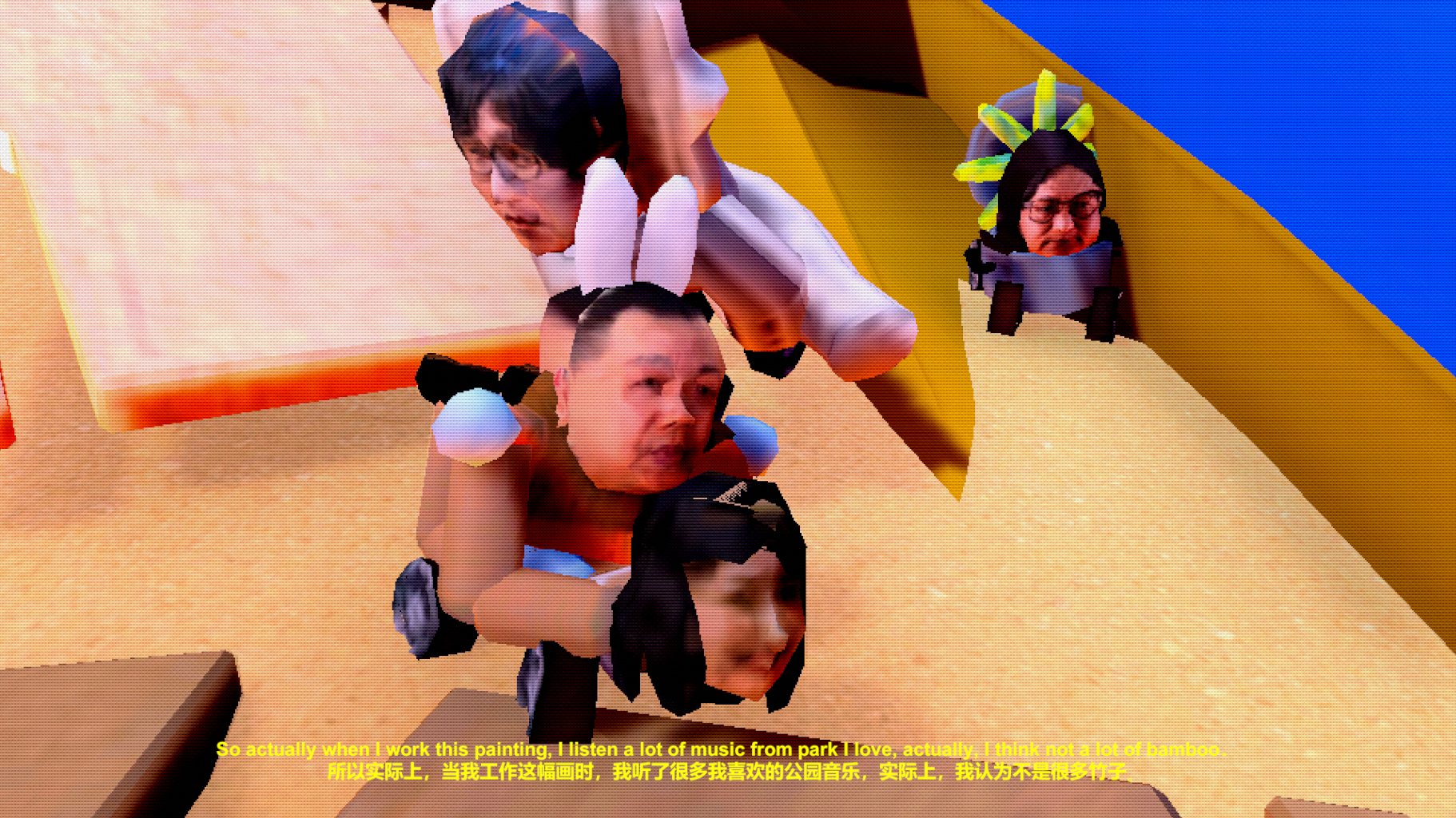
Xia Han’s ArtíMon Kart (2023-2024) is the exhibition’s most direct engagement with game form. Conceived as an interactive video installation and PC game, the work turns the global art system into a grotesque, Pokémon-like competition in which renowned Chinese contemporary artists are recast as “ArtíMon”, or artist-monsters, caught in a continuous kart race. The setting is a synthetic vacation scene: beach furniture, toy-like obstacles, and cut-out versions of prestigious Western art galleries form the track on which these artist-characters compete for visibility and historical inscription. The art world appears as a game of acceleration, branding, elimination and institutional luck, in which cultural prestige is treated as both fantasy reward and programmable outcome.
Xia’s broader practice has long revolved around computer games, consumer culture and the ethical consequences of technology. Working with game engines, video and constructed virtual spaces, he often uses the game scene as a theatre of utopia and ruin, desire and loss. ArtíMon Kart pushes that method toward institutional critique. Its apparent absurdity conceals a colder proposition: that contemporary art’s global circulation can resemble a game whose rules are rarely announced, whose winners are retroactively mythologised, and whose defeated participants disappear from view.
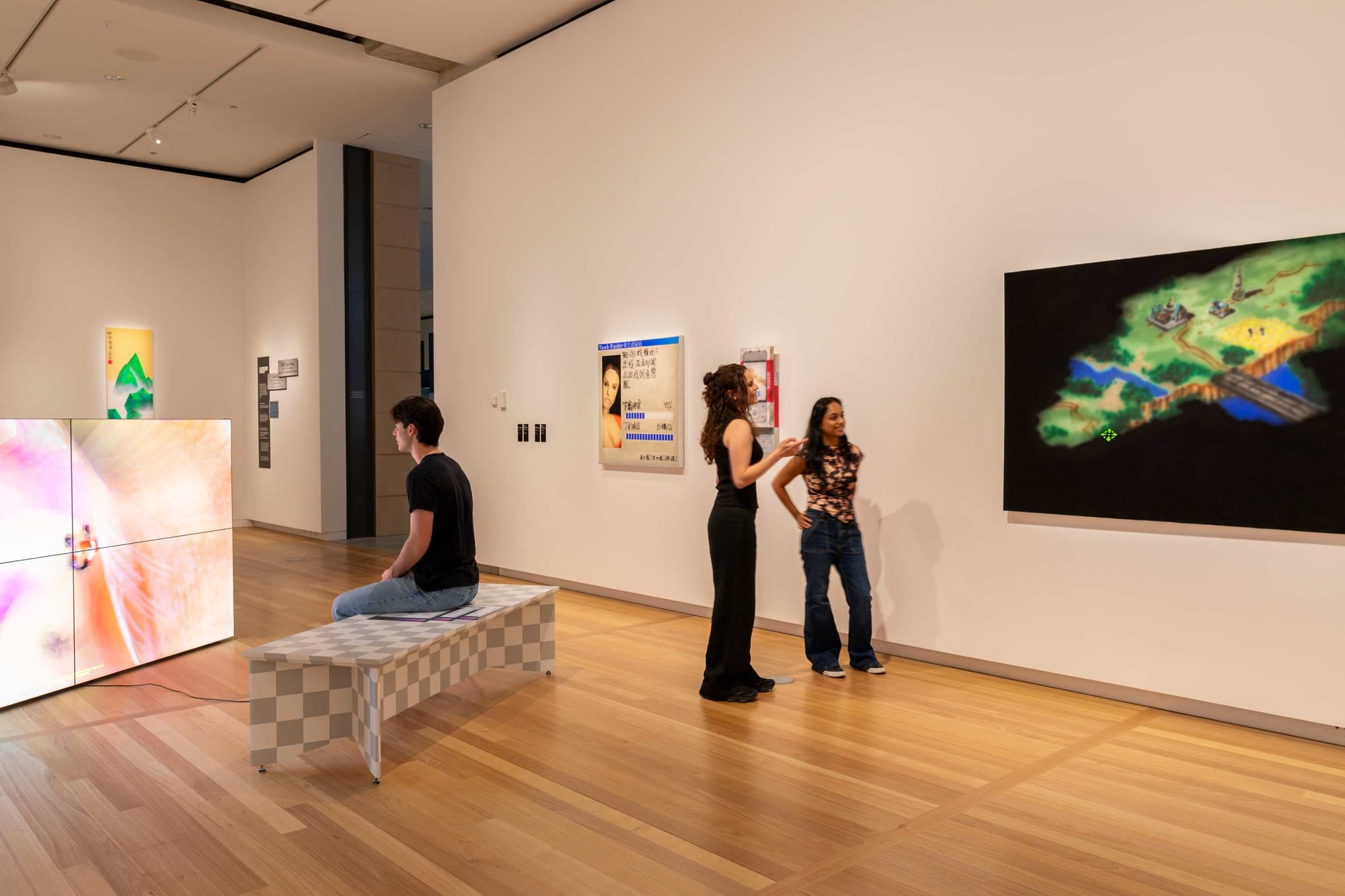
Gao Hang approaches video game aesthetics through painting. His acrylic and airbrushed canvases draw from early 3D graphics, low-poly avatars, garish system colours and the visual awkwardness of late-1990s and early-2000s game worlds. At first glance, the works seem comic, even deliberately crude. Their surfaces recall obsolete consoles, distorted character models, default backgrounds and malformed digital bodies. Yet Gao treats this dated visual language as a contemporary archaeology of feeling. What once promised technological realism now appears strange, raw and emotionally exposed.
In Infinite Scroll, paintings such as The mysterious sacred cultural knowledgeable chi painting (2023), Proud to download for free 2 (2021), Everything gets better but not Nokia (2024), and Exciting journey begins (2022) place retro game aesthetics in dialogue with meme culture, masculinity, social performance and existential fatigue.
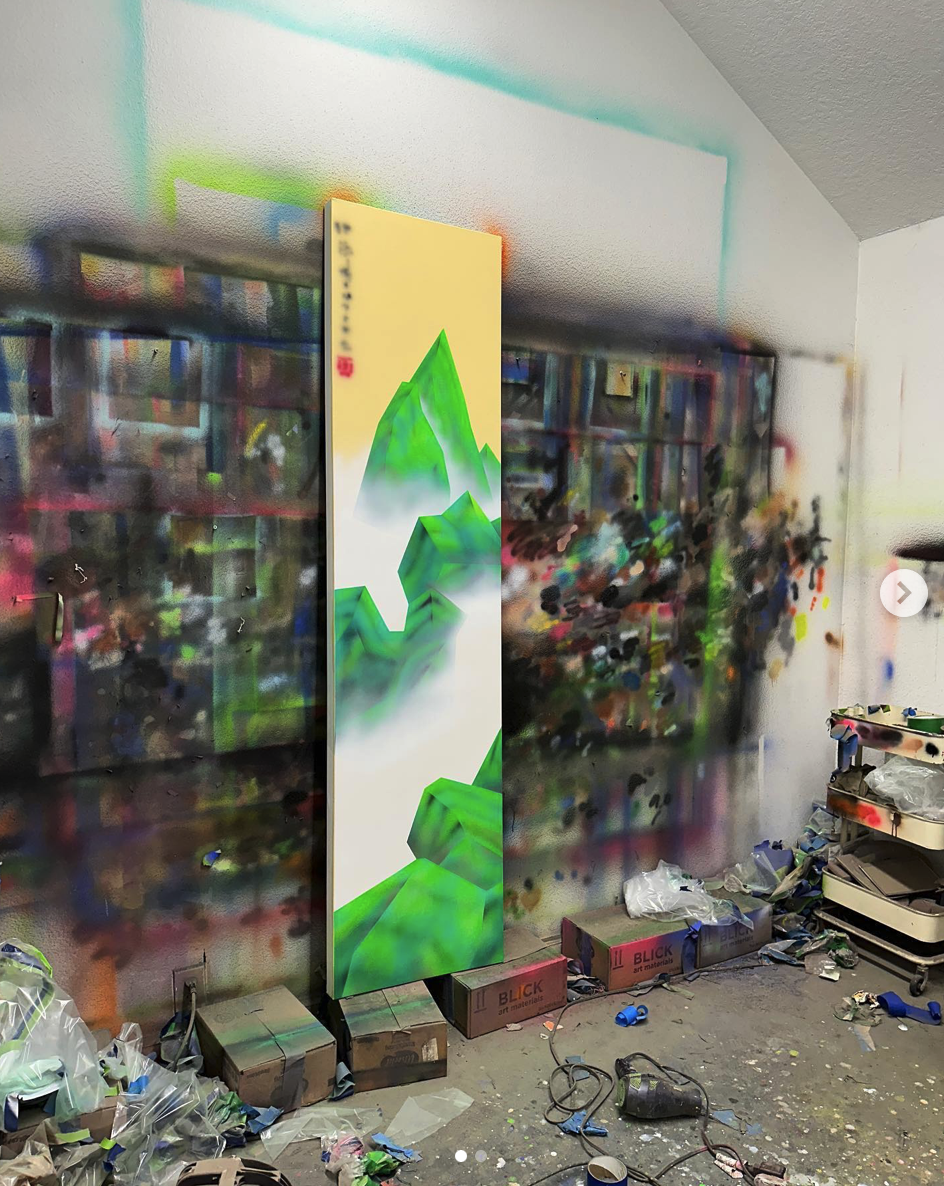
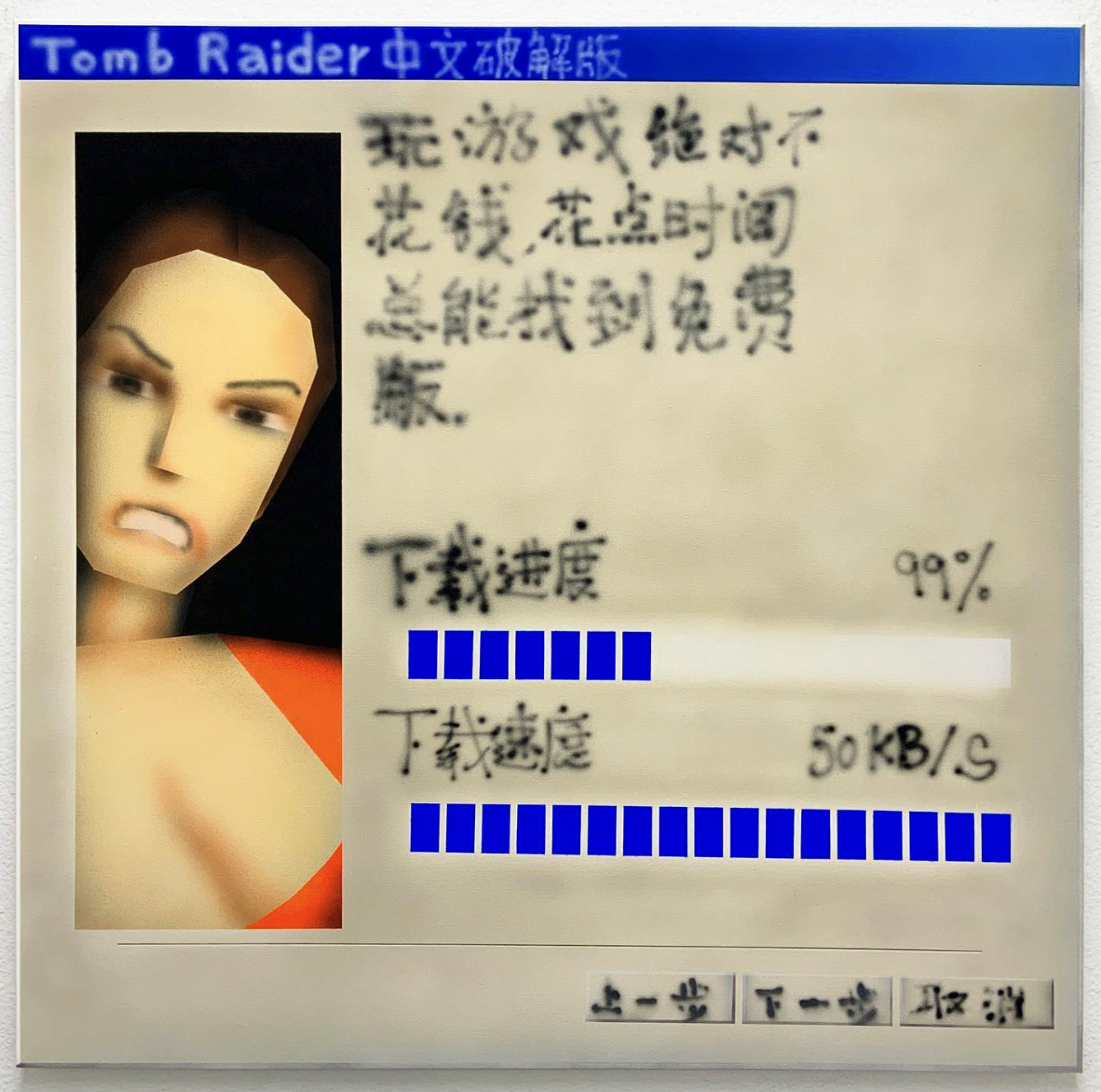
Gao has described digital graphics as a kind of twenty-first-century found object. That formulation is useful: his work does not simply imitate game imagery, but retrieves it as a shared visual memory of technological aspiration. The low-poly figure becomes a historical body, bearing the embarrassment of former futurity.
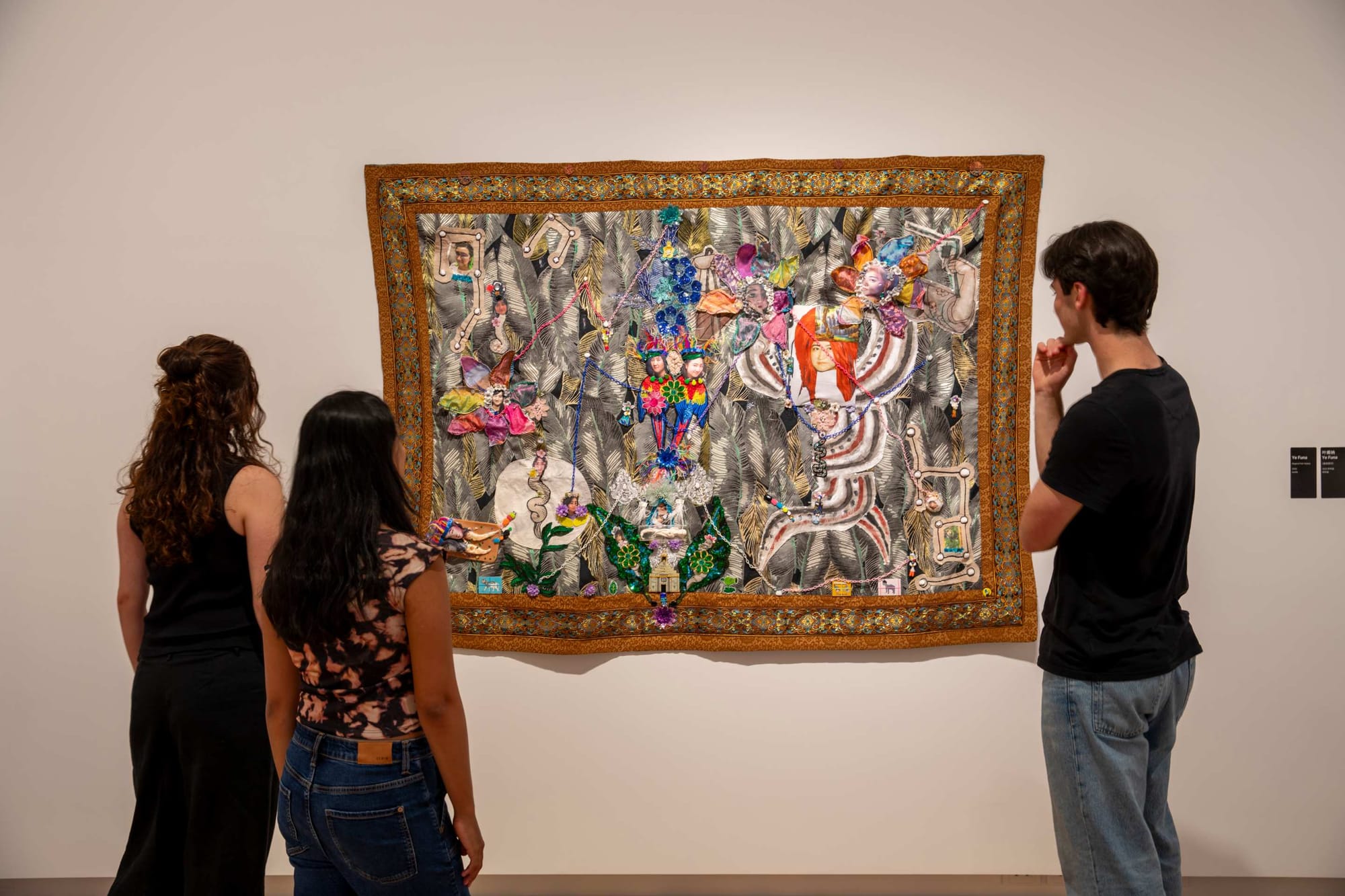
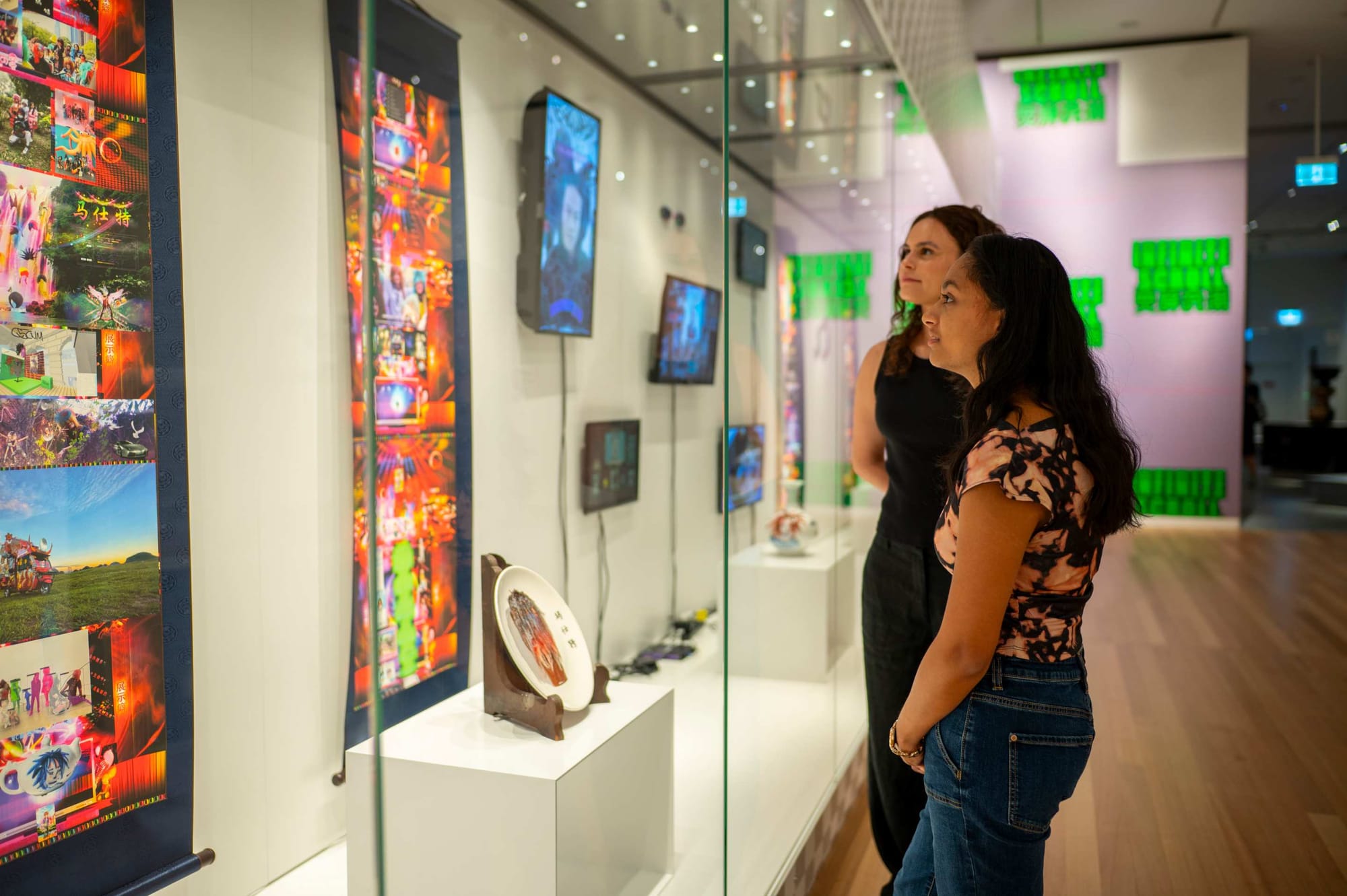
Ye Funa’s work enters the exhibition through a different but related register. Her practice has consistently examined internet subcultures, participatory display, gendered self-fashioning, vernacular creativity and the traffic between online identity and offline performance. In Infinite Scroll, works including shamate.org (2025), Mastr™ (2022), and Magical Hair Galaxy (2025) extend her long-running interest in the cultures of transformation that emerge around the screen. If Xia Han works through game mechanics and Gao Hang through game graphics, Ye Funa works through avatarisation: the production of identity as style, surface, upgrade, costume, pose and shared image.
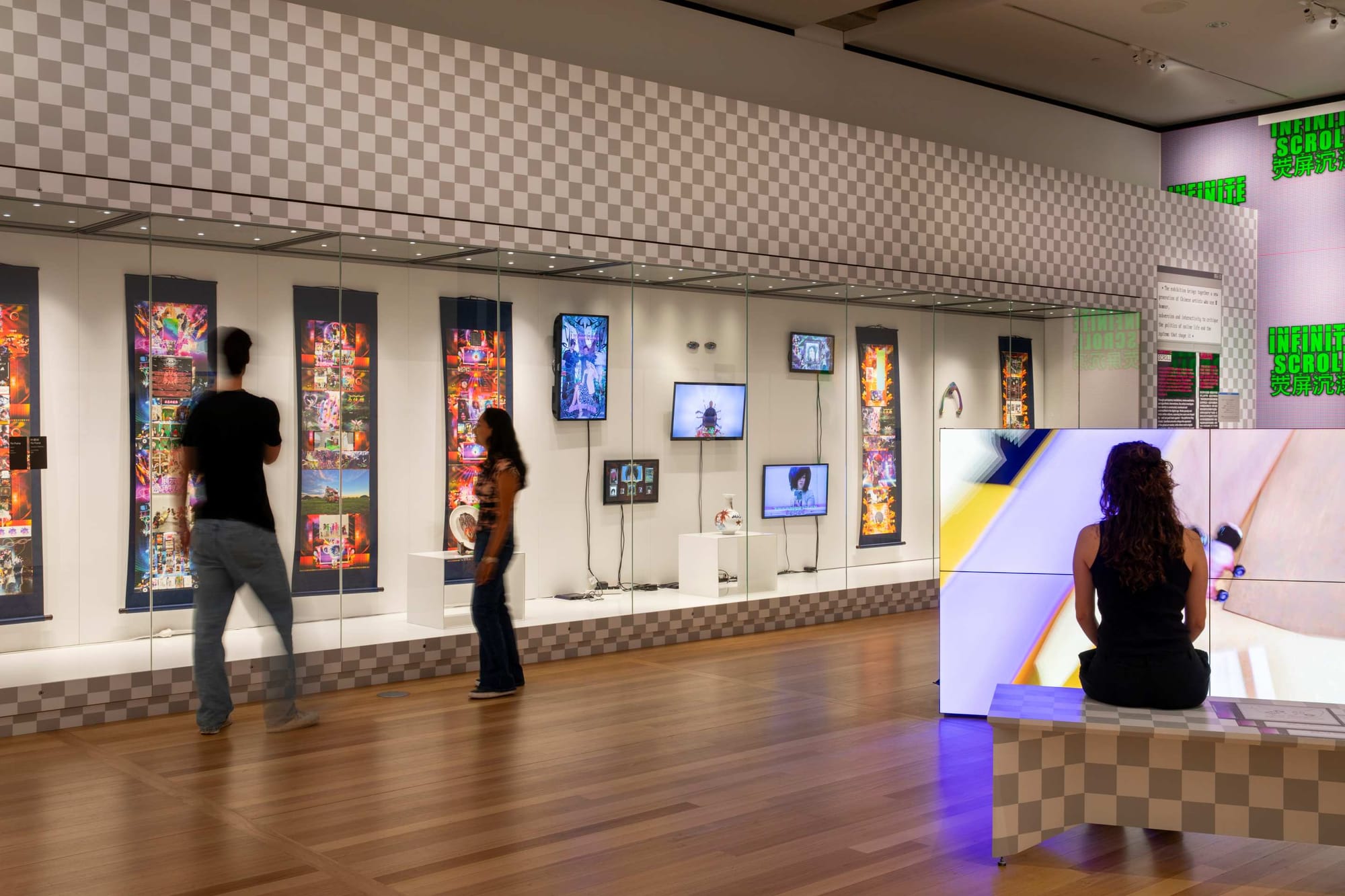
Her recent TRANSFORM.ME installation at 4A turned the gallery into a cyber-grunge salon paying homage to China’s Shamate subculture, a youth formation associated with extravagant hair, online self-display and vernacular forms of glamour. That project helps clarify the stakes of her contribution to Infinite Scroll. Ye is interested in the point at which self-expression becomes interface, and at which popular visual culture becomes a form of social theory. Her work suggests that the logic of the avatar has moved far beyond the game screen. Hair, nails, cosmetics, filters, profile images, selfies and synthetic personae all become instruments through which subjects are rendered, edited and circulated.
Infinite Scroll is a study of digital training. It examines how platforms, games and image economies teach users to look, compete, desire, joke, choose and display themselves. The scroll is its central figure because it has become one of the dominant forms of contemporary spectatorship: restless, repetitive, intimate and impersonal. By bringing together game aesthetics, online satire and participatory image culture, the exhibition offers a compact but pointed account of life inside the feed, where play and labour, selfhood and interface, parody and critique are increasingly difficult to separate.