EVENT: THE POWER OF PLAY (JULY 4–OCTOBER 25 2026, HONG KONG)

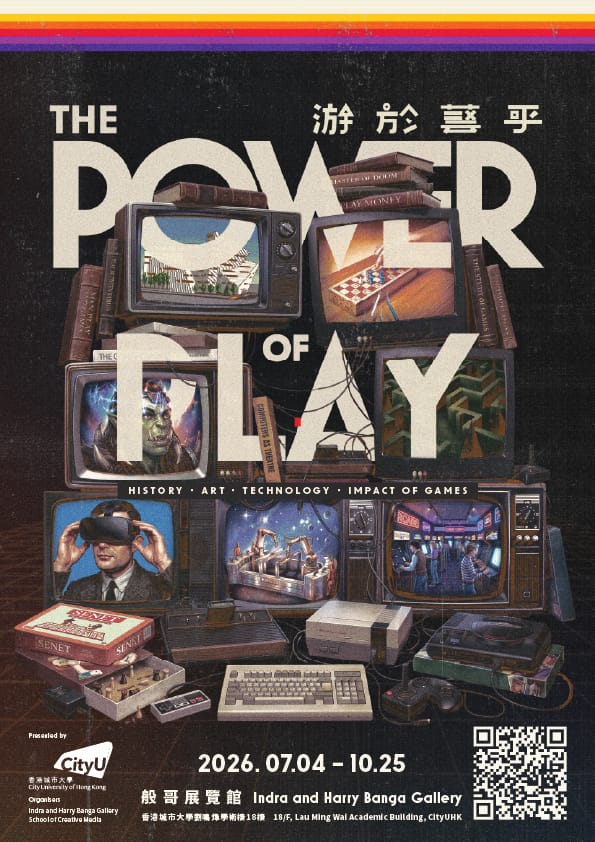
The Power of Play
Artists/participants: Espen Aarseth, Pok Yin Victor Leung, postgraduate students from CityUHK School of Creative Media’s Art and Activist Games Workshop, and game cultures represented through Senet, Counter-Strike, Quake III Arena, Minecraft, labyrinth traditions, robotic play, indie games, and eSport
Curator: Espen Aarseth, Dean and Chair Professor of Game Studies, School of Creative Media, City University of Hong Kong
Venue: Indra and Harry Banga Gallery, 18/F, Lau Ming Wai Academic Building, CityUHK, Hong Kong
Dates: 4 July–25 October 2026
Opening hours: 11:00–19:00, Tuesday–Sunday; closed Mondays
Admission: online registration is recommended for visitors not affiliated with CityUHK
Presented by: City University of Hong Kong
Games consume time, discipline attention, organize desire, and produce failure by design. The Power of Play, opening at CityUHK’s Indra and Harry Banga Gallery on 4 July 2026, treats that ordinary paradox as an object of cultural inquiry. Curated by Espen Aarseth, Dean and Chair Professor of Game Studies at the School of Creative Media, the exhibition marks the gallery’s tenth anniversary and frames play as a serious form of symbolic, social, and technological activity. The show runs through 25 October 2026.
The exhibition’s premise is that play precedes many of the institutions that later attempted to discipline it. CityUHK’s curatorial prologue invokes Johan Huizinga’s familiar claim that play is older than civilization, while the exhibition asks what games do once they enter ritual, education, competition, industry, addiction discourse, and computational culture. The official section headings make the range visible: Reimagining Senet, Lost? In the Labyrinths, Good, Bad, or Innocent Fun?, From Gaming to eSport, Minecraft, What Is an Indie Game?, and Game Addiction.
Reimagining Senet opens the exhibition with one of the oldest known board games, associated with ancient Egypt and the afterlife. The section includes a historically informed reconstruction and contemporary reinterpretations developed by postgraduate students from the School of Creative Media’s Art and Activist Games Workshop. This is a productive curatorial decision: the ancient game is treated neither as a museum relic nor as a simple ancestor of modern game design, but as a system whose rules, cosmology, and material form can still be tested through play.
Lost? In the Labyrinths moves the visitor into VR. The work draws on three maze traditions: Chartres Cathedral in France, Hampton Court Palace near London, and Villa Pisani in Italy. The labyrinth here is not reducible to spatial puzzle-solving. It also carries religious, architectural, and bodily histories, since the player’s progress depends on orientation, memory, hesitation, and return.
The exhibition’s more contemporary sections turn to the moral and political anxieties that repeatedly attach themselves to games. Good, Bad, or Innocent Fun? addresses suspicion toward play across history, including gambling and modern debates around video game violence. Game Addiction asks what addiction means when applied to a medium built on repetition, reward, mastery, and prolonged attention. The topic could easily become moralizing, but the exhibition’s framing suggests a more useful question: how societies decide when play becomes excessive, and who receives the authority to make that judgment.
From Gaming to eSport examines the transformation of digital play into organized competition and mass spectatorship. Early 2000s titles such as Counter-Strike and Quake III Arena appear in this section, placing first-person shooters within a genealogy of skill, reflex, team coordination, broadcast culture, and professionalization. The move from player to spectator is central here. eSport makes visible what games have long contained: a public performance of rule-bound competence.
Minecraft receives its own section, an appropriate choice given its unusual position between game, tool, platform, and participatory archive. The CityUHK material describes Minecraft as a sandbox, builder, and open-ended game released by Mojang Studios in 2011, and the exhibition invites visitors into a virtual city that begins at a newly constructed City University of Hong Kong in Minecraft. In this context, Minecraft appears as a medium for collective construction rather than a fixed work. It belongs as much to player communities, mods, and shared servers as to the company that released it.
The most striking newly credited work appears to be Buckets of Fun, a real-time collaborative robotic game designed by Espen Aarseth and Pok Yin Victor Leung. Leung, Assistant Professor at CityUHK’s School of Creative Media, works across art, technology, architecture, robotic fabrication, computational design, custom machines, and interactive systems. In Buckets of Fun, two teams of six players compete by controlling industrial robot arms, with control distributed across participants rather than assigned to a single operator. The game turns automation into a problem of coordination: no player owns the machine, yet every gesture affects its movement.
The Power of Play refuses to isolate games within a single chronology. Senet, labyrinths, eSport, Minecraft, indie production, and robotic play occupy different historical registers, but the exhibition reads them through actions: moving, choosing, failing, waiting, watching, collaborating, and trying again. The exhibition looks especially relevant because it connects game studies, media archaeology, playable installation, and contemporary digital art without treating video games as a novelty category. It understands play as a cultural technique, a technological interface, and a form of social rehearsal.
Visitors will find the exhibition at the Indra and Harry Banga Gallery, located on the 18th floor of the Lau Ming Wai Academic Building at CityUHK. The gallery’s visitor information lists opening hours as 11:00 to 19:00 from Tuesday to Sunday, with Mondays closed, and the booking page recommends online registration for visitors who are not affiliated with CityUHK.
Special thanks to Edwin Lo