CALL FOR PAPERS: MUSEUMS AND VIDEOGAMES (DEADLINE: AUGUST 31, 2026)

Museums and Video Games. Collection, Interaction, and Playable Heritage
Edited by Matteo Bittanti and Elisabetta Modena
In 2011, artist and game designer Pippin Barr created The Artist Is Present, a video game based on Marina Abramović’s performance of the same name, originally staged in 2010 at the Museum of Modern Art in New York as part of a retrospective dedicated to the artist. Described by its creator as a lo-fi recreation of the performance, the game asks players to enter the museum, purchase a ticket, join a queue, and wait for their turn to sit across from the artist. Waiting time, bodily discipline, and the institutional regime governing access thus become gameplay procedures, interface constraints, and forms of experience.
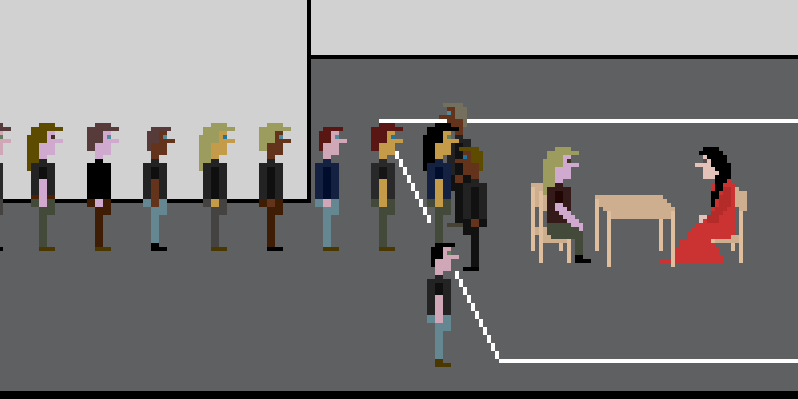
This example sheds light on a point of contact that remains relatively underexplored, including within semiotics: both museums and video games organize pathways, thresholds, values, spectator postures, and programs of action. Both define modes of access to cultural objects, determine what may be seen or manipulated, and distribute roles among institution, text, space, and user. In both cases, meaning is not conveyed solely through images or narratives; it takes shape through regulated practices, permitted gestures, waiting periods, prohibitions, inventories, maps, instructions, and forms of presence.
Over the past decade, the relationship between museums and video games has gained increasing institutional visibility. The Museum of Modern Art acquired fourteen video games in 2012 and, ten years later, counted thirty-six in its collection. Exhibitions such as The Art of Video Games at the Smithsonian American Art Museum in Washington, D.C. (March 16–September 30, 2012), Game Masters: The Exhibition at ACMI in Melbourne (June 28–October 28, 2012), Videogames: Design/Play/Disrupt at the Victoria and Albert Museum in London (September 8, 2018–February 24, 2019), and Worldbuilding: Gaming and Art in the Digital Age, curated by Hans Ulrich Obrist and Amira Gad for the Serpentine Gallery in London (2023), have contributed to redefining the video game as an exhibition object, a design form, and a cultural practice.
The relationship also proceeds in the opposite direction. Video games represent museums, archives, galleries, storage facilities, ruins, inventories, and collections. The museum may become a setting, a narrative space, a classificatory interface, a memory device, a site of power, or an object of institutional critique. In this perspective, Relooted (2026), developed by Nyamakop, foregrounds this political dimension through the structure of a heist game: players must recover African artifacts removed during the colonial era and currently housed in Western museums or collections. The mechanics of planning, theft, and escape are thus brought into dialogue with questions of provenance, colonial dispossession, restitution, ownership, and historical justice.
The ICOM definition approved in 2022 describes the museum as a permanent, non-profit institution that research, collects, conserves, interprets, and exhibits tangible and intangible heritage. Video games compel us to reconsider these functions when heritage takes the form of software, simulated environments, digital collections, interactive experiences, or objects that can only be preserved through documentation, emulation, and technical preservation practices.
This issue of Carte Semiotiche aims to explore the relationship between museums and video games from a plurality of perspectives, with particular attention to the ways in which both produce meaning through images, spaces, pathways, rules, objects, interfaces, and practices of engagement. Preference will be given to contributions grounded in specific case studies and explicit analytical hypotheses, capable of bringing into dialogue visual semiotics, the semiotics of texts and practices, game studies, museum studies, media archaeology, digital heritage studies, art history, design, and decolonial perspectives.
The editors welcome contributions that approach the video game as a museum object, an art form, a learning environment, an operational archive, a reenactment device, or an instrument of institutional critique. The museum, in turn, may be analysed as an interactive space, a structure of orientation, a system of selection and valorisation, an institution of memory, or a site traversed by conflicts over access, ownership, and visibility.
Particular attention is also encouraged to the central role that artists and Game Art have played in creating relationships between these two cultural dispositifs.
Possible Research Topics
- Video Games in Museums: Exhibition, collection, display design, acquisition, and museum interpretation of video games; criteria for selection, display, interaction, preservation, and mediation.
- Museums in Video Games: Representations of galleries, exhibition displays, archives, collections, storage facilities, wunderkammern, archaeological sites, and cultural institutions in game worlds; the narrative, spatial, and symbolic functions of the museum as a playable environment.
- Semiotics of Interaction: Paths, thresholds, interfaces, maps, inventories, instructions, objectives, rules, and action programs; comparisons between museum visits and gameplay experiences.
- Enunciation, Spectatorship, and Agency: Positions of the visitor, player, and spectator; regimes of vision, presence, participation, waiting, manipulation, and interpretive responsibility.
- Collection, Inventory, and Value: Forms of collecting in museums and video games; catalogues, databases, achievements, completionism, rarity and scarcity, accumulation, selection, and cultural hierarchies.
- Education, Edutainment, and Gamification: Video games produced or adopted by museums; serious games, educational games, VR/AR, museum apps, public engagement, accessibility, informal learning, and experience evaluation.
- Game Art, Machinima, and Playable Installations: Artistic practices that use video games as material, language, environment, or exhibition device; machinima, mods, performances, interactive installations, and game-based artworks.
- Reenactment, Simulation, and Heritage: Historical reconstruction, performative reactivation, authenticity, anachronism, procedural memory, and interpretations of the past through simulated environments.
- Preservation and Obsolescence: Preservation of hardware, software, interfaces, peripherals, documentation, code, emulation, restoration, versions, platforms, and conditions of playability.
- Restitution, Decolonization, and Counter-Archives: Video games that address provenance, looting, colonial collecting practices, restitution, access to collections, museum authority, and contested memory.
Submission Guidelines
The editorial board of Carte Semiotiche invites scholars to submit proposals in Italian, English, French, or Spanish. Proposals should consist of an abstract of no more than 2,000 characters including spaces (approximately 500 words), accompanied by a short biographical note (maximum 10 lines) and a brief bibliography of relevant references.
Abstracts should be submitted by August 31, 2026 to the following addresses:
- cartesemiotiche@semio-cross.it;
- matteo.bittanti@iulm.it;
- elisabetta.modena@iulm.it
Schedule
- Abstract submission deadline: August 31, 2026
- Notification of proposal acceptance: September 15, 2026
- Submission of full papers: November 30, 2026
- Completion of the peer review process: December 2026
- Submission of final versions of the papers: January 2027
- Publication: February 2027
Carte Semiotiche is an international and interdisciplinary journal of semiotics and image theory dedicated to exploring the production of meaning in visual objects. The journal welcomes and encourages a plurality of perspectives on the visuality of cultural artefacts. In the belief that textual analysis is a crucial tool for the comparison between different disciplinary approaches, Carte Semiotiche favours a focus on textuality and the analytical dimension of research. Each annual monographic volume addresses a specific topic, open to diverse methodological and theoretical perspectives.