CALL FOR PAPERS AND ARTWORKS: HACK THE GAME (TÉTOUAN, MOROCCO, DEADLINE: AUGUST 31 2026)
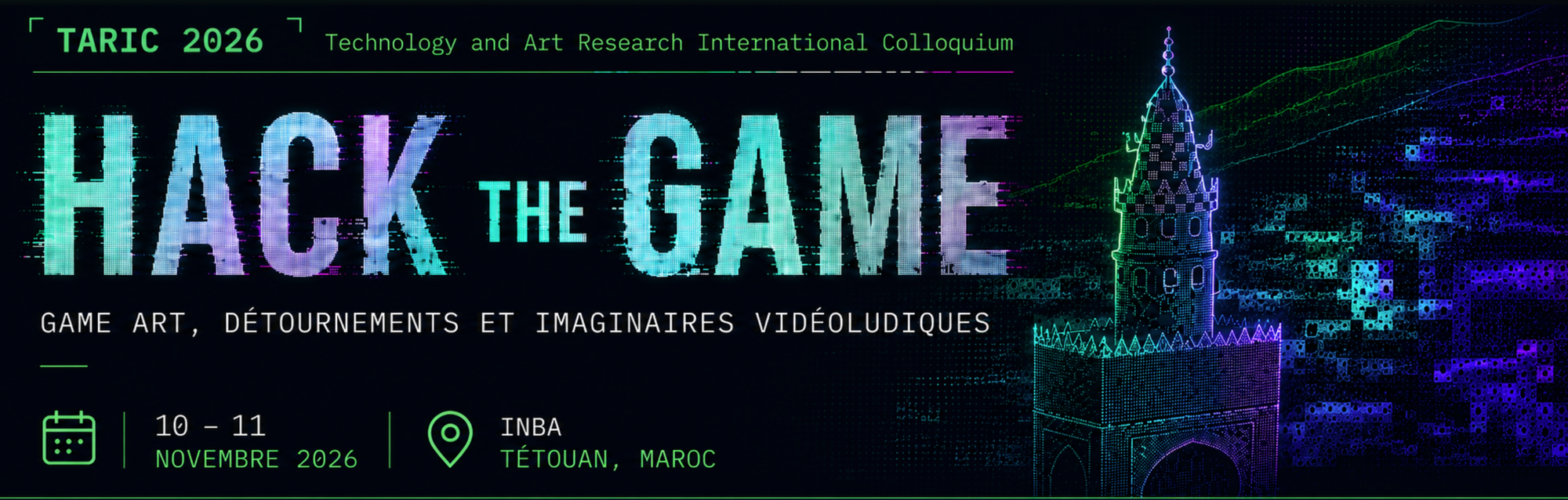
The Institut National des Beaux-Arts in Tétouan, Morocco, has announced Hack the Game: Game Art, Détournement and Video Game Imaginaries, the inaugural edition of the Technology and Art Research International Colloquium (TARIC). The event will take place during the 17th Mediterranean Biennale of Art Schools, scheduled for 9–13 November 2026.
Organised by the INBA Media Lab and Université Paris 8’s AIAC–INREV research unit, the colloquium will bring together artists, researchers, designers, theorists, and practitioners working with videogames as artistic media, research tools, experimental systems, and sites of critical inquiry.
The call examines how artists and players alter the programmed structures of videogames through mods, machinima, glitches, code interventions, remixing, and other forms of détournement. It situates these practices in relation to algorithmic surveillance, behavioural gamification, artificial intelligence, technological obsolescence, and the political assumptions embedded in software architectures.
Thematic areas
Proposals may address the following subjects:
- Aesthetics of détournement and hacking practices, including mods, machinima, glitch art, code rewriting, interventions in game engines, malfunction, and reworking.
- Game art and artistic research, with attention to videogames as artistic languages and experimental media.
- Resistance and critical imaginaries, including behavioural gamification, algorithmic surveillance, militarisation, counter-narratives, collective memory, and shared narratives in the Mediterranean region.
- Identities, avatars, and acting bodies, including representation, identity experimentation, and postphenomenological approaches to human-technology relations.
- Histories and memories of games, including preservation, archival practices, technological obsolescence, low-poly aesthetics, photorealism, and technological fetishism.
- Decolonial perspectives and emerging scenes, including game studies from the Global South, Mediterranean margins, postcolonial imaginaries, cultural sovereignty, and asymmetrical exchanges between northern and southern institutions.
- Interactive narratives and transmedia imaginaries, including nonlinear narration, hypertextuality, collaborative storytelling, and transmedia forms.
- Serious games and cultural applications, including mediation, heritage interpretation, and the circulation of material or intangible cultural heritage through playable environments.
- Videogames and art education, with particular attention to pedagogical experiments in Mediterranean institutions of higher artistic education.
The organisers welcome proposals beyond these areas when they correspond to the colloquium’s broader focus on game art, critical play, technological intervention, and artistic research.
Contribution formats
The colloquium accepts two principal forms of contribution.
Research papers
Long-form papers should present developed research related to the colloquium’s subjects.
Accepted papers must be prepared as articles of 4,000–6,000 words, excluding notes and bibliography. Each participant will receive 15 minutes for the presentation, followed by 5 minutes of discussion.
Participation in person is required for accepted research papers.
The initial submission consists of an abstract and the accompanying information requested through the online form. Final articles will undergo a subsequent double-blind review for possible publication as chapters in a collective volume.
Artistic projects and works
Artists may submit projects that use videogames as media for production, intervention, or experimentation. Eligible formats include:
- interactive installations;
- game art works;
- experimental prototypes;
- performances and playable devices;
- immersive experiences;
- related forms of artistic research.
Selected works and projects will be presented at the Centre d’Art Moderne de Tétouan during the Biennale.
Submission procedure
All proposals must be submitted through the Sciencesconf platform.
The submission form requires:
- title;
- abstract;
- keywords;
- relevant thematic area;
- contribution type;
- institutional affiliation;
- a short biographical note for each author.
Proposals sent by email or through other channels will not be considered. The official deadline is 31 August 2026, meaning that submissions must reach the platform before 1 September.
Research abstracts and artistic proposals will undergo double-blind review.
Questions concerning eligibility, registration, or submission may be sent to:
Key dates
- 31 August 2026: deadline for abstracts and artistic project proposals
- 7 September 2026: notification of accepted papers and selected exhibition projects
- 7–30 September 2026: registration-fee payment period
- 5 October 2026: publication of the final programme
- 5 October 2026–10 January 2027: submission period for completed articles intended for double-blind review and possible publication as book chapters
- 9 November 2026: publication of the colloquium proceedings, including the exhibition catalogue, participant list, and paper abstracts
- 9–13 November 2026: 17th Mediterranean Biennale of Art Schools
Venues
The colloquium sessions will be held in the auditorium of the Institut National des Beaux-Arts:
Institut National des Beaux-Arts
Avenue Mohammed V
Cité Scolaire, BP 89
Tétouan, Morocco
The exhibition of selected artworks and artistic projects will be held at the Centre d’Art Moderne de Tétouan.
Registration fees
The registration categories are:
- Senior researchers: €300, including accommodation
- Doctoral researchers: €150, including accommodation
- Participants in the 17th Mediterranean Biennale of Art Schools: €60
- Participants based in Morocco: €60, without accommodation
- Five scholarship recipients from Morocco and the Maghreb: €60, including accommodation
Five accommodation scholarships are available to participants from Morocco and the Maghreb who have not received an invitation through the Biennale. The scientific committee will select the recipients.
The €60 registration package includes access to the colloquium sessions and collective exhibition, the programme and published proceedings, a certificate of participation, coffee breaks, and eligibility for consideration in the collective publication.
Organisation
The organising committee comprises Mehdi Zouak and Mikael Fetri Daoudi of the INBA Media Lab, Chu-Yin Chen of INREV–AIAC at Université Paris 8, and Salma Bahlaouane of Université Paris 8 and the INBA Media Lab.
The scientific and artistic committees include researchers, artists, and educators affiliated with institutions in Morocco, France, Spain, Portugal, and other Mediterranean contexts. The complete committee lists and author instructions are available through the official submission platform.