EVENT: PIXEL PIONEERS (APRIL 25–SEPTEMBER 20 2026, ROTTERDAM, THE NETHERLANDS)

Event: Pixel Pioneers
Artists: Christopher Kulendran Thomas, Feng Mengbo, Larry Achiampong, Claudia Hart, Suzanne Treister, Geert Mul, Hoos Blotkamp, Nam June Paik, Peter Struycken, Jeroen Jongeleen
Curator: Amira Gad
Venue: Depot Boijmans Van Beuningen, Gallery II, 4th floor, and Gallery III, 5th floor, Museumpark 24, 3015 CX Rotterdam, The Netherlands
Dates: April 25–September 13, 2026. Geert Mul’s Horizons remains on view until September 20, 2026.
Opening hours: Tuesday–Sunday, 11:00 a.m.–5:00 p.m.
Admission/access: Depot ticket with booked time slot required. Full price €20; visitors up to 18 and Boijmans Friends free. The Depot is wheelchair accessible, with lifts to each floor. Assistance dogs are welcome.
Presented by: Museum Boijmans Van Beuningen
Supported by: VriendenLoterij, Mondriaan Fonds, Fonds 21, Stichting Museum Boijmans Van Beuningen, the estate of Rine Coolen–Kalkman, and the Municipality of Rotterdam. The restoration of Geert Mul’s Horizons is supported by the De Heus Family Restoration Fund.
The strongest message in Pixel Pioneers is architectural.
Museum Boijmans Van Beuningen’s main building remains closed for renovation, while the Depot, its publicly accessible storage facility, has become the visible face of the institution. Digital art, often described through immateriality, networks, code, or circulation, appears here inside a building dedicated to storage, care, conservation, and controlled access. That setting gives the exhibition a useful tension. A digital artwork reaches the museum as a set of dependencies: files, sensors, consoles, databases, screens, emulation problems, permissions, failed platforms, obsolete interfaces, and bodies willing to interact with them.
Curated by Amira Gad, Pixel Pioneers is the first major Boijmans exhibition devoted entirely to digital art. It spreads across two galleries in the Depot and uses the museum’s collection to test a larger proposition: the digital image did not suddenly appear with AI, NFTs, streaming platforms, or generative software. Its history runs through experimental painting, electronic media, algorithmic procedures, video sculpture, gaming cultures, and database aesthetics. The exhibition’s title could sound triumphalist, yet the show becomes more interesting when “pioneer” is read against the Depot itself. Here, the pioneer is the artist who handed the museum a technical problem that still has to be kept alive.
Geert Mul’s Horizons (2008/2026) is the exhibition’s conceptual hinge. First commissioned by Boijmans nearly twenty years ago and restored for this presentation, the work draws on more than two hundred images from the museum’s collection, each containing a visible horizon. Mul turns the collection into a responsive panorama: visitors move, sensors register the body, and the image recomposes itself on screen. The work frames the museum collection as a database long before “database” became a default cultural metaphor. Its restoration also asks a difficult conservation question. Preserving a digital artwork means preserving behaviour, timing, responsiveness, scale, and the relation between visitor and system. The file alone is never the artwork.
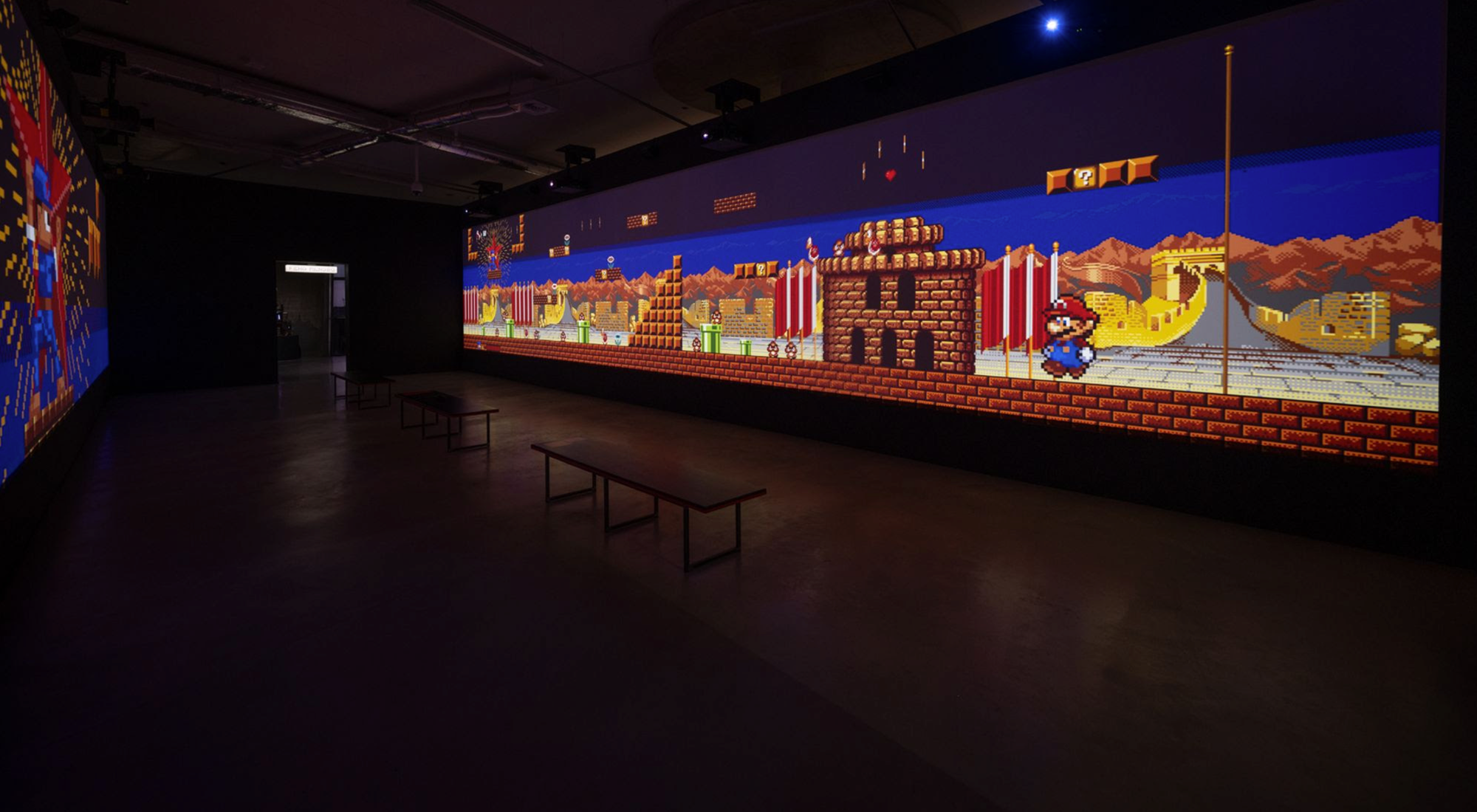
The most significant work presented in the exhibition is Feng Mengbo’s Long March: Restart, which remains one of the decisive works in the history of game-based art. Presented as a monumental interactive projection, it reworks the Long March of 1934–35 through the grammar of side-scrolling videogames. Revolutionary heroism becomes level design, repetition, combat rhythm, and pixelated spectacle. Feng’s work understands that games can compress ideology into movement: the jump, the attack, the boss fight, the scroll, the reward. Historical narrative becomes playable, and play becomes a way to see how political myth can be simplified, accelerated, and made strangely pleasurable.
Larry Achiampong’s The Gaming Room takes a different route, using videogames as memory, domestic space, diasporic formation, and shared infrastructure. Drawing on the artist’s personal archive of consoles, games, books, music, film, and memorabilia, the installation recalls the gaming room as a place where popular media shaped attention, imagination, and social life. In Achiampong’s work, gaming carries the pressure of biography without becoming a nostalgic prop. The room asks visitors to consider how videogames taught forms of persistence, style, failure, repetition, and belonging across the material culture of the late twentieth century. The controller is also an archive object.
Claudia Hart, Suzanne Treister, and Christopher Kulendran Thomas extend the exhibition into adjacent questions of power, authorship, belief, and corporate mythology. Hart’s new commission Empire Failure positions big tech and cryptocurrency culture within a longer history of imperial fantasy and collapse. Treister’s HEXEN works use the tarot format as a speculative diagram for countercultures, ecological thought, finance, computation, and artificial intelligence. Kulendran Thomas’s AI-assisted paintings bring machine learning into contact with Sri Lankan visual histories and contested memories, raising questions about training data, inheritance, and the politics of style. These works treat the digital as a system that produces images and belief at the same time.
The historical works in the exhibition prevent the present from congratulating itself. Hoos Blotkamp, Nam June Paik, Peter Struycken, and Jeroen Jongeleen help situate contemporary digital practice within older experiments in video, electronics, computation, and rule-based image-making. This historical range is valuable because digital art is still too often narrated through narratives of novelty and technical innovation. Pixel Pioneers shows a different history: digital culture as maintenance, repetition, translation, repair, and institutional delay.