PLAY-TO-PAINT: SASHA YAZOV’S MID-POLY LIVES

PLAY-TO-PAINT is an ongoing series examining the influence of video games on contemporary painting. Each article considers how artists translate game imagery, virtual camera systems, player-made content, and the temporal logic of play into material form, treating the canvas as a site where digital experience is edited and made durable.
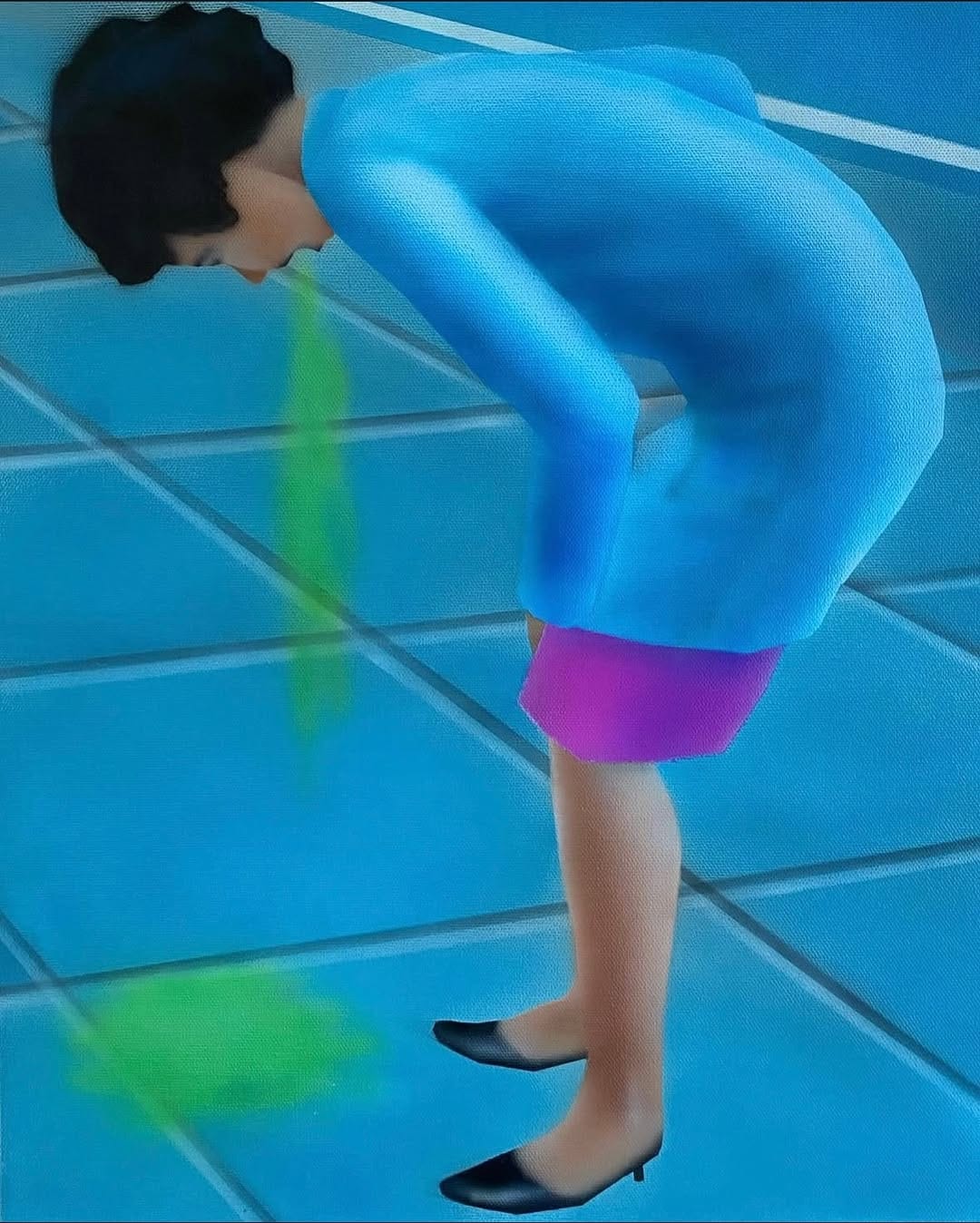
A female-coded avatar bends over a tiled floor. Her electric-blue top and magenta skirt retain the immaculate saturation of a customization menu while a translucent green stream falls from her mouth into a fluorescent puddle. Heels stay planted beneath a torso folded into an ungainly arc. The character loses composure inside an image that remains clinically clean. Vomit has neither thickness nor splatter. It lies across the scene as a chromatic instruction telling the player, or rather, the viewer, how to read the body.
The painting isolates a basic operation of life simulation. A gameplay condition must acquire a visible form in order to be legible: hunger lowers a meter; fatigue produces a slouch; illness activates a prescribed animation. Yazov removes the onscreen interface that would explain the event, enlarges the avatar and transfers the scene to canvas. A passing status indicator becomes an extended encounter with a virtual body whose distress can assume only the forms permitted by its rig.
This process of translation runs through Yazov’s work. The figures solicit recognition as people while displaying the geometry, textures and programmed behaviours that construct them. In a recent profile, the artist describes their appearance as “closer to what you’d call mid poly,” correcting the reflex that classifies any visibly polygonal game image as low-poly. In 3D production, mid-poly is an informal, context-dependent designation for an intermediate degree of geometric resolution. The artist’s models carry enough detail to sustain posture, clothing and identity, yet their manufacture remains visible in moulded hair, conspicuous joints and faces assembled from a restricted arrangement of planes. Emotion appears as a property of the model, rendered through poses and effects. Clearly, mid-poly is not a region of the Uncanny Valley...