EVENT: CAPTURED IN CODE: VIRTUAL PHOTOGRAPHY (JUNE 11–21 2026, DORTMUND, GERMANY)

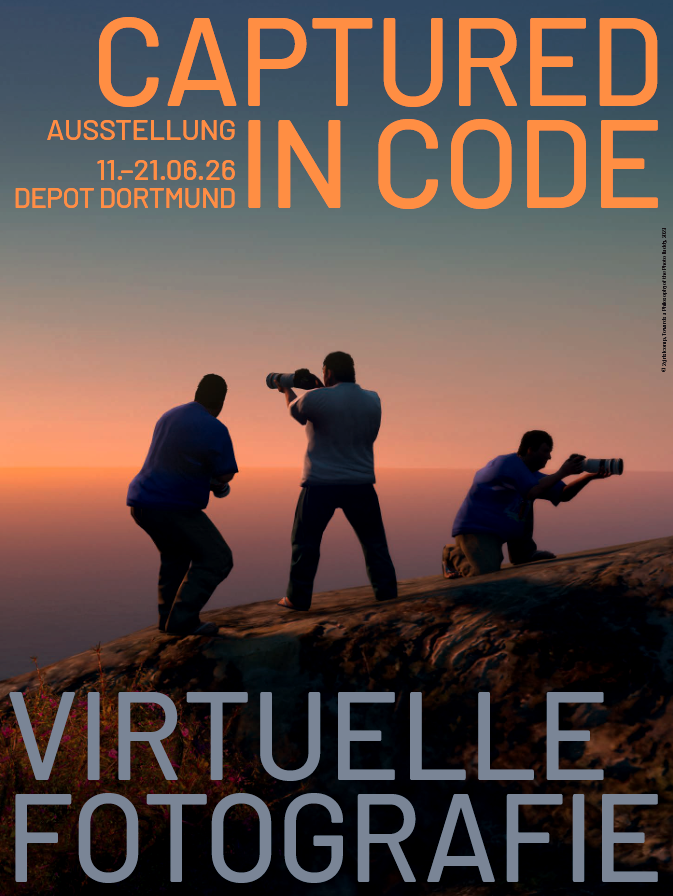
Venue: Kulturort Depot Dortmund, Halle, Dortmund, Germany
Dates: June 11–21, 2026
Opening: June 11, 2026, 7:00 p.m.
Finissage: June 21, 2026, 7:00 p.m.
Opening hours: Monday-Friday, 11:00 a.m.-8:30 p.m.; Saturday-Sunday, 2:30-8:30 p.m. Opening hours may vary for operational reasons.
Admission: Free
Curators: Isabelle Hamm, Thomas Spies and Sebastian Möring.
Guided tours: June 13, 2026, 11:00 a.m.; June 19, 2026, 6:00 p.m. Tours are in German; English tours can be requested by email.
Workshops: Natalie Maximova, Off Script: In-Game Photography, June 21, 11:00 a.m.-2:30 p.m., English; Prof. Dr. Federico Alvarez Igarzábal, Auf Pause: Einführung in die virtuelle Fotografie, June 21, 2:30-6:00 p.m., German. Both workshops take place at the Koproduktionslabor, Leonie-Reygers-Terrasse 2, 44137 Dortmund.
Artists: 2girls1comp, Christiano Bonora, Claire Hentschker, COLL.EO, Daniel J.F. Martins, Elise Aubisse, Federico Alvarez Igarzábal, Gareth Damian Martin, Kent Sheely, Leo Sang, Lorna Ruth Galloway, Luca Morgantini, Malin Frisegård, Natalie Maximova, neontales, Raphael Brunk, Total Refusal.
Website: Captured in Code
From June 11-21, 2026, Kulturort Depot Dortmund presents Captured in Code: virtual photography, a group exhibition curated by Isabelle Hamm, Thomas Spies, and Sebastian Möring. Dedicated to photographic practices produced within digital game worlds, the exhibition brings into public view a form of image-making that has long circulated through online communities, artist networks, modding cultures, and platform-specific archives, while still receiving comparatively limited attention in exhibition contexts.
The premise is deceptively simple: virtual photography is made through screenshots, photo modes, camera-like tools, mods, spectator systems, glitches, and self-devised capture techniques. Yet this technical description says little about the intensity of the practice. The resulting image may be generated from simulated light, authored assets, scripted weather, proprietary engines, and controllable avatars, but the photographic act still depends on timing, attention, framing, patience, and an ability to read the expressive potential of a programmed environment.
Captured in Code frames in-game photography neither as a derivative form of gameplay nor as a novelty attached to visual fidelity. It approaches the medium as a serious photographic condition: an image practice in which the referent is executable, the camera may be internal to the software, and the scene being photographed may belong to a world designed for movement, combat, driving, role-play, or exploration rather than contemplation. The exhibition’s title identifies this tension: these are images made from code, yet they are also shaped by bodies at keyboards, controllers, consoles, and screens.
At stake is a modified account of capture itself. Classical photography has often been discussed through optics, indexicality, chemical trace, mechanical reproduction, and the social uses of the camera. In-game photography shifts those terms without discarding them. The shutter is replaced by an input command, the lens may be a virtual camera; the world is navigated before it is photographed, the decisive moment may occur inside an engine whose time, weather, depth of field, and physical laws can be paused, bent, or broken. The image is therefore both composition and evidence: a record of looking, of moving through a system, of discovering what the game did not necessarily ask the player to see.
The exhibition’s featured artists lineup reflects the breadth of the field. It includes practitioners associated with art, game studies, machinima, virtual photography communities, glitch-based research, and critical interventions into commercial game worlds. Daniel J.F. Martins’s work, for instance, turns away from spectacle and concentrates on the incidental: minor objects, surfaces, colours, and light conditions that a player might otherwise absorb as background. His interest in sequencing links virtual photography to the photobook tradition, where meaning emerges between images as much as within them.
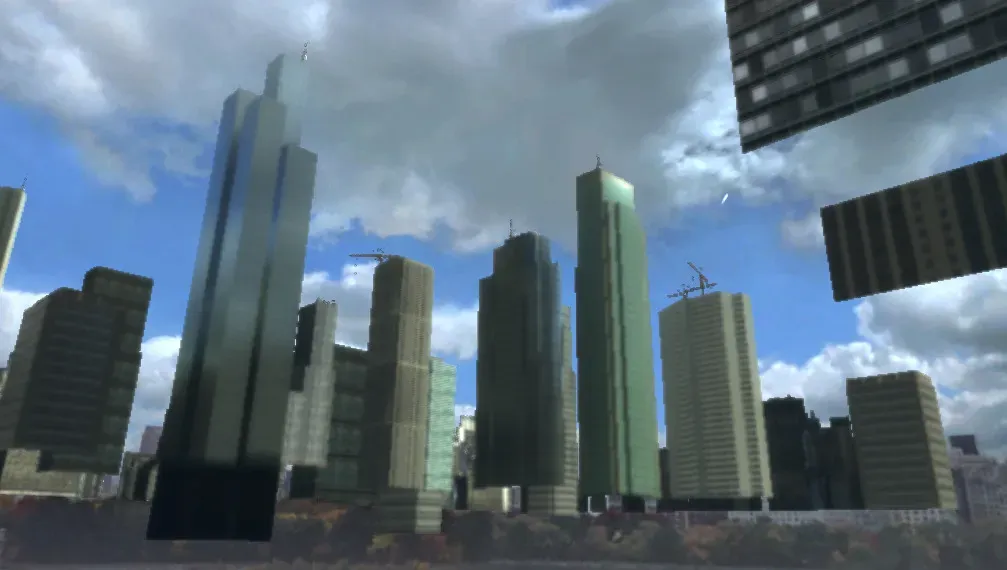
Federico Alvarez Igarzábal’s Spectator Mode, begun in 2012, returns to one of the earliest and most suggestive conditions of videogame photography: the camera released after death. In multiplayer first-person shooters, spectator mode gives the player temporary access to a mobile, disembodied point of view. Alvarez Igarzábal uses this interval to reach marginal zones: low-resolution textures, floating architectural fragments, incomplete assets, and spatial seams that active play tends to bypass. Presented through a slide projector, the work also makes the accelerated history of game graphics visible through an older photographic apparatus.
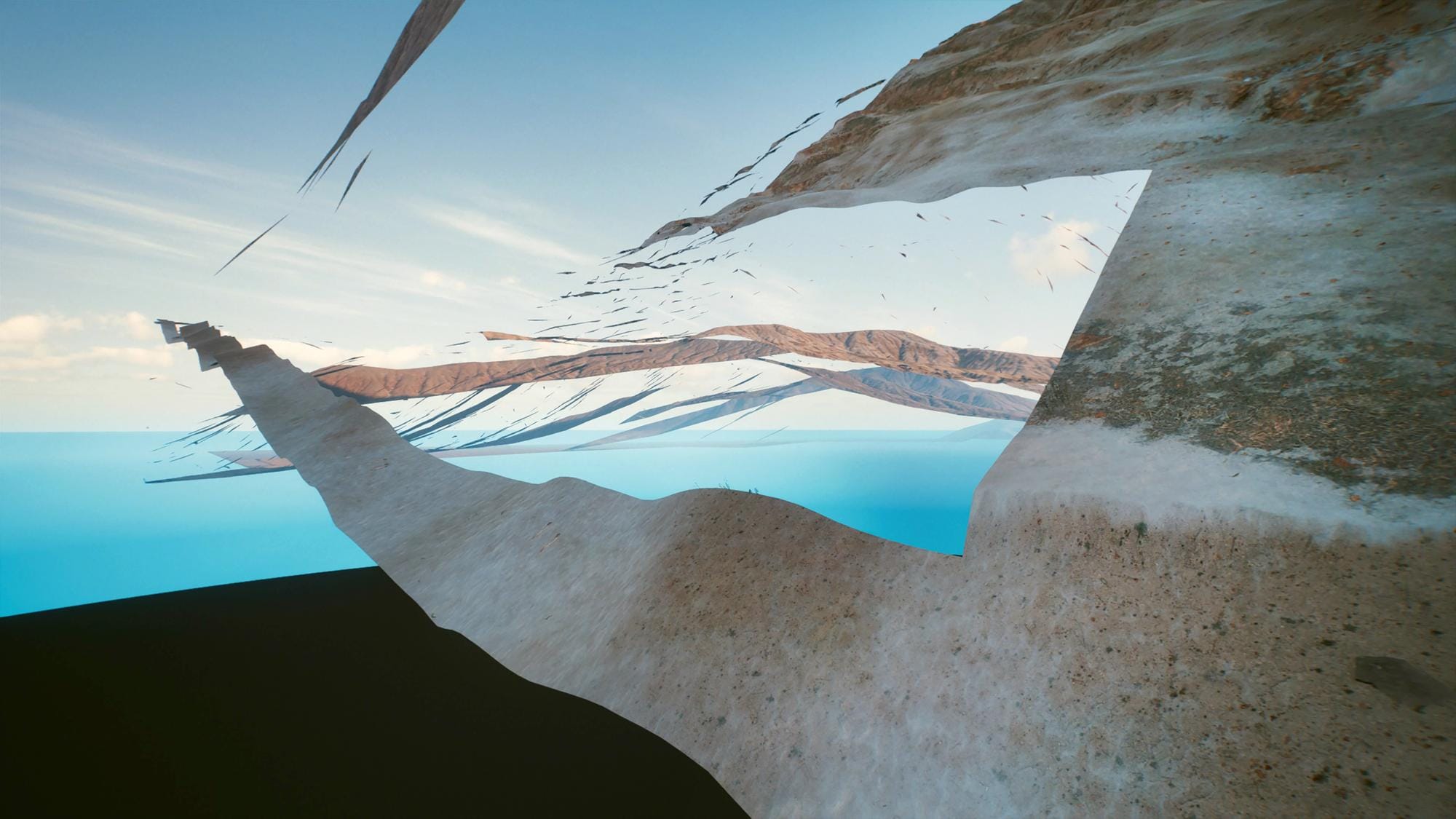
Natalie Maximova’s The Edge of the World approaches Cyberpunk 2077 through its limits. Her images examine the out-of-bounds areas where design logic becomes exposed, where the fantasy of urban continuity gives way to unfinished surfaces, rough edges, and broken spatial promises.
Such works suggest that in-game photography is not confined to beautiful screenshots or promotional aesthetics. It can also function as a critical practice, able to test the borders of simulated worlds and extract images from their failures.
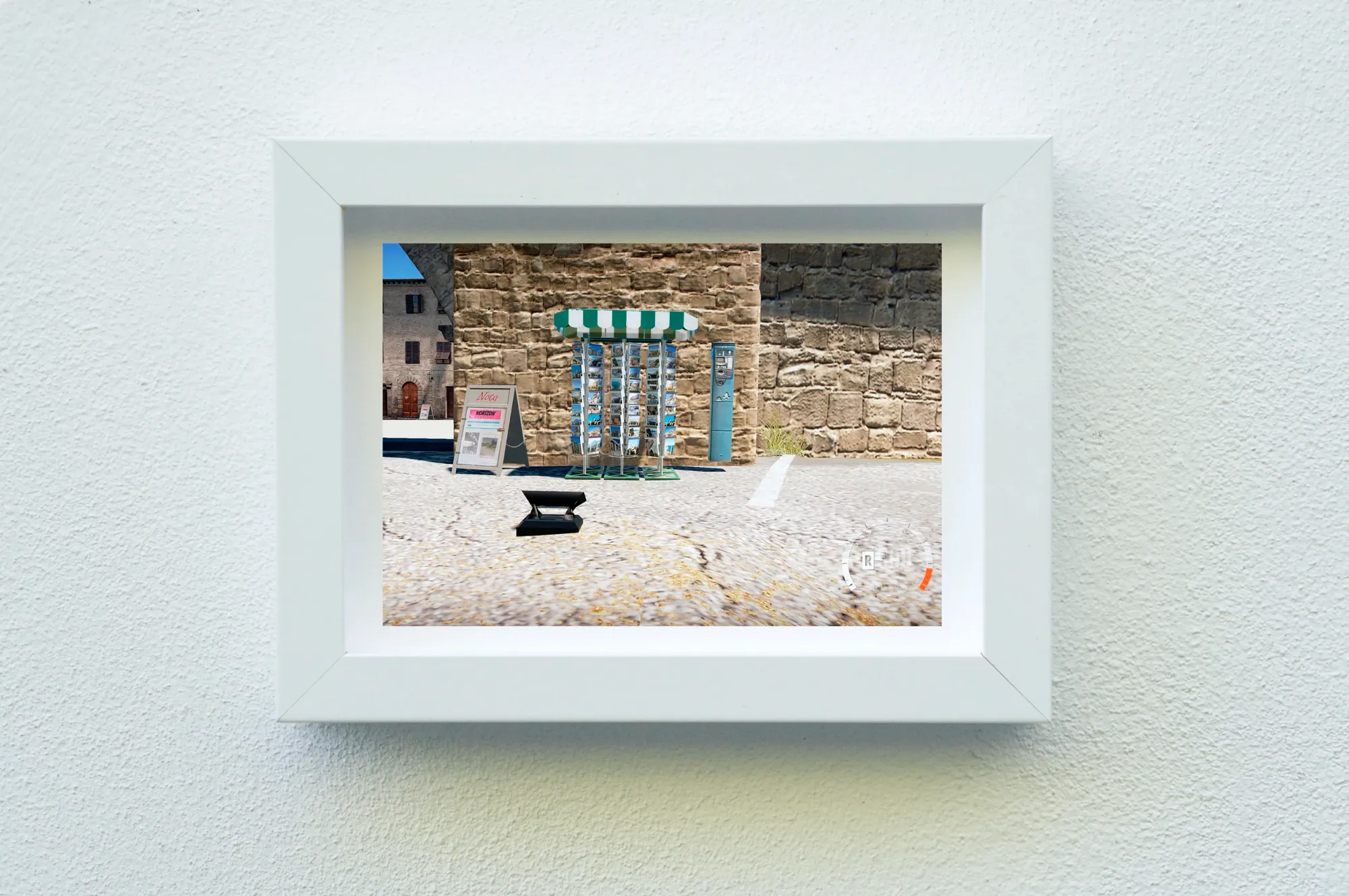
COLL.EO’s Boring Postcards from Italy (2014–16) brings a deliberately anti-spectacular intelligence to Captured in Code. Composed from images captured in Forza Horizon 2, the project borrows the conceptual grammar of Martin Parr’s Boring Postcards and relocates it inside a simulated Italy built for automotive pleasure, scenic mobility, and tourist fantasy. Its dullness is tactical: road edges, empty villas, generic vegetation, underpopulated plazas, and fragments of infrastructure expose the game’s Italy as a stock-image geography, a programmed Belpaese assembled from design convention rather than lived place. By adopting the postcard, a form historically bound to tourism, circulation, and modest sentiment, COLL.EO turns in-game photography into a critique of simulation’s defaults. The work asks what happens when the player stops racing and begins to look, finding in the game’s least heroic views an analysis of how software manufactures locality, leisure, and cultural memory.
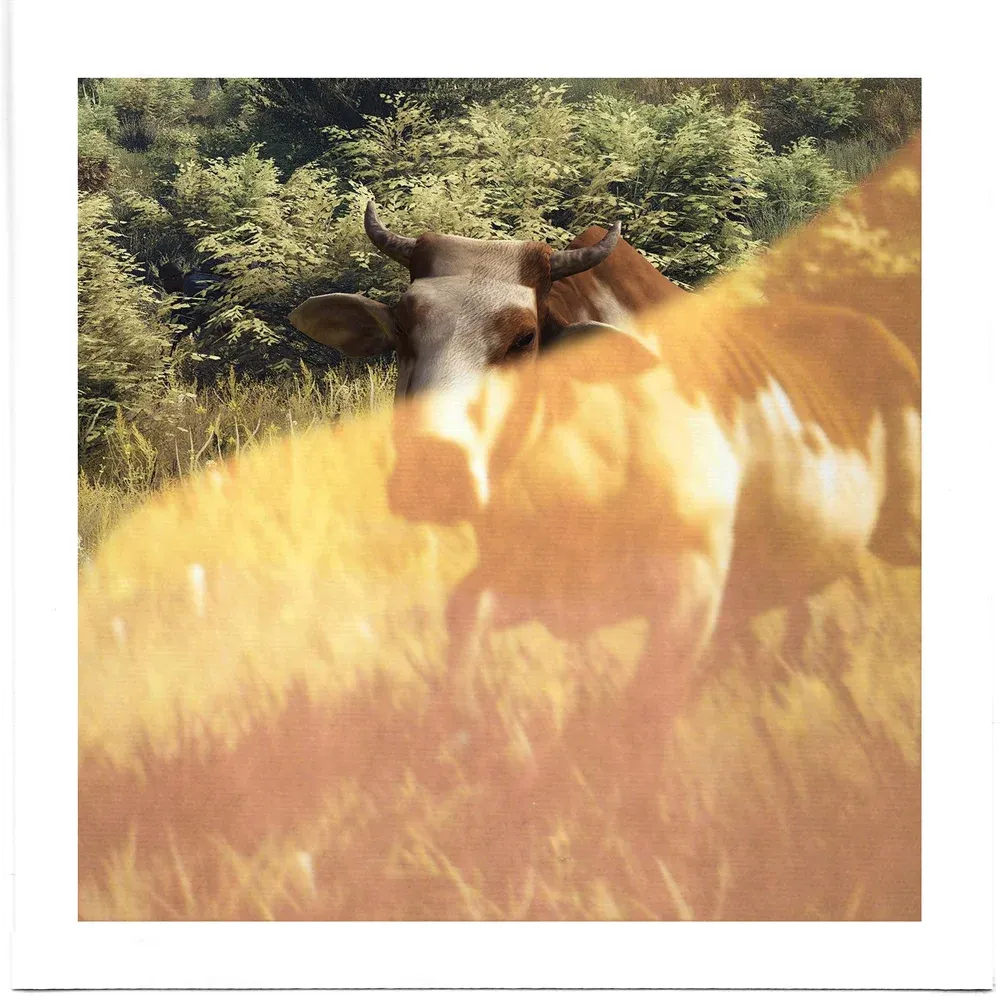
Élise Aubisse brings a sustained inquiry into photography’s relation to reality at the point where the referent becomes fully synthetic. A professional photographer based in Lille, France, Aubisse treats videogame worlds as legitimate sites of photographic encounter, asking what remains of the photographic gesture when the scene before the camera is generated by software. She refuses a single technical protocol. Across projects made in Star Wars Battlefront, Fallout 4, Ghost Recon Wildlands, Control, and Doom Eternal, she moves between screenshots, digital photographs of the screen, analogue processes, expired film, medium-format Polaroid backs, and delicate printed supports. This oscillation between screen image and photographic material gives her work a dense temporal charge: the videogame image is not simply captured, but translated, rephotographed, damaged, printed, and re-entered into the history of photographic surfaces. In Aubisse’s hands, in-game photography becomes a test of the medium’s limits, extending pictorial attention into spaces that are artificial without being visually inert, fictional without being unavailable to aesthetic experience.
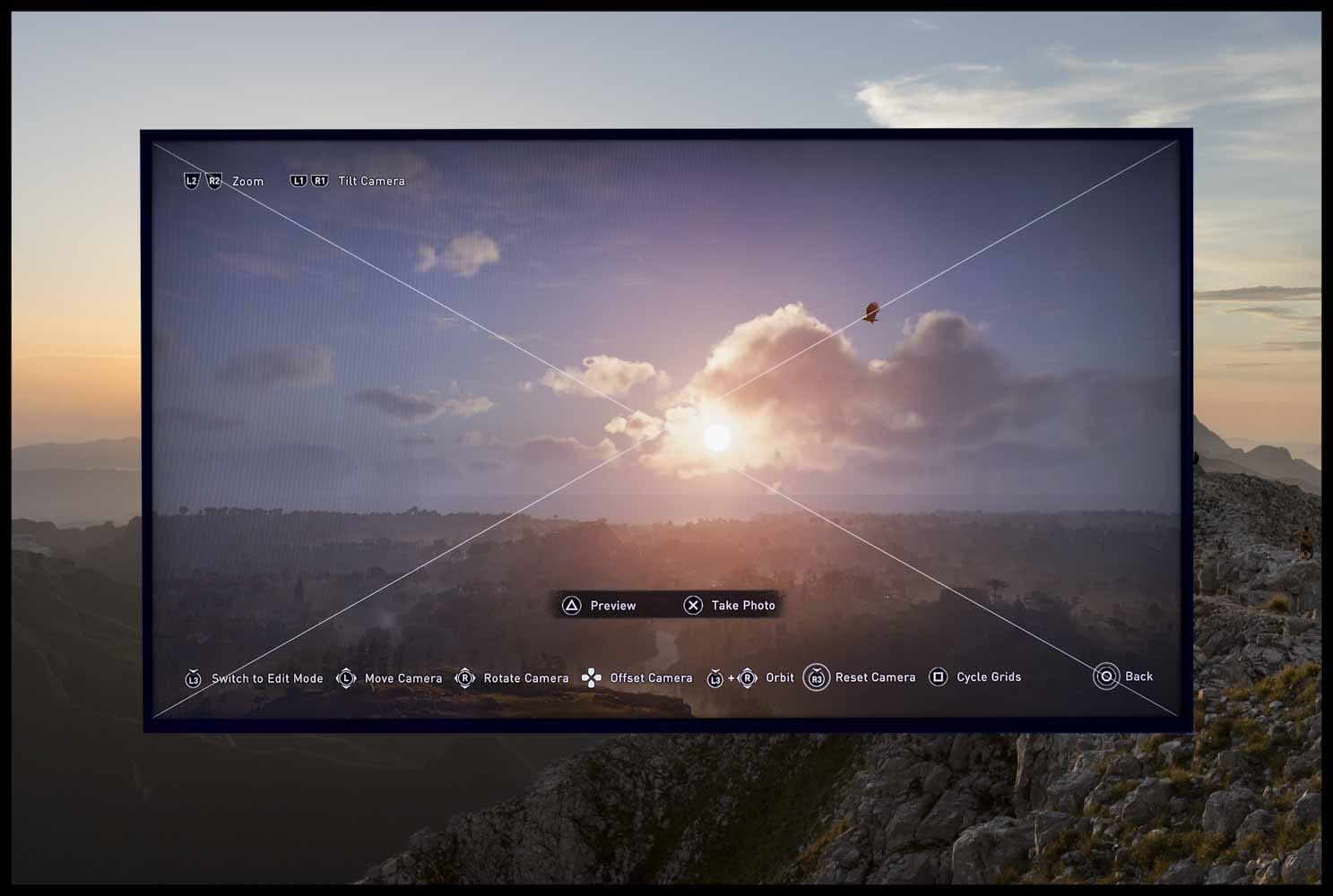
Rather than suppressing the apparatus of in-game photography, Luca Morgantini’s The Game Frame makes it visible: the Photo Mode interface remains on the screen, the television border cuts through the image, and a second digital frame is added to the photographed world beneath. The resulting works do not simply extract images from games; they examine the conditions under which such images become photographic. By pairing a game image captured from a screen with a second image drawn from the non-virtual world, Morgantini constructs a visual hinge between simulated light and photographic light, virtual camera and physical camera, playable environment and observed scene. The project’s force lies in this refusal of seamlessness. Here the frame is both technical boundary and conceptual instrument. Morgantini asking where the game begins, where photography resumes, and how much of the image belongs to the interface that made it possible.
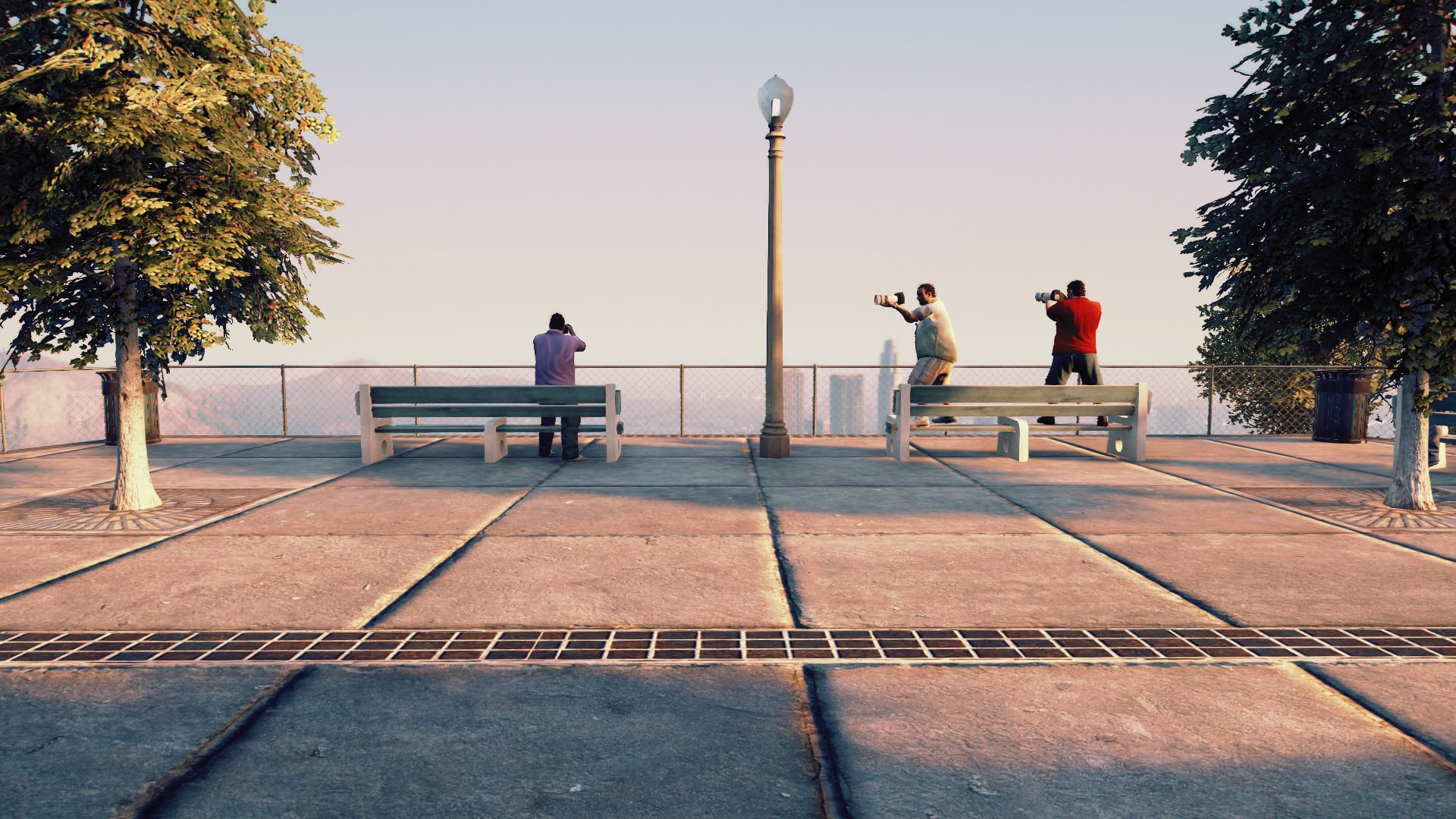
2girls1comp’s Towards a Philosophy of the Photo Daddy (2023) turns Grand Theft Auto V into a cruelly comic theory machine. The mod replaces Los Santos’s pedestrians with camera-bearing “photo daddies”, all trapped in a loop of compulsive image-taking, while the city is held in the flattering stasis of permanent golden hour. Over this automated spectacle, fragments from Vilém Flusser’s Towards a Philosophy of Photography are recited by voice-over, converting the open world into a seminar on photographic obedience. Thus, a game built around speed, mission structure, and cinematic excess becomes a habitat for redundant pictures, where every NPC behaves like a minor servant of the apparatus. The work offers one of the exhibition’s most pointed critiques of in-game photography. It does not celebrate the virtual camera as a tool of liberation: it examines how quickly photographic desire can become programmed behaviour, aesthetic habit, and ritualised production.
Captured in Code refuses to separate artistic production from community practice. Virtual photography has developed across forums, social media feeds, console sharing systems, fan archives, game-specific subcultures, and artist-run platforms. This history has often been informal, distributed, and technically fragile. By placing online image-makers alongside artists who use game engines, glitches, and modded systems, the exhibition recognises a practice whose meanings are aesthetic, social, and procedural at once.
The accompanying programme extends that approach into direct participation. Guided tours, an interactive photo station, and two workshops invite visitors to treat games as spaces for making images rather than as finished entertainment products. Maximova’s English-language workshop, Off Script: In-Game Photography, will address experimental approaches to photographic production in game environments. Alvarez Igarzábal’s German-language workshop, Auf Pause: Einführung in die virtuelle Fotografie, will introduce participants to the methods and questions of virtual photography.
The exhibition, one of the most extensive survey of avant-garde (and beyond) of in-game photography ever staged anywhere, situates the practice within contemporary image culture while preserving its specificity: its dependence on engines, interfaces, avatars, player movement, software limits, and community circulation.
In doing so, Captured in Code asks a precise question: What kind of photography becomes possible when the world before the camera is already an image, but one that must still be entered, searched, interrupted, and composed?