EVENT: PIXELATED: MIKE WHITING (SEPTEMBER 3 2026–JUNE 5 2027, LOGAN, UTAH)

September 3 2026–June 5, 2027
Utah State University’s Logan and Price campuses.
The exhibition is free and open to the public.
On Wednesday, October 21, 2026, Whiting will lead a guided Walk and Talk tour of the Logan installations, beginning at 12:15 p.m. at the Nora Eccles Harrison Museum of Art (650 North 1100 East, Logan, Utah) and concluding at 1:15 p.m., followed by a complimentary lunch.
An eagle rendered in angular steel stands on the Quad at Utah State University. Its stepped silhouette recalls the low-resolution sprites of early arcade games, although its monumental dimensions and industrial construction give the familiar visual language an unexpected physical presence.
The sculpture is part of Pixelated: Mike Whiting, an outdoor exhibition organized by the Nora Eccles Harrison Museum of Art (NEHMA) in Logan, Utah. Running from September 3, 2026, through June 5, 2027, the exhibition features ten large-scale sculptures distributed across USU’s Logan campus, with additional installations at its Price campus.
Born in Provo, Utah, Whiting has spent nearly two decades investigating the formal affinities between early videogame graphics and American Minimalism. His sculptural vocabulary consists of rectilinear silhouettes, deliberately restricted visual information, and saturated colors. Deer, birds, sailboats, and other recognizable figures emerge from combinations of squares and rectangular volumes. Constructed from welded steel and finished with automotive paint, these objects translate the visual conventions of pixel-based imagery into physical structures whose appearance changes according to the viewer’s position.
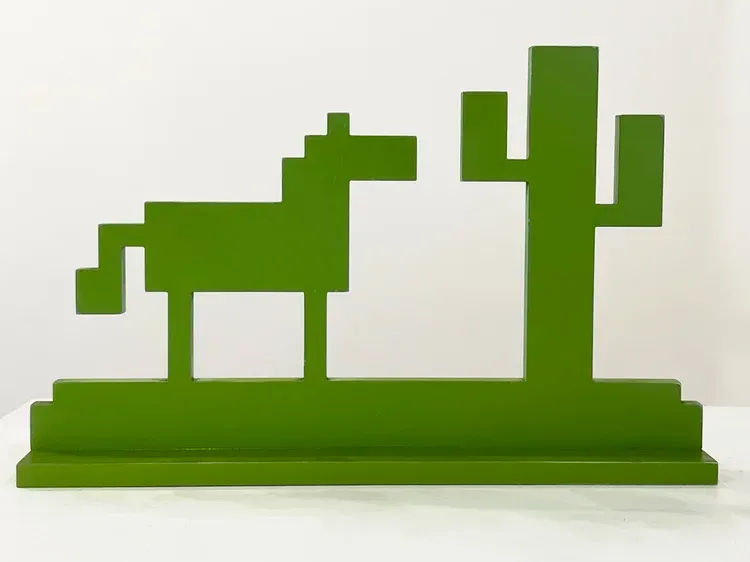
Whiting developed this approach while studying sculpture at Pratt Institute in Brooklyn. During a visit to the Museum of Modern Art, he encountered Piet Mondrian’s Broadway Boogie Woogie (1942–43), whose rhythmic arrangement of colored squares reminded him of early arcade graphics. The association informed his subsequent work, connecting the visual economy of videogames with an earlier history of geometric abstraction.
In his artist statement, Whiting identifies a revealing historical discrepancy. Early videogame designers simplified their imagery in response to severe technological limitations. Minimalist artists such as Donald Judd and Tony Smith pursued formal reduction as an aesthetic principle. The resulting similarities conceal substantially different artistic objectives. Whiting appropriates their shared geometry while reintroducing recognizable imagery into an artistic tradition frequently associated with nonrepresentational forms. The material qualities of his sculptures further complicate this relationship. Whiting deliberately leaves visible scuffs and irregularities in the painted surfaces, distinguishing his objects from the immaculate finishes associated with much Minimalist sculpture. Their weight and susceptibility to weathering also contradict the apparent immateriality of digital images. A pixelated animal occupying a garden acquires an entirely different relationship to scale and physical space than its apparent equivalent on a monitor.
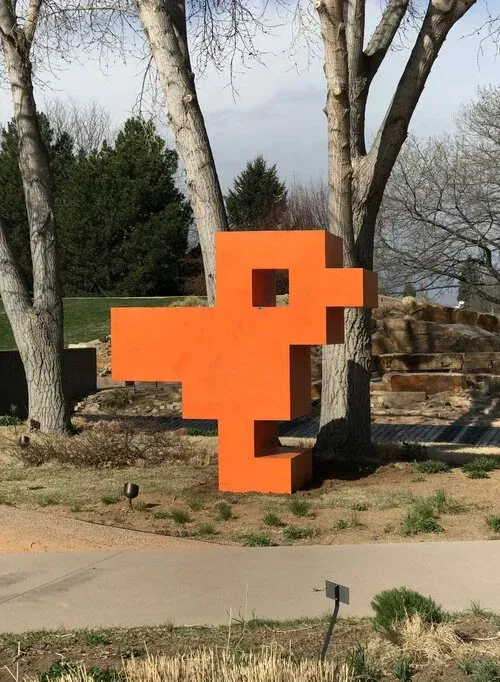
Pixelated extends a series of exhibitions that have progressively relocated Whiting’s videogame-inspired forms into public environments. In 2012, the Brigham Young University Museum of Art presented 8-Bit Modern, an outdoor installation featuring ten sculptures, including Buck, a geometric deer, and Blockhead, a pixelated human figure. In 2018, the Denver Botanic Gardens hosted an earlier iteration of Pixelated, placing works such as Cactus among carefully cultivated botanical environments.
Whiting continued this investigation in 2023 with Level Up, presented at the Dumke Arts Plaza in Ogden, Utah. Distributed across different elevations of the public plaza, the exhibition demonstrated how his geometric figures could interact with architectural structures and pedestrian circulation. Elsewhere, permanent public commissions have brought his sculptures to cities including Salt Lake City, Sunnyvale, and Long Beach.
Within the broader history of videogame-related art, Whiting’s work shares certain concerns with the French street artist Invader, whose ongoing Space Invaders project, initiated in 1998, translates arcade iconography into ceramic mosaics installed in urban environments. Their methods and intentions differ considerably. Invader reproduces the pixel’s modular structure through tiles affixed to existing surfaces, whereas Whiting develops autonomous sculptural objects that transform low-resolution imagery into monumental forms.
The exhibition’s relationship with its surroundings is particularly significant. Whiting has described gardens as carefully constructed environments, drawing an analogy between designed outdoor spaces and virtual worlds. In this context, the geometric animals introduce an additional layer of artificiality into settings already shaped by human decisions. Their presence complicates any straightforward opposition between technological representation and supposedly untouched nature.
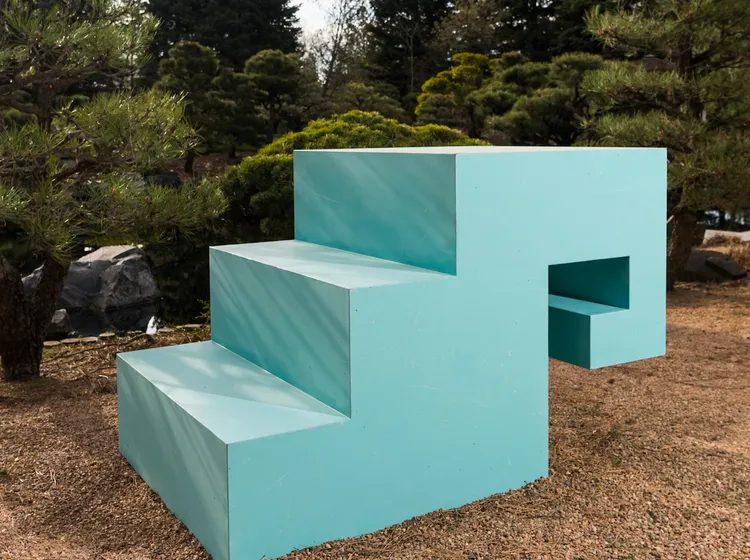
For NEHMA, an institution founded in 1982 with a substantial collection of modern and contemporary art from the American West, Pixelated also expands the exhibition beyond the conventional museum gallery. The sculptures become part of the university’s everyday environment, encountered during ordinary movement across campus. Their accessibility encourages forms of engagement that differ from those traditionally associated with a dedicated exhibition visit.
The project also invites reflection on the current cultural status of videogame imagery. The aesthetics of early computer graphics have long outlived the technological restrictions that originally produced them. Their continued presence in contemporary games and digital culture demonstrates how obsolete technical conventions can acquire independent expressive value. Whiting’s sculptures extend this development into public art, where the familiar pixel becomes a physical unit of construction.