BOOK: ANGELO CARERI’S GRAND THEFT AUTO CRIME ET ARCHITECTURE (2026)

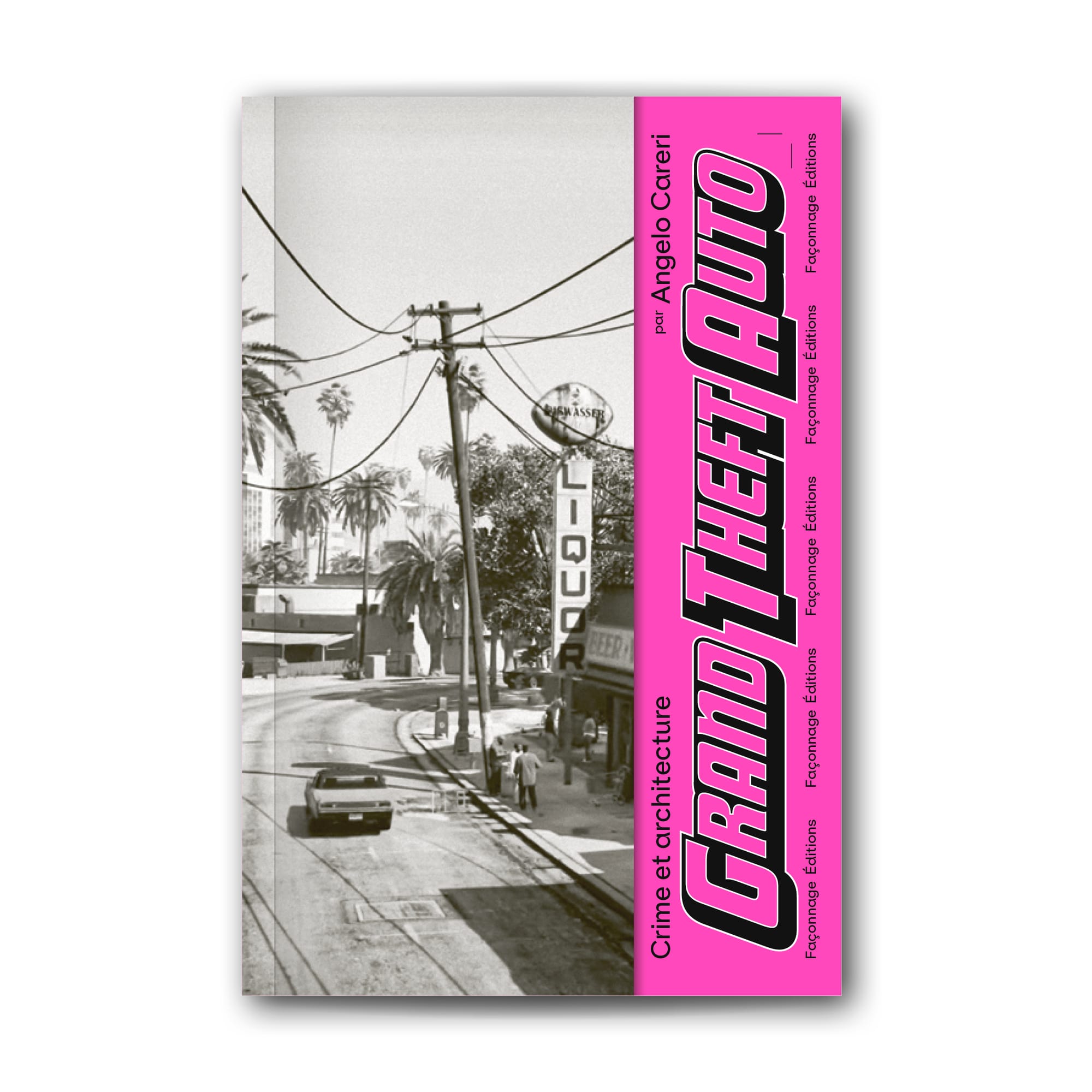
Façonnage Éditions has announced the release of Angelo Careri’s first book, Grand Theft Auto – Crime et architecture, a French-language long essay devoted to one of the most commercially dominant, culturally abrasive, and theoretically productive videogame series of the last three decades.
Published in the Everglades collection, the book includes a preface by philosopher Mathieu Triclot and game-photography by Leonardo Magrelli. Its official release is scheduled for 26 May 2026, followed by a launch event on Thursday 28 May at 19:30 at Librairie Le Monte-en-l’air, 2 rue de la Mare, Paris 20e.
Careri approaches Grand Theft Auto as more than a successful entertainment franchise. Over nearly thirty years, GTA has become one of the most recognisable objects in global popular culture: an open-world crime simulator, a satire of American decline, a corporate juggernaut, and a permanent source of moral panic, fascination, criticism, and player invention. From Goodfellas to Scarface, from carceral urbanism to platform capitalism, from Hollywood crime mythology to online roleplay, the series has absorbed and recomposed some of the most persistent fantasies of contemporary media culture.
Grand Theft Auto – Crime et architecture examines this phenomenon through the relation between crime, city space, capitalism, and social performance. Rather than treating GTA only as a violent game or a parody of America, Careri reads it as an urban machine: a programmable city in which roads, missions, police response, real estate, bodies, vehicles, and criminal opportunity become part of a single spatial logic. The book situates Grand Theft Auto within American history and urban imagination, while also considering how the series has become an unexpected laboratory for new forms of socialisation, especially through online play, roleplay servers, and artistic interventions.
This focus on architecture is especially productive. GTA has always promised freedom, yet its worlds are built from constraints: traffic loops, mission triggers, scripted escalation, economic incentives, surveillance, and punishment. Los Santos and Liberty City are not neutral backdrops. They are behavioural systems. They teach players how to move, how to desire, how to flee, how to exploit, and how to perform identity under pressure. In this sense, the franchise offers a compressed model of the contemporary city: spectacular, violent, monetised, over-policed, and strangely convivial.
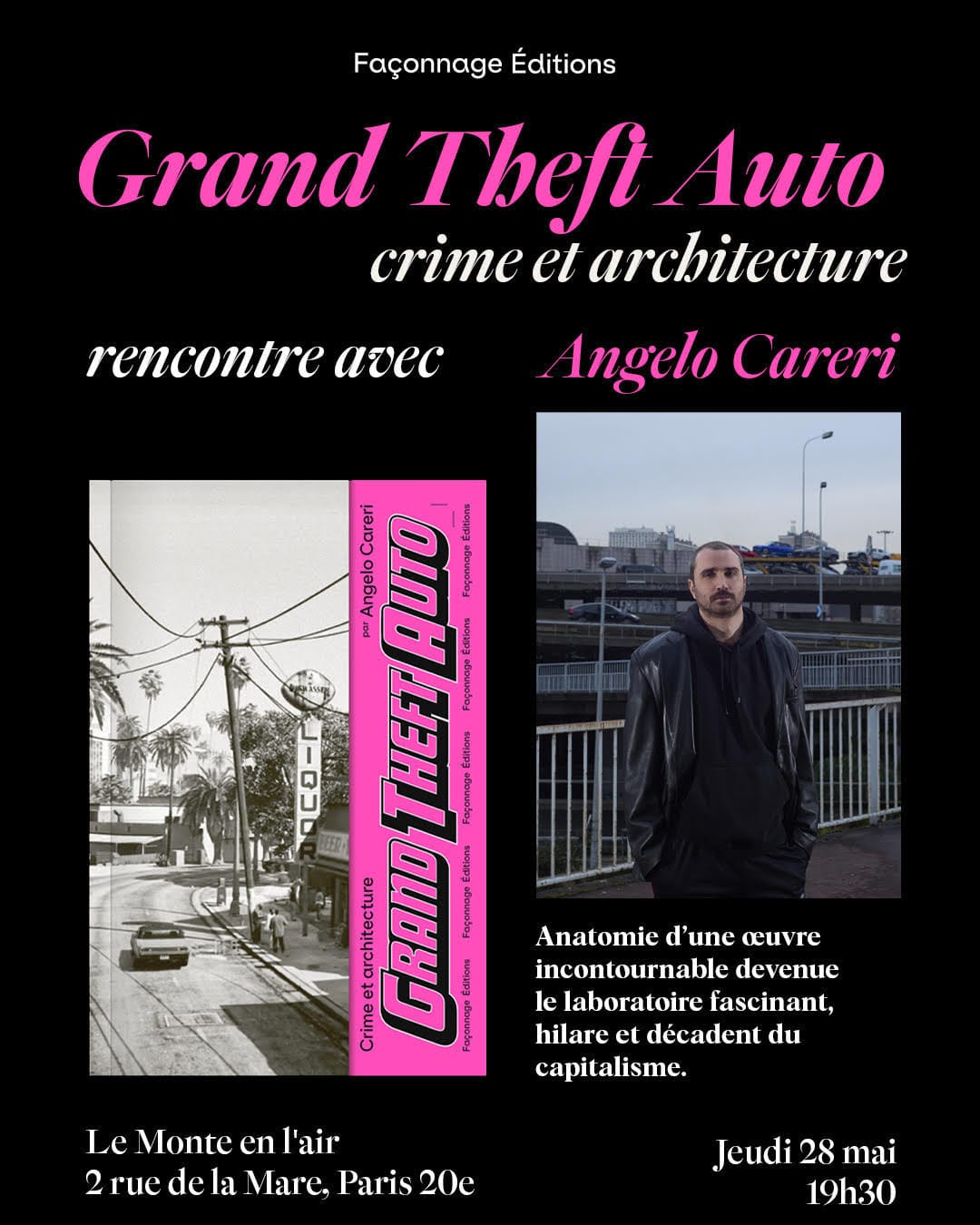
Angelo Careri is a critic, editor, teacher, and artist-researcher whose work connects game studies, contemporary art, and experimental forms of writing around videogames. He is editor-in-chief of the French videogame magazine Immersion, co-head of the Game Art studio at ENSAD Paris, and teaches game theory and experimental game design at ICAN. He is also an artist-researcher at ENSBA Lyon within the Unité de Recherche Numérique, where his research focuses on visual and narrative systems in videogames and new forms of interactive writing. His position is therefore particularly suited to a project of this kind: Grand Theft Auto – Crime et architecture is neither fan commentary nor conventional cultural journalism, but a sustained attempt to understand GTA as a critical instrument for reading contemporary urban life.