EVENT: ART BIT #6 BRINGS PLAYABLE INDIE GAMES AND GAME ART TO HOTEL ANTEROOM KYOTO (MAY 16–JULY 12 2026, KYOTO, JAPAN)
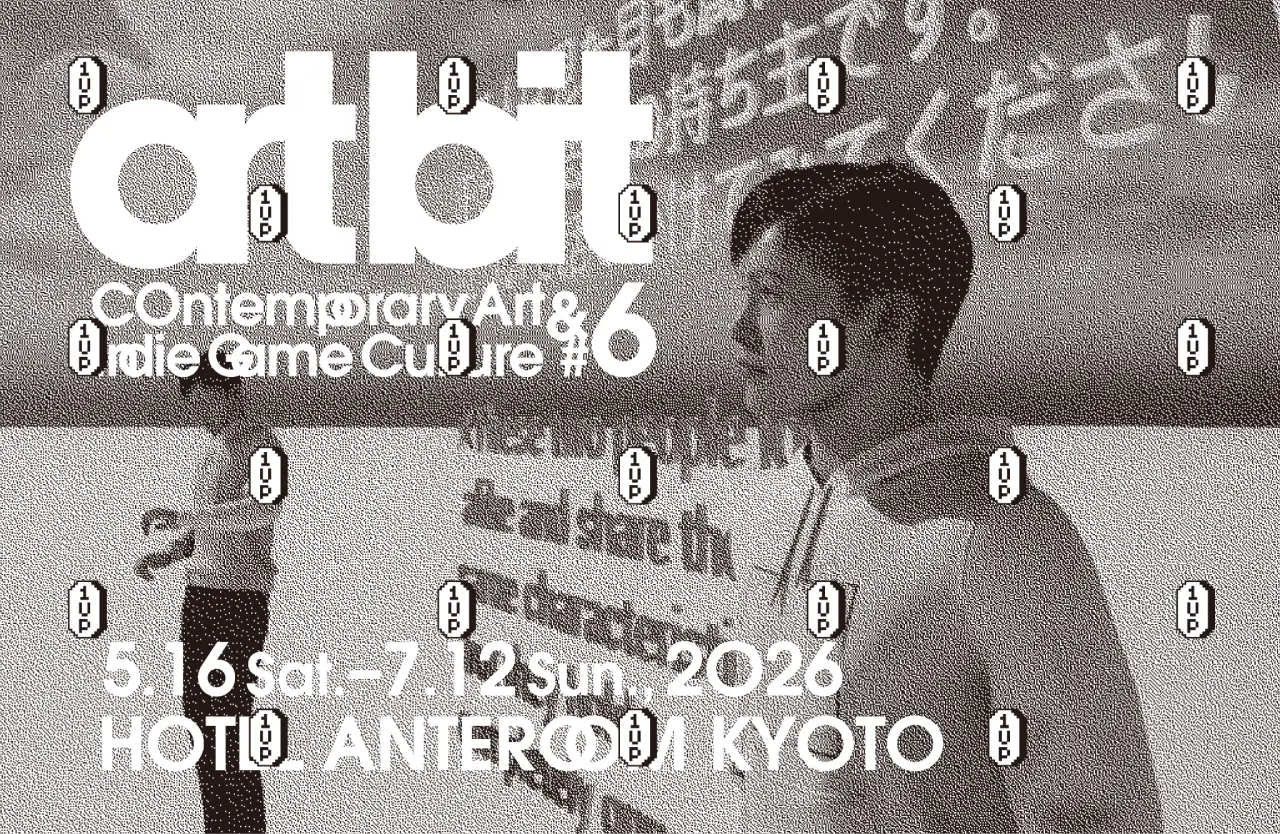
art bit – Contemporary Art & Indie Game Culture – #6: Game Playing Society runs from 16 May to 12 July 2026 at Hotel Anteroom Kyoto, Gallery 9.5, 7 Higashikujo Aketa-cho, Minami-ku, Kyoto. Opening hours are 10:00–20:00. Admission is free. A reception and workshop are planned for 16 May. The related international symposium will be held on 17 May, 13:00–18:30, at Ritsumeikan University, Kinugasa Campus, Soshikan Conference Room.
Hotel Anteroom Kyoto will host art bit – Contemporary Art & Indie Game Culture – #6: Game Playing Society from 16 May to 12 July 2026 at Gallery 9.5. The exhibition is free to enter and open daily from 10:00 to 20:00. This sixth edition of art bit focuses on the forms of social life produced, rehearsed, distorted, or repaired through games.
The premise is straightforward but fertile: what happens when play is treated not as escape from society, but as a way of modelling it? Game Playing Society brings together playable indie games and game-based artworks that examine crowds, labour, identity, restitution, automation, memory, and collective behaviour. The result is a compact exhibition about games as social diagrams. Not games as entertainment products waiting to be reviewed, but games as systems that organise attention, choice, conflict, and cooperation.
The project also has a specific local history. art bit grew out of the encounter between Hotel Anteroom Kyoto, a gallery-hotel devoted to contemporary art and culture, and BitSummit, Kyoto’s major independent game festival. BitSummit began in 2013 as a small industry event and has since become a key platform for Japanese and international independent game development. Hotel Anteroom’s Gallery 9.5, located between Kujo and Jujo, has meanwhile developed into a flexible exhibition space for art and cultural events connected to Kyoto’s creative networks.
The playable indie game selection includes HUMANITY by tha ltd. / Enhance, Coffee Talk by Toge Productions, CRAFTPIA by Pocketpair, SCHiM by Ewoud van der Werf / Extra Nice, and Relooted by Nyamakop. Each title gives the exhibition’s theme a different inflection. HUMANITY turns crowd direction into a strange choreography of obedience and salvation. Coffee Talk reframes service work as listening, intimacy, and social repair. SCHiM builds a platformer around shadows and attachment. CRAFTPIA compresses farming, hunting, building, automation, and survival into a sandbox of production. Relooted transforms museum restitution into an Africanfuturist heist game about recovering cultural objects from Western institutions.
The game-art section extends this framework beyond commercial game formats. The announced lineup includes Mélanie Courtinat’s INDULTO, Vincent Moulinet’s Daddy loves you too, Sakiko Fujishima’s Digital Persona – Two Voices ver. 2026, and Tomo Kihara’s What Plays You? – Game of Possible Lives. Kihara’s work is particularly apt for this edition: in its Mori Art Museum presentation for Roppongi Crossing 2025, the game used Japan’s 2020 national census data to generate plausible lives shaped by age, gender, income, work status, marital status, and nationality. It converts social probability into playable biography.
The exhibition also includes works that move across sculpture, craft, installation, and videogame interfaces, including Game Art Project “CÔGEIMU” by Kamiena, Ryosuke Shiomi, and Takashi Kaneko, and YANOKEN PROJECT’s The Great Adventure of SHIP’S CAT, developed from Kenji Yanobe’s sculptural universe. These works are especially relevant to art bit’s interest in the border between object and interaction: the game is no longer simply played on a device, but embedded within crafted forms, sculptural supports, and exhibition furniture.
The theoretical frame is ambitious: the exhibition links play, game engines, creator economies, mixed reality, and Joseph Beuys’s expanded notion of social sculpture. This could easily become inflated rhetoric, but the selection keeps the argument grounded. The strongest works in the programme ask how games distribute agency: who acts, who follows, who is measured, who is excluded, who gets to rewrite the rules. This is the most compelling aspect of art bit #6: it treats game art and independent games as adjacent practices rather than separate cultural categories.
A related international symposium, Thinking about Game Playing Society: From the interface between play and art, will take place on 17 May 2026 at Ritsumeikan University’s Kinugasa Campus, co-organised by ars●bit and the Ritsumeikan Center for Game Studies. The programme includes critics, curators, artists, and game creators, with sessions on international art-and-game exhibitions, current problems in game-based artistic practice, and the social imagination of play. Admission is free.
updated May 17: the original article erroneously mentioned Vincent Moncho instead of Vincent Moulinet. We apologise for the inconvenience.