GAME ART: ‘PLAY ITSELF’ OR LEO CASTAÑEDA AT THE WHITNEY BIENNIAL 2026

Leo Castañeda’s inclusion in Whitney Biennial 2026 constitutes an unambiguous institutional decision: videogames are no longer admitted to the museum as visual source material for gallery video. They are being exhibited as environments with rules, furniture, sound, and duration, formats that reorganize the conditions of spectatorship from within.
Running 8 March through 23 August 2026 and co-organized by curators Marcela Guerrero and Drew Sawyer, the Biennial frames its program through forms of relationality that explicitly encompass “technological affinities” and “infrastructural supports”. That language maps directly onto Castañeda’s practice, which is built as much around the labor and logistics of game production as it is around the image.
The exhibition centers on Camoflux: Levels & Bosses Video Game Installation Incendio Igapó (2023–26), an ultra-high-definition videogame presented with fiberglass furniture and vinyl, a pairing that refuses to treat the screen as a neutral aperture. Alongside it, Camoflux Incendio Igapó 360 (2026) presents 360-degree in-game video capture at 8K resolution, with custom software and an 8:10 runtime. The curatorial adjacency of these two works stages a productive distinction: one organized by interaction and feedback; the other by the camera logic of world-recording: machinima deployed not as documentation but as a competing ontological claim on the same spatial material.
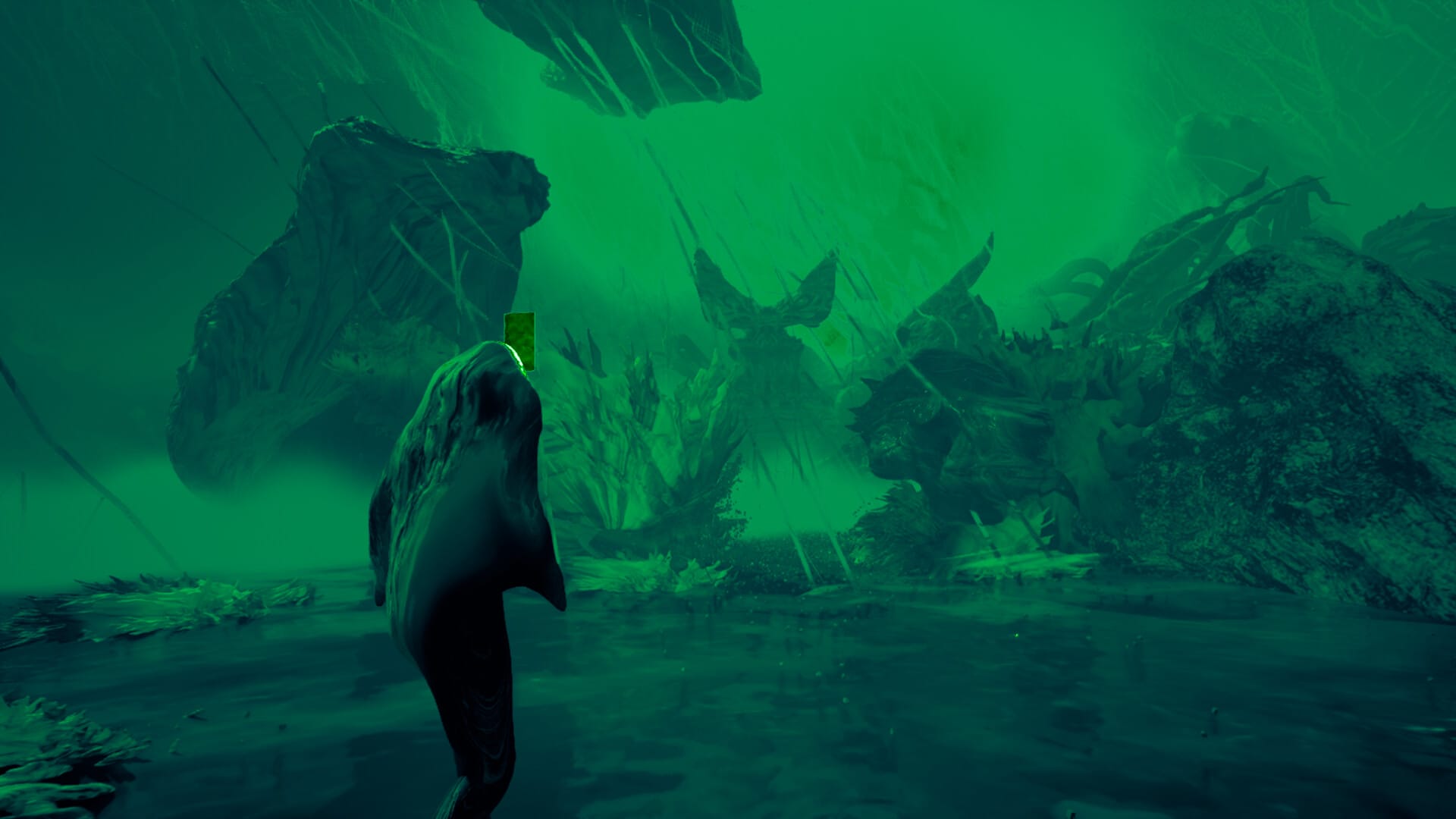
A third component extends the project beyond the gallery. Camoflux Recall Grotto (2025–26), commissioned for the Whitney’s artport platform and acquired into the collection, is a browser-based game in which the player, inhabiting the perspective of an organic drone, gathers water and sunlight to cultivate cyberflora across a primordial landscape, whereupon holographic memories surface from the blooming vegetation. Growth here operates not as cumulative progression but as feedback: the game’s tempo fluctuates with seedling density, slowing to meditative quiet or accelerating toward ecological overload.
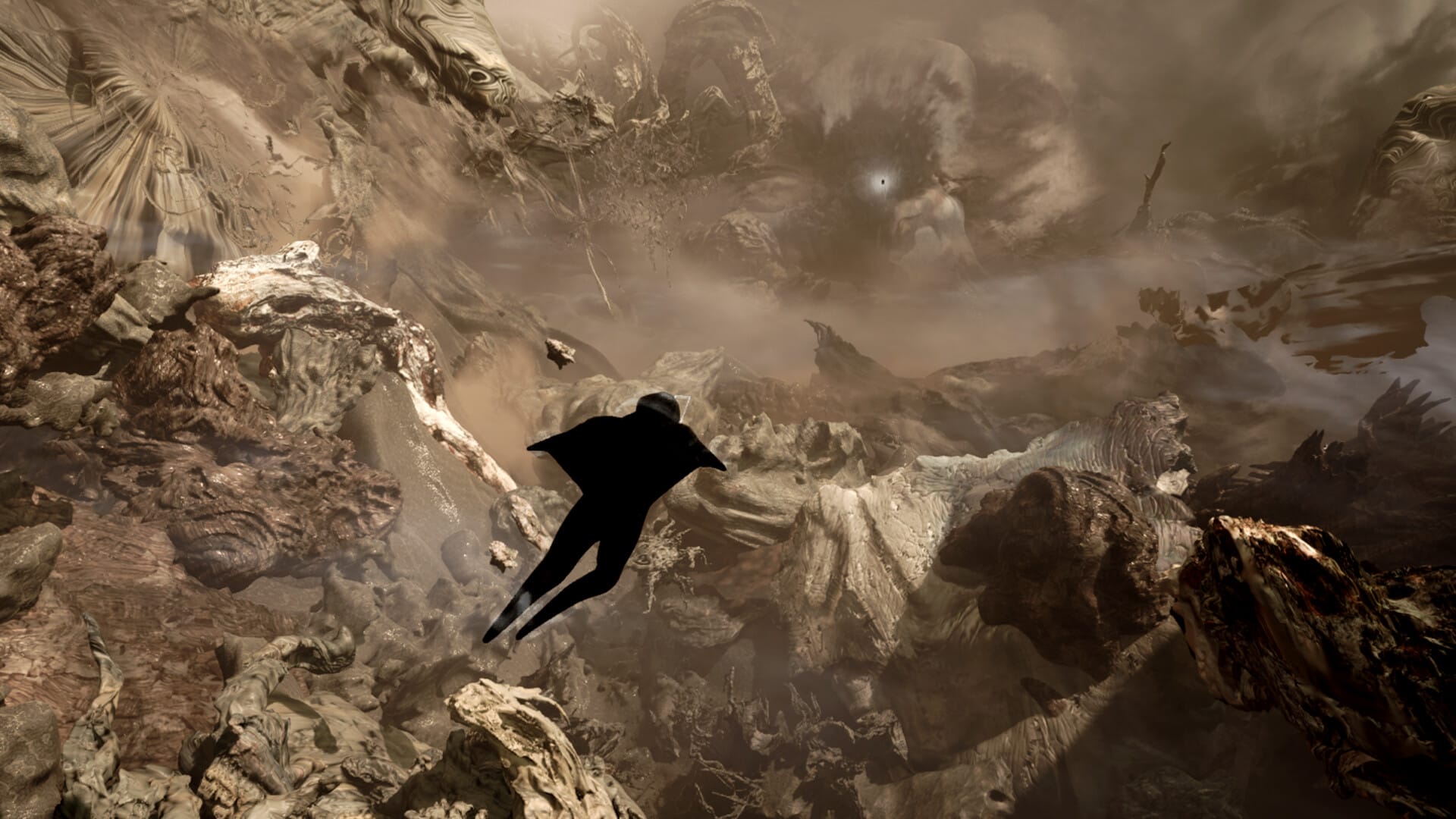
Castañeda (b. 1988, Cali, Colombia) describes the broader Camoflux project as a hand-painted, episodic exploration game concerned with environments where bodies, landscapes, and technology fuse, and where camouflage and environmental energy transform the terms of conflict. He frames this through a phrase of his own coinage — “third-person ontology” — by which the conventional third-person perspective becomes a vehicle for treating world-formation as philosophical proposition rather than genre convention. Whether one finds that rhetorical scaffolding persuasive or overdetermined, it clarifies what the Whitney is actually exhibiting: not a game seeking art’s legitimizing frame, but a project conceived from the outset to treat painting, 3D modeling, and game engine work as co-equal forms of making.
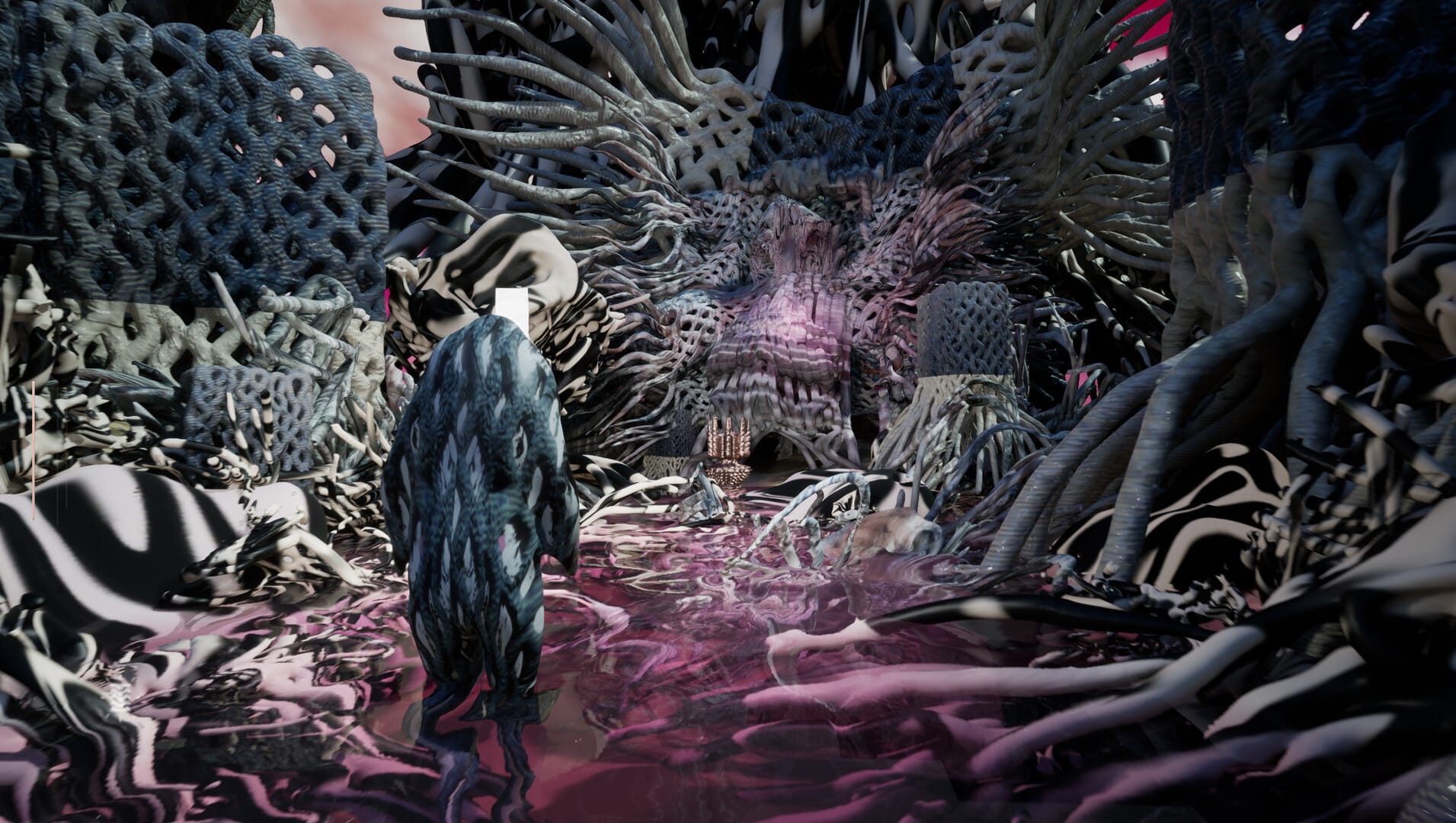
The simultaneous availability of Camoflux on Steam encodes a deliberate porosity between vernacular distribution and institutional context, a tension the Biennial installation is designed to activate and sustain, not resolve. That porosity has structural consequences. In the gallery, the work is mediated by staff, spatial choreography, and a relatively stable interpretive apparatus; on Steam, it enters a storefront economy governed by recommendation algorithms, discount rhythms, and review culture, where validation accrues through player reception and platform metrics rather than curatorial discourse. The temporal regimes diverge accordingly: museum display implies a fixed work with a date, edition, and stable object-status, while the storefront normalizes versioning (e.g., patches, optimizations, iterative updates) producing a mutable software object whose public modification record complicates standard conservation expectations. What the institution exhibits at a given moment may not be identical to what players download months later, even as the title remains constant. This double address — to the biennial visitor and to the platform user — does not resolve the incompatibility between those two publics. The work inhabits it, allowing distribution itself to become part of the piece’s meaning and afterlife.
This accounts for why the gallery presentation does not read as a screen placed in a room. The seating, surfaces, and spatial configuration function as part of the work’s address, shaping how visitors enter, linger, converse, and observe others at the controls. The installation is not a container for the game. It is the game’s extension into social space: a site of duration, hesitation, and collective attention that no distribution platform can supply.
Castañeda’s inclusion traces a longer arc through which videogame culture has migrated across Whitney Biennial editions, from hacked object to cinematic extraction to playable installation. Cory Arcangel’s Super Mario Clouds (2002), first exhibited at the Whitney Biennial 2004 and subsequently acquired by the museum, proposed the video game as code and display infrastructure, stripped of narrative content. Every visual and audio element was hacked away save the scrolling clouds, an act of reduction that aligned game culture simultaneously with the legacies of painterly abstraction and institutional critique.
Two decades on, Jacky Connolly’s Descent Into Hell (2021) — a four-channel, 34-minute video installation shown in Whitney Biennial 2022 — repositioned the game engine as a substrate for moving-image construction. Combining footage from Grand Theft Auto V with her own animations, Connolly produced a mode of machinima that collapsed the distinction between game capture and film grammar into a coherent video art practice, legible within cinema’s existing exhibition vocabulary: projection, montage, and multichannel installation. The work’s institutional assimilation ratified a dominant strategy, games accessed and validated through the alibi of the moving image.
Castañeda’s 2026 presence signals a further displacement. The Whitney is now exhibiting a game as spatial encounter — with rules, feedback, and the social friction of live play — while simultaneously commissioning a browser-based work for artport and situating both within the Biennial’s public identity. The alibi of capture is no longer required and the translation of gameplay into linear video is no longer the precondition of institutional access. What the museum is now hosting, directly and with apparent conviction, is play itself, together with all the logistical friction and social awkwardness that entails.
That is the operative argument embedded in Camoflux at the Whitney. The work does not arrive as an aesthetic object imported from game culture. It is an exhibition framework built through game development: an interface that recasts the Biennial visitor as participant, even when they are only watching someone else negotiate the controls.