GAME ART: LYNNE COHEN’S PHOTOGRAPHS OF VIDEOGAME-LIKE ENVIRONMENTS

Galerie Jacky Strenz, Frankfurt, 1 November 2025 – 24 January 2026.
Kurt-Schumacher-Str. 2, 60311 Frankfurt am Main, Germany
From 1 November 2025 to 24 January 2026, Galerie Jacky Strenz (Frankfurt) presents Play at Your Own, a focused exhibition of black-and-white photographs made between 1977 and 1991 by Lynne Cohen (1944–2014). The images depict deserted interiors – military and police training rooms, reconstructed aircraft cabins, shooting ranges, paintball facilities – photographed as found, without arranging props or directing any action.
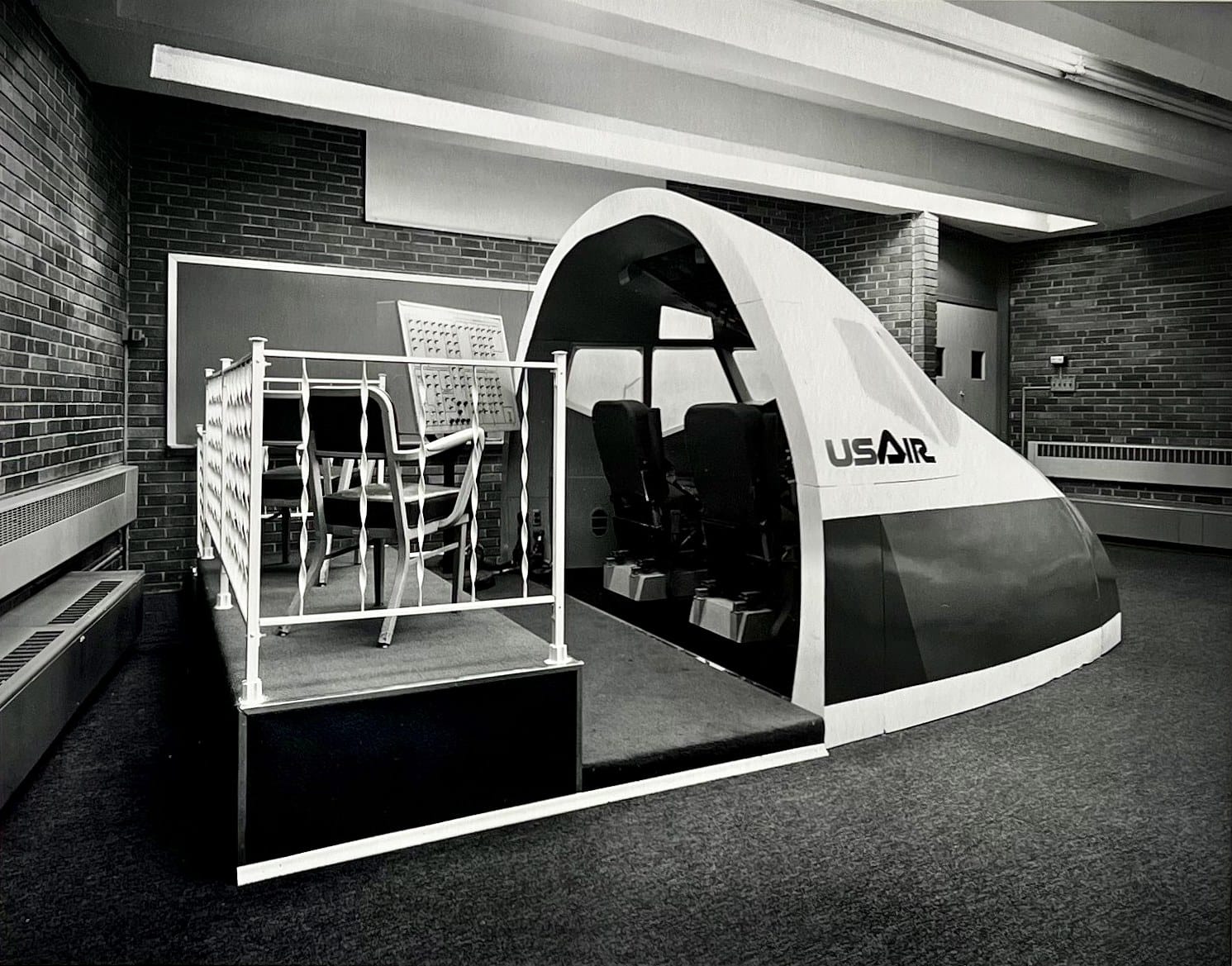
Many of Cohen’s institutional environments look uncannily like unpopulated game levels or testing maps, spaces built for rehearsal, calibration, and controlled behaviour rather than lived experience. The work is fully grounded in analogue photography (Cohen used large-format equipment and a methodical, frontal compositional language), yet its “visual regime” anticipates the pleasures of architectural exploration associated with digital play: the corridor that implies traversal, the room designed for procedural repetition, the prop-world that waits for bodies to arrive.
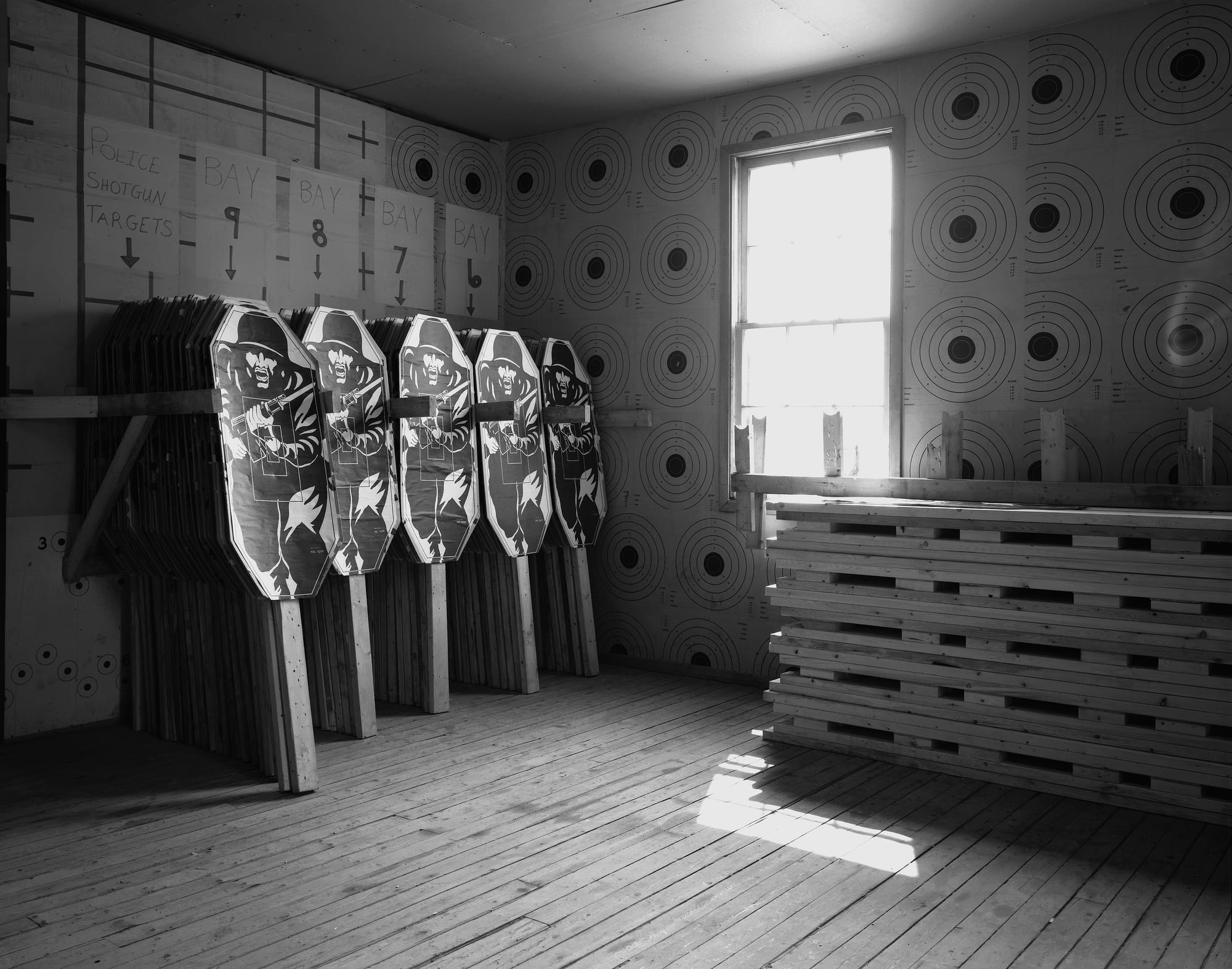
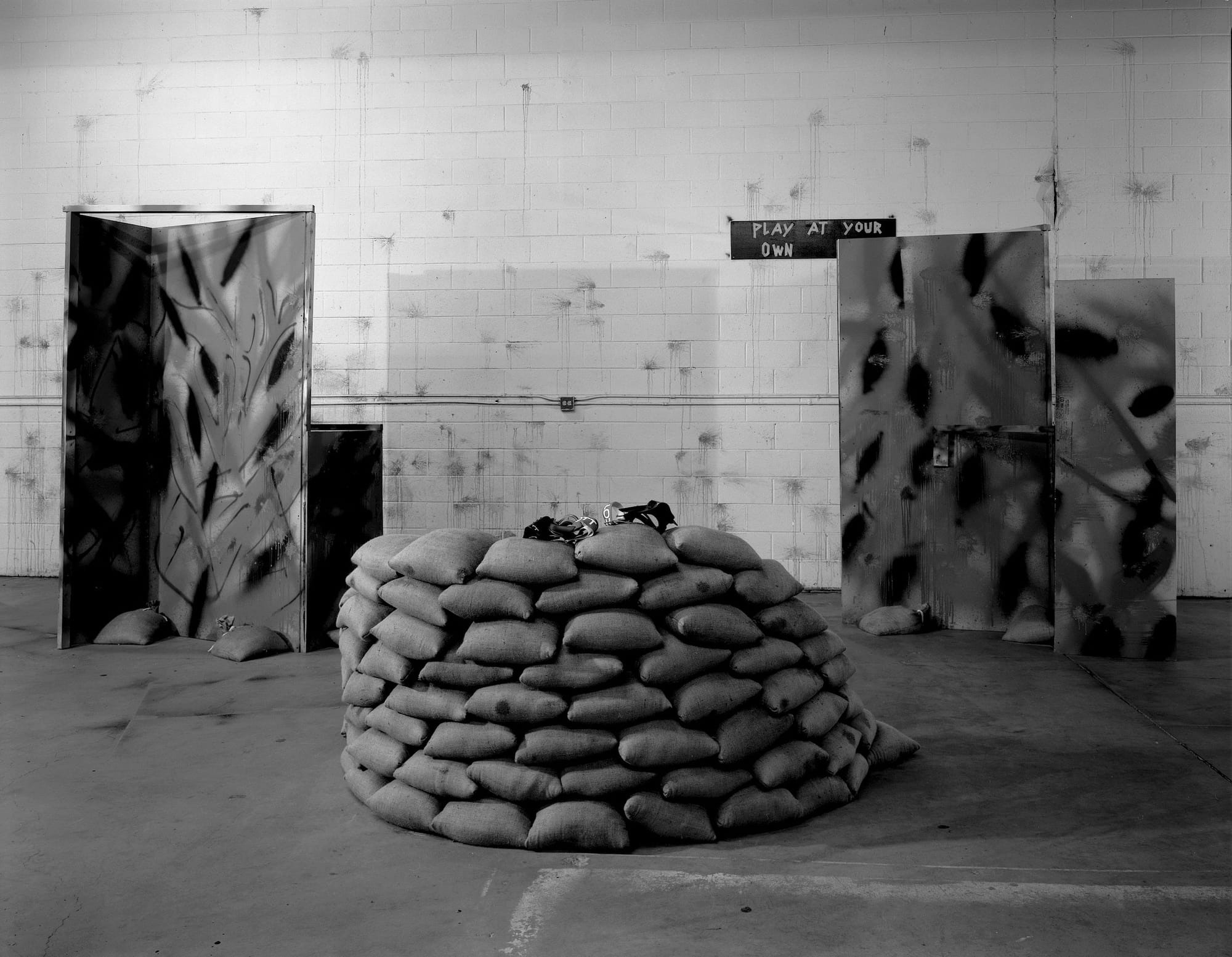
The title is drawn from a phrase visible within the work itself: “Play at Your Own” appears as wall text behind stacked bags of paintball equipment: an accidental caption that reads like a warning. In Strenz’s presentation, this stray signage captures the exhibition’s tonal pivot. The photographs can feel eerie with its clinical lighting, schematic layouts, and mannequins and targets standing in for people, yet Cohen’s dry comedic register is evident. In her photographs, institutional seriousness verges on the absurd.
That blend of menace and wit matters for a game-facing interpretation. Many videogame spaces such as tutorial rooms, firing ranges, safehouses, “sandbox” test areas, depend on the same affective contradiction. They promise fun while rehearsing discipline: your agency is real, but bounded; your freedom is purchased through constraints you are meant not to notice.
Cohen is a major figure in conceptual documentary photography, drawing on Walker Evans while also echoing the installation-minded “Environments” discourse of the 1960s and 1970s. Her trajectory moves from North American middle-class interiors and semi-public social sites (clubs, banquet halls, hotel lobbies, offices) to spaces where power is trained and reproduced: laboratories, classrooms, police and military facilities, shooting ranges.
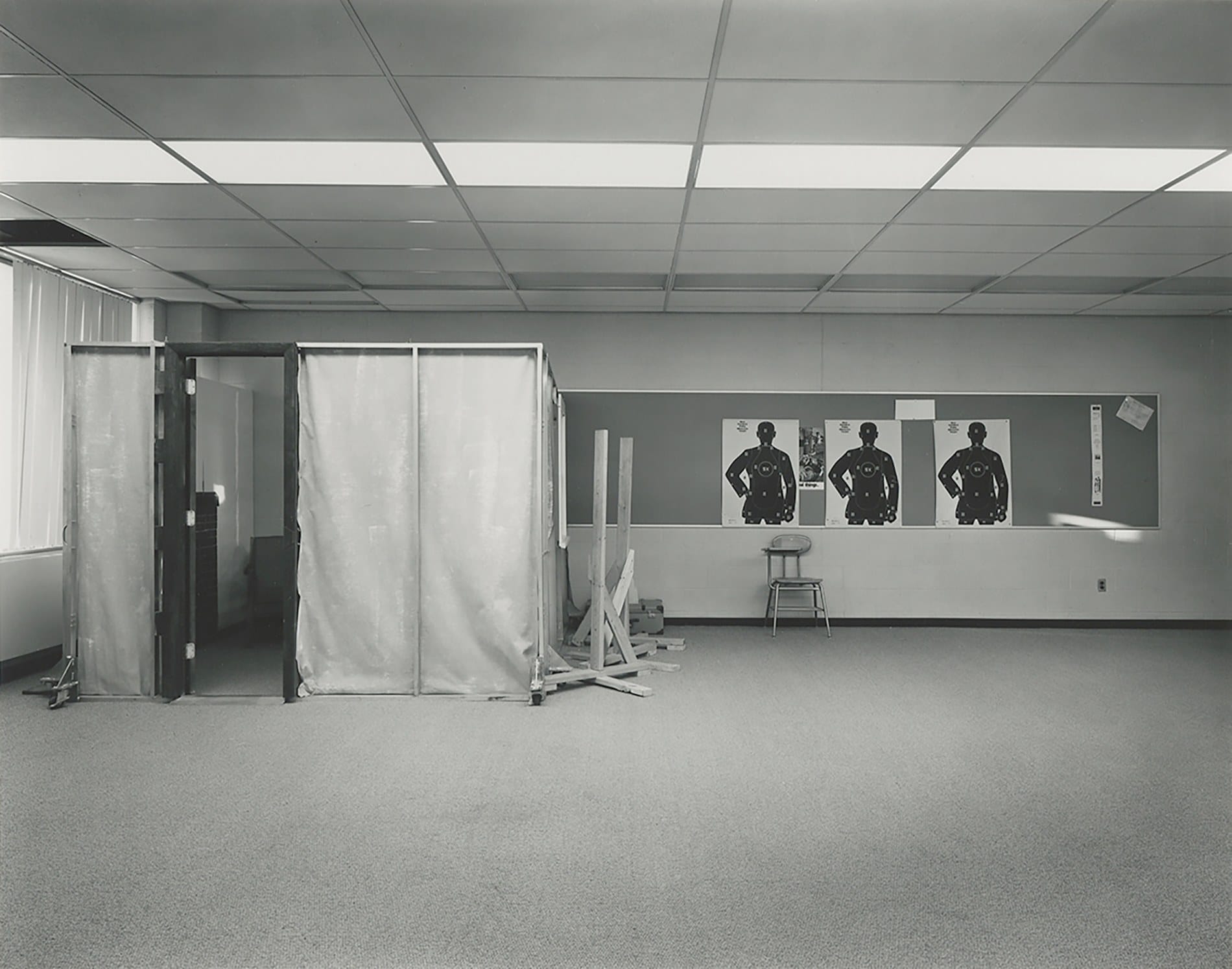
It is important to stress that Cohen does not photograph these rooms as “architecture” in the celebratory sense. Instead, they are captured as operational sets: built to produce compliance, competence, and predictable behaviour. Cohen herself, speaking in a seminal Afterall interview, links her pull towards such interiors to a strangeness embedded in the familiar, where banal sites can feel disturbing precisely because they sit too close to everyday life.
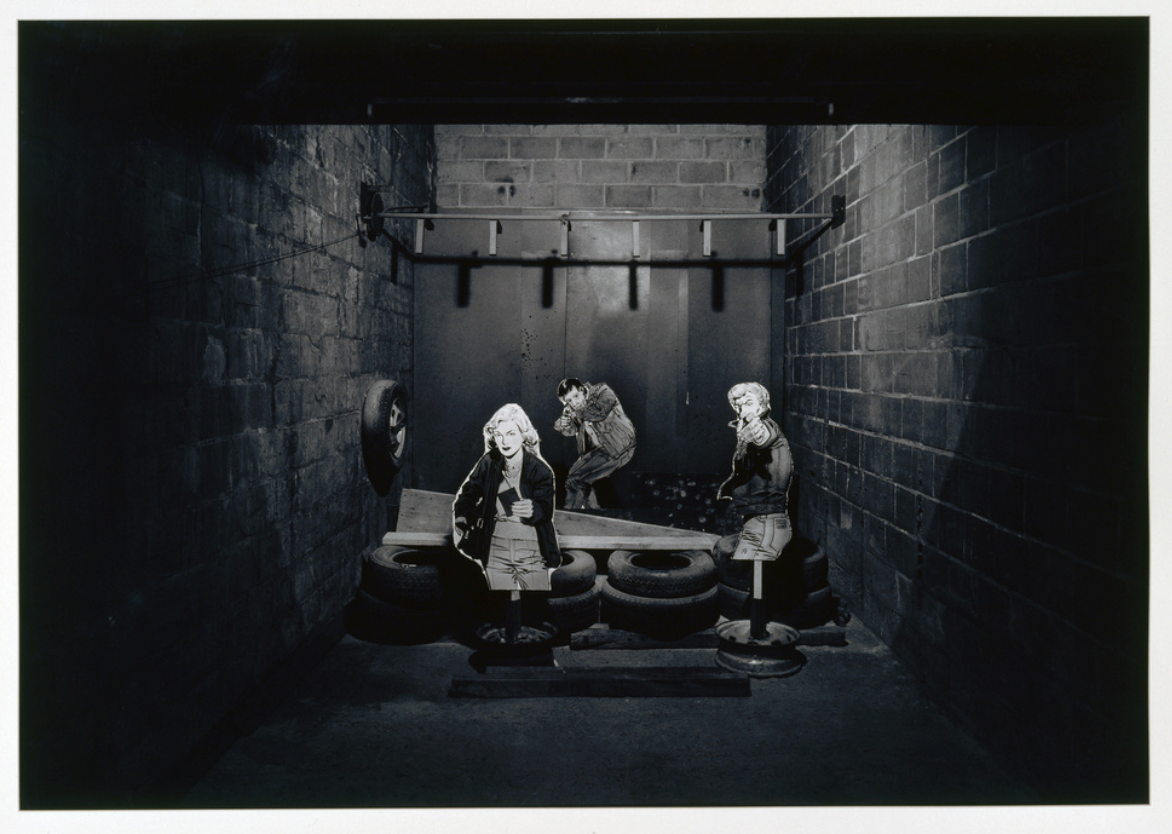
If video game teach us anything, it is that architecture is never neutral. Cohen’s images make a similar point without digital rhetoric: the room already scripts the body. It tells you where to stand, what to aim at, how to move, which actions count.
It would be reductive, or perhaps inaccurate, to claim Cohen “predicts” videogames. The more accurate claim is structural: she documents a world of simulation infrastructures: training environments that model reality, compress risk into controlled drills, and replace social contingency with rehearsed procedure. That is close to what level design does, especially in zones intended for practice: spaces that look real enough to naturalise behaviour, to instill a specific forma mentis, but artificial enough to be repeated.
All images courtesy of Galerie Jacky Strenz