GAME ART: JOEY TORO’S ANIMATED PAINTINGS

‘I am creating digital resting places in order to reorient the way in which we allocate our attention to digital media. I strongly believe the current “attention economy” has created a void where slow paced and methodical engagement with the digital media used to exist.’ (Joey Toro)
The most compelling aspect of Joey Toro's recent work is its refusal of speed. He uses Unreal Engine to produce houses, courtyards, gardens, and other compact environments that ask for patience.
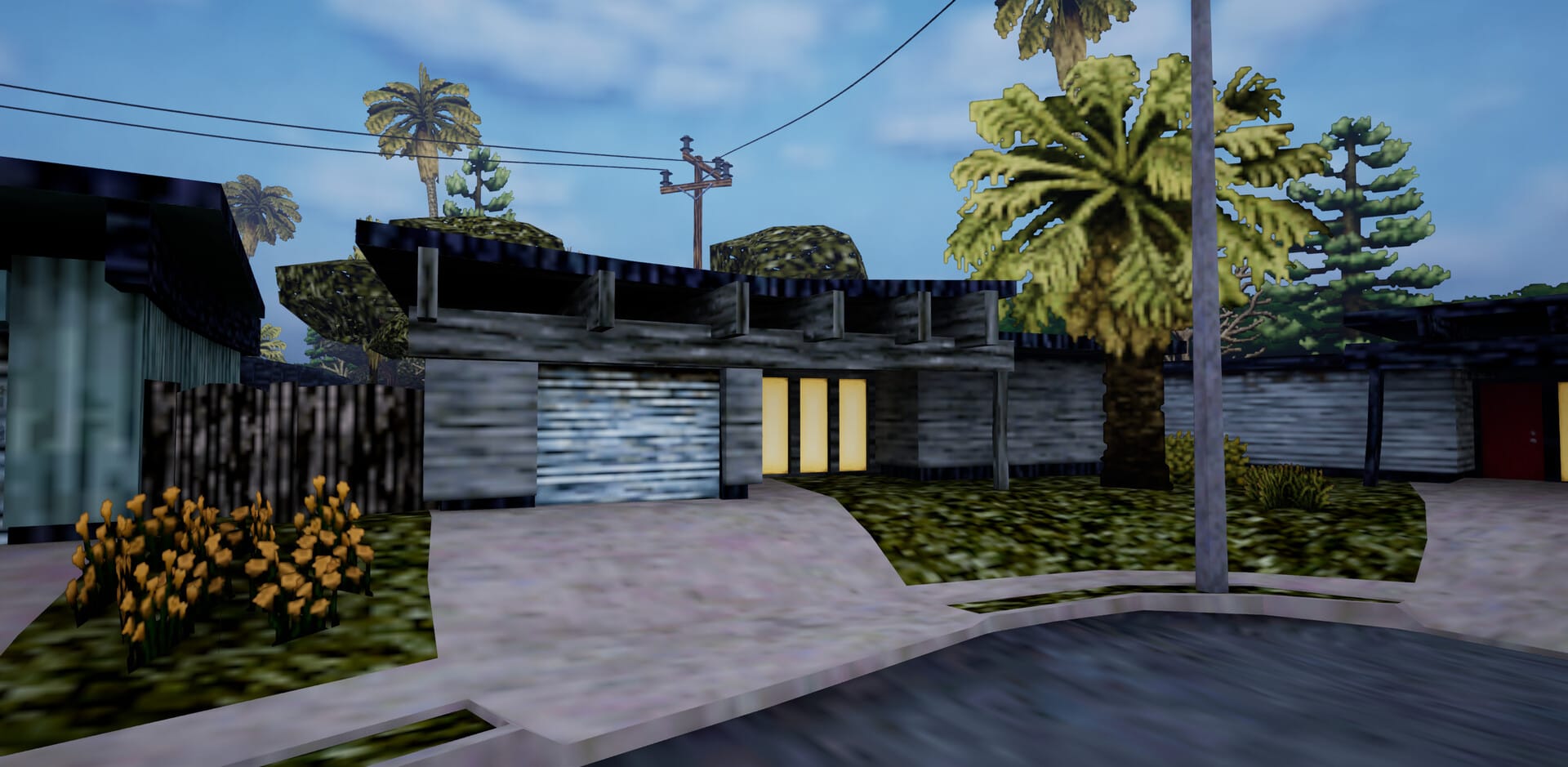
Toro, an artist from San Jose, California received a BFA from San Jose State University and completed an MFA at San Francisco State University. Three of his machinima works, Walkthrough (2024), Dreamhouse (2025), and Media Landscape (2025), were featured in the SFSU Autonomous Zones exhibition (April 25 – May 15, 2025), curated by Sharon E. Bliss.
Toro recontextualises the aesthetics of retro-digital environments, circa 2000, which is a better description than the familiar rhetoric of innovation that often clings to engine-based art. He employs limited colour palettes, blurry textures, angular structures, and objects that remain recognisable while never quite shedding their estrangement.
Earlier works involved tearing canvases into strips and rebuilding them as sculptural objects; later, he began photographing painted textures and mapping them onto virtual environments. This transition explains why the engine feels so specific in his practice: Unreal continues his concerns as a painter by other means. Paint becomes texture and texture becomes wall, hedge, corridor, or façade. The work therefore remains studio-based in sensibility even when it opens into navigable 3D space.
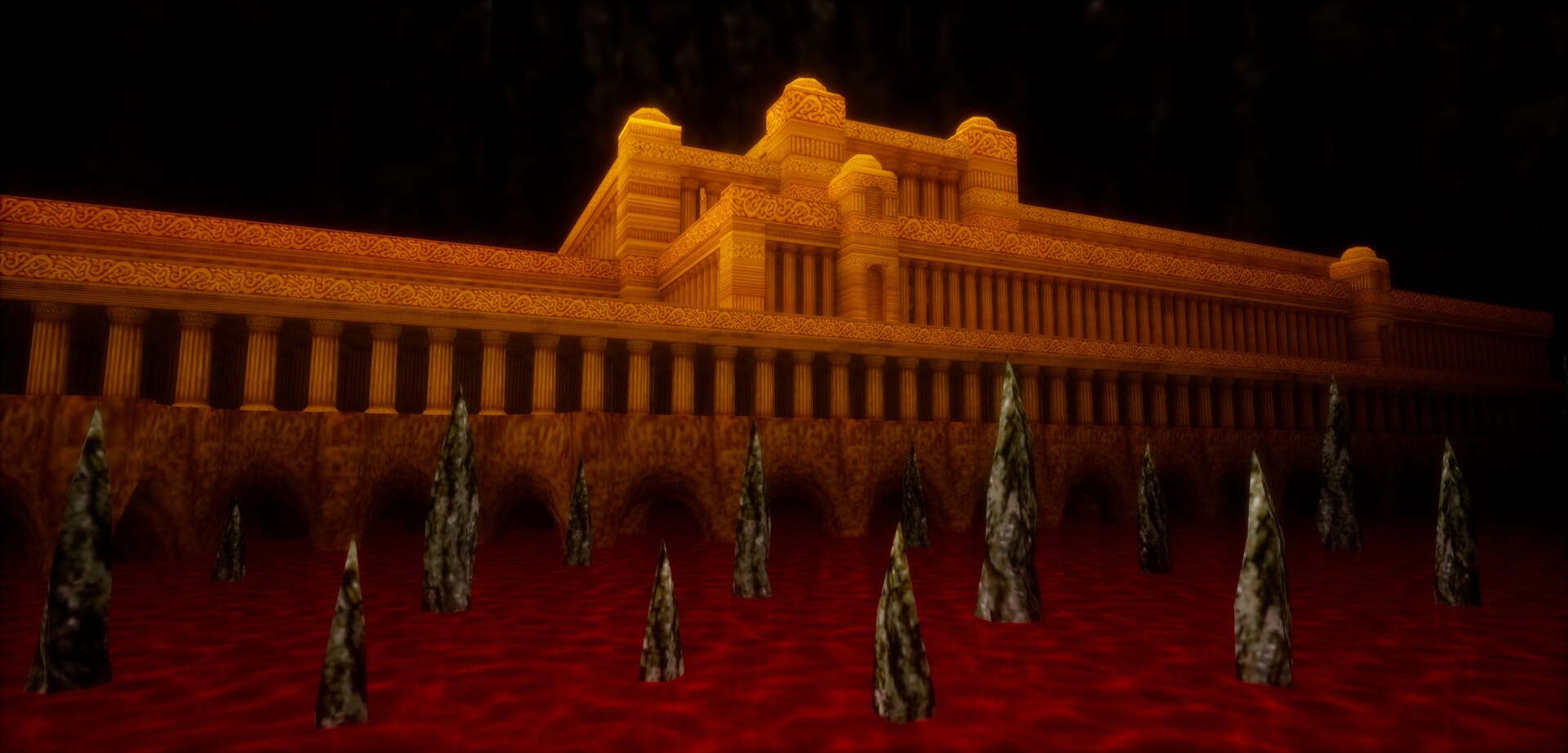
Take Low Poly Pandemonium. This work translates John Martin’s infernal architecture into the visual syntax of circa 2000 digital aesthetics. Toro retains Martin’s monumental symmetry, harsh theatrical illumination, and overwhelming scale, then rebuilds them through blunt geometry, tiled ornament, and a restricted palette of gold, black, and blood-red. The image draws much of its force from that tension between splendour and reduction: the palace appears ornate and imperial, yet its structure remains emphatically lo-fi, so that nineteenth-century apocalypse passes through the memory of retro game graphics and returns as something closer to a hostile digital environment.
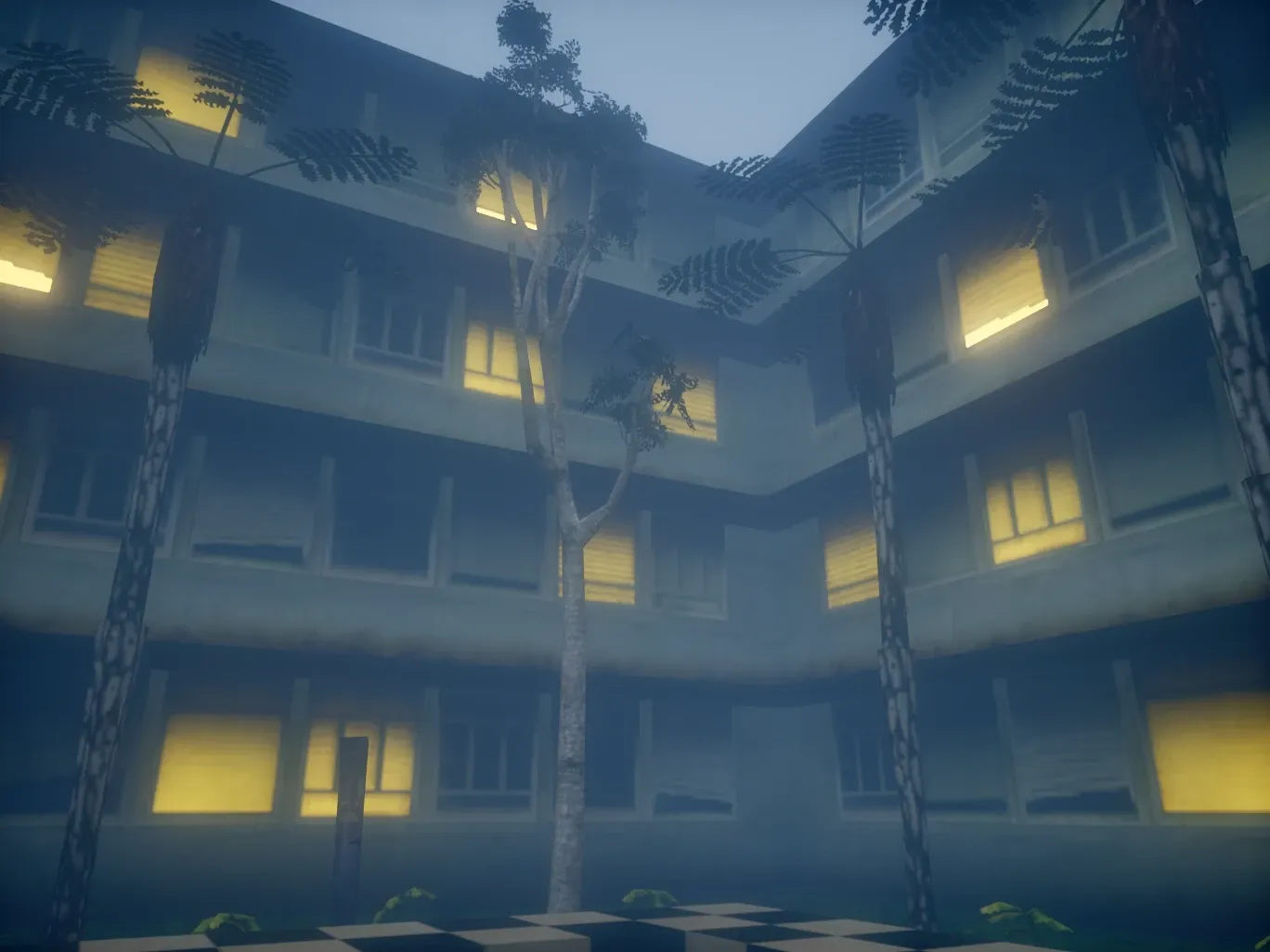
In Corner (2026), Toro transforms a modest courtyard encountered in a video game into a chamber of suspended unease. The upward viewpoint, the blue haze, and the soft yellow glow behind the windows recast ordinary domestic architecture as a site of memory rather than habitation, as though the space were being recalled imperfectly rather than observed directly. The checkerboard floor at the image’s lower edge introduces a faint ludic artifice, while the spindly trees break the rigid geometry of the building and give the enclosure a fragile, almost spectral vertical rhythm. What makes the work compelling is its control of atmosphere: Unreal Engine is used here to reconstruct the afterimage of a place, charged with familiarity, vacancy, and a mild but persistent psychic tension.
Although Unreal dominates the recent portfolio, Toro’s practice moves freely across engines, and that mobility says something important about his method. Several works are made in Hammer — a level-design tool developed by Valve — including Chercher, Bedroom, and Mainroom, the last two forming part of a larger project titled Silent Hill in Source Engine. BR_ extends the same approach. And yet, all tools are used toward the same end: the construction of atmospheres in which memory is inseparable from mediation. Each engine carries its own visual history, and Toro works through those histories rather than smoothing them away.