EVENT: THE TRANSPARENT FACTORY (OCTOBER 2 2026– JANUARY 10 2027, MARTORELL, CATALONIA, SPAIN)
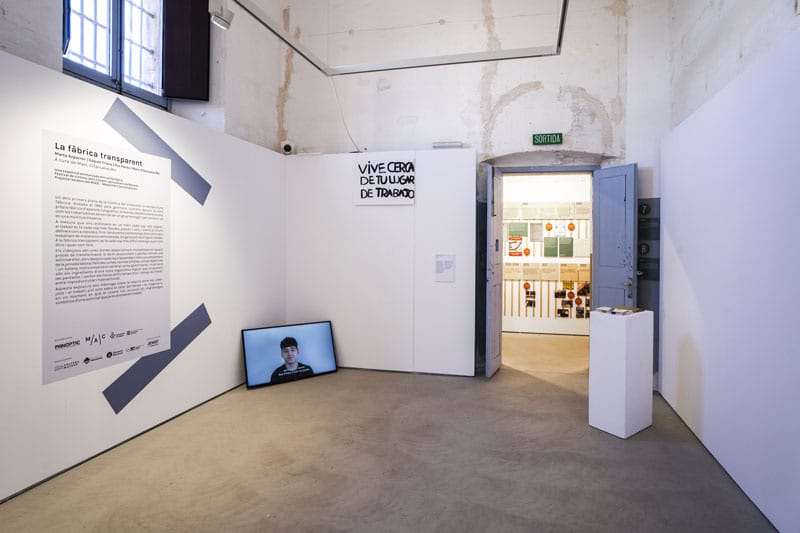
The transparent factory / La fàbrica transparent
Curator: Marc Villanueva Mir
Artists: Marta Azparren, Alán Carrasco, Raquel Friera, Roc Parés,
Mónica Rikić, Total Refusal, Ezequiel Soriano, Festival Panòptic
Venue: Muxart, Espai d’Art i Creació Contemporanis, Plaça de les Hores, Martorell, Catalonia
Dates: 2 October 2026–10 January 2027
Admission: Free
Organized by: Festival Panòptic and M|A|C Mataró Art Contemporani, within the traveling exhibitions program of the Generalitat de Catalunya.
At Muxart in Martorell, an exhibition curated by Marc Villanueva Mir examines the changing relationship between productive labor and leisure. Its consideration of videogames extends a history of industrial representation that begins with the Lumière brothers and reaches the programmed routines of contemporary virtual worlds.
In 1895, the Lumière brothers positioned a camera outside their photographic factory in Lyon and recorded employees leaving the building. The resulting film, La Sortie de l’usine Lumière à Lyon, established an enduring image of industrial modernity: workers crossing a threshold, momentarily released from the discipline of the workplace. A century later, Harun Farocki returned to that image in Workers Leaving the Factory (1995), examining how cinema had represented the relationship between labor and visibility.
The opening premise of The transparent factory, an exhibition currently presented at Muxart in Martorell, is that the threshold has become increasingly difficult to locate. Contemporary employment follows people into their homes through portable devices and digital platforms. Activities conventionally classified as leisure may also generate economic value for companies. Videogames occupy a particularly ambiguous position within this transformation. Players voluntarily submit to timed assignments, repetitive tasks and elaborate reward systems. The completion of one objective generally produces another.
Curated by Barcelona-based artist and dramaturg Marc Villanueva Mir, the exhibition brings together eight artistic positions, including works by Marta Azparren, Alán Carrasco, Roc Parés, Mónica Rikić, Ezequiel Soriano, Raquel Friera, the Austrian collective Total Refusal and Villanueva himself. Its media range from experimental video to electronically controlled sculpture and interactive games. The works differ substantially in their methods and political implications, yet share an interest in the organization of activity: how actions are prescribed, repeated, observed and assigned value.
The exhibition’s title comes from an unusually pertinent source. In his 2007 doctoral dissertation, La fábrica transparente: Arte y trabajo en la época postfordista, Catalan artist and researcher Octavi Comeron (1965–2013) examined Volkswagen’s celebrated glass-walled factory in Dresden, which opened in 2001 to assemble the Phaeton luxury automobile. The Dresden facility presented manufacturing as an experience for visitors. Its glass architecture allowed spectators to watch employees assembling vehicles in a carefully designed environment of wooden floors and controlled lighting. The spectacle depended, however, on an extensive production network that remained outside the building. Many components arrived from other factories, where industrial labor continued under considerably different conditions.
Comeron understood this arrangement as a problem of representation. Transparency did not guarantee comprehensive knowledge of production. The company determined which activities visitors could observe, and the carefully selected image helped construct the product’s commercial identity.
The exhibition develops that argument within the digital economy. Contemporary games offer elaborate simulations of workplaces and social systems while concealing many of the technical and economic arrangements responsible for their construction. Their visibility is selective. A player may inspect an extraordinarily detailed virtual city without acquiring any knowledge of the labor required to build it.
The labor of the non-player character
The most direct connection between videogames and labor appears in Total Refusal’s Hardly Working (2021), presented here as a four-channel installation. The Austrian collective, founded in 2018, has developed an extensive body of work through the appropriation and modification of commercial games. Its members use virtual environments to investigate the ideological assumptions embedded in mainstream entertainment.
Total Refusal, Hardly Working, 2021
Hardly Working examines the lives of four non-player characters in Rockstar Games’ Red Dead Redemption 2. A laundress washes clothes, a stablehand maintains the animals, a street sweeper cleans public space and a carpenter repeats his assigned activities. These figures ordinarily provide background detail to the player’s adventures. Their simulated labor establishes the apparent continuity of a functioning social world. Total Refusal reverses the usual hierarchy of attention. The protagonists of the western disappear from consideration, and workers programmed to remain inconspicuous occupy the image. Their actions continue without measurable development. A completed task produces no meaningful alteration in their circumstances.
The collective’s observational approach resembles an ethnographic study of computational behavior. Small inconsistencies in animation become especially revealing. A movement fails to achieve its intended purpose, or the prescribed activity continues beyond the point at which its practical justification has disappeared. Such moments expose the distinction between labor as a meaningful social activity and labor as an endlessly reproducible performance.
The installation also raises a problem concerning spectatorship. These characters exist for the player, even when that player has no reason to watch them. Their labor sustains the credibility of an environment organized around somebody else’s freedom. The four-channel configuration is particularly appropriate to this investigation. Separate activities can continue simultaneously, with no prospect of completion. Total Refusal subsequently developed a single-channel film version of Hardly Working in 2022, but the earlier installation retains the spatial coexistence of its workers.
Another contribution introduces a necessary qualification. Alán Carrasco’s Índices de incidencia (2019, revised in 2025) addresses actual workplace fatalities in Spain. The installation combines official documents concerning occupational deaths with an electronic alarm and countdown mechanism. The timing of the signal derives from statistical information about fatalities recorded in 2024. Carrasco’s artistic research frequently examines official narratives, historical omissions and the political organization of memory. Here, administrative language transforms individual deaths into a statistical category. The alarm reintroduces an uncomfortable temporal dimension to information that might otherwise remain confined to institutional records.
Placed in proximity to Hardly Working, Carrasco’s installation makes an important distinction visible. Digital characters can repeat their routines indefinitely without suffering physical injury. Human workers cannot. An analysis of labor through videogame simulation must account for the difference between the programmed representation of exploitation and its material consequences.
The body as controller
Roc Parés, Marc Villanueva, Laboratori proletari, 2024. Source: Roc Parés
Roc Parés and Marc Villanueva’s Laboratori proletari (2024) approaches the relationship between gaming and work through physical interaction.
The installation uses a custom videogame, a metal workbench and an expanded interface incorporating Makey Makey technology and a Kinect sensor. Visitors operate the apparatus while attempting to control a character compelled to run in a single direction. Their bodily movements become inputs for a system that monitors and projects their activity. The reference to Charlie Chaplin’s Modern Times (1936) is explicit. In that film, Chaplin’s industrial worker becomes unable to separate his gestures from the repetitive movements demanded by the assembly line. Parés and Villanueva transfer this situation to an interactive environment in which the spectator must perform physical actions according to a computationally imposed rhythm.
Parés, an established figure in interactive media art and a longtime researcher at Universitat Pompeu Fabra, has consistently examined the social and aesthetic implications of technological interfaces. His contribution also provides a useful correction to the apparent immateriality of digital entertainment. Hardware occupies space. Bodies become tired. Interaction requires physical effort, even when its visible consequences appear only on a screen.
Villanueva’s own Quan sortim de l'institut s’encenen els llums (2024), a thirteen-minute video developed from an earlier educational residency, introduces another perspective. Students from Barcelona’s Institut Maria Espinalt describe their experiences of gaming after school. Their accounts reveal a vocabulary of assignments, progression and rewards that resembles descriptions of employment. The work is especially interesting for the way it connects institutional forms of learning with the procedural organization of videogames. Games frequently reward persistence through scores or accumulated resources. Educational systems also measure progress through recognizable achievements. The comparison invites scrutiny of how contemporary culture organizes motivation, although voluntary play and compulsory schooling remain distinct activities.
The exhibition’s most incisive contributions preserve this distinction. The resemblance between game mechanics and managerial systems is analytically productive, but resemblance alone does not establish exploitation. Players can derive satisfaction from repetition or deliberately refuse a game’s preferred objectives. Such possibilities complicate any account that reduces gaming to unpaid employment.
Factory memory and the politics of time
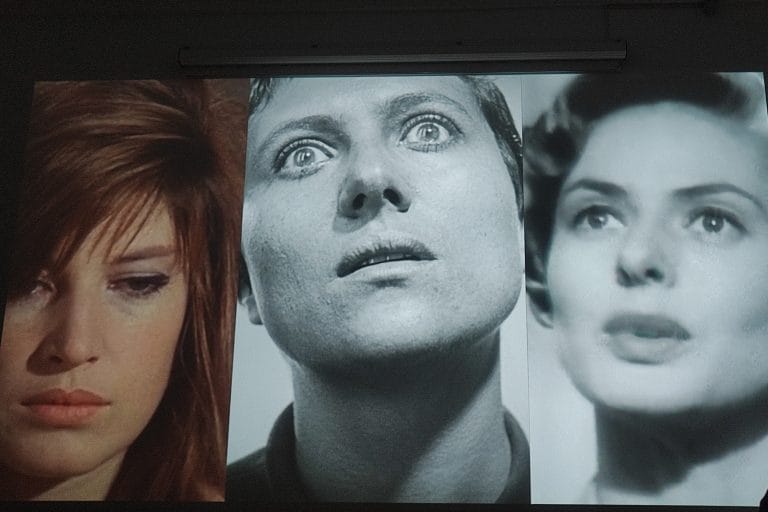
Marta Azparren’s Diari de fàbrica (2020–2025) provides the exhibition with a substantial historical dimension.
Azparren works across experimental cinema (consider, for instance, her seminal 2009 machinima), drawing and live audiovisual performance. Her practice has long examined the status of images and the relationship between artistic activity and labor. This project explicitly engages with Simone Weil’s writings about factory employment during the 1930s.
Working with testimonies from former textile workers recorded in Naples and Tunis, Azparren reproduces gestures associated with industrial production. Their repetition creates marks on a metal surface, turning remembered bodily movements into material traces. The installation incorporates video, sound, modified gloves and a punch clock. These objects resist the abstraction through which industrial history can become a generalized account of production. Labor acquires a duration that must be recorded and a physical form that persists after the activity ends.
Azparren’s treatment of repetition also complicates the relationship between artistic practice and industrial work. The artist performs actions derived from other people’s employment, while the resulting installation enters the contemporary art system. The gesture changes institutional context without entirely escaping the economic structures associated with its original function.
At Martorell, the project will acquire a further local dimension through an audiovisual performance developed with former industrial workers from the municipality. This capacity to incorporate additional testimonies makes Diari de fàbrica particularly appropriate to a traveling exhibition.
Raquel Friera introduces an alternative relationship to productive time in Sobre perder el tiempo (2007). The artist hired an actor to spend eight hours performing activities understood by Barcelona residents as wasting time. The duration corresponds to a conventional working day, and the resulting video includes a clock indicating the remaining time. Visitors are invited to sit on cushions and observe the performance. Remaining for the entire work would require an unusually extensive commitment. Its duration becomes part of its argument, rather than a technical obstacle to overcome.
Friera’s larger practice investigates temporal discipline and the social regulation of everyday life. With philosopher Javier Bassas, she also developed the Instituto del Tiempo Suspendido, a fictional institution concerned with alternatives to contemporary regimes of acceleration and productivity.
Her earlier work remains especially pertinent to the exhibition because the actor’s apparently unproductive behavior constitutes paid employment. The refusal of productivity becomes a task, complete with a prescribed duration. Friera exposes how easily an activity intended to escape economic measurement can be incorporated into it.
Automated creativity
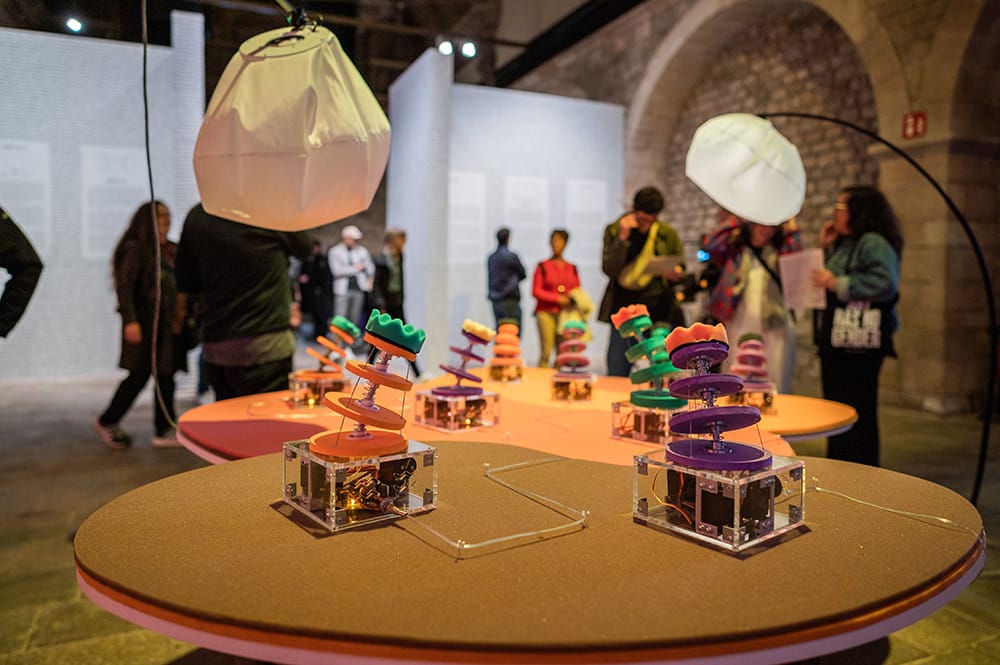
Mónica Rikić’s Creació (Hipertèlia) (2023) shifts the discussion toward the automation of intellectual activity.
Rikić, a Barcelona-based electronic artist working with handmade devices and creative coding, constructs systems whose behavior raises questions about autonomy and machine intelligence. In Creació (Hipertèlia), a small apparatus continuously generates ideas through a programmed procedure. Lights illuminate and a thermal printer produces a record whenever the mechanism reaches an apparent result. Its physical construction remains visible, yet its activity resists any simple distinction between creativity and mechanical execution. The accumulated printouts suggest an economy in which the production of ideas has become an obligation, regardless of their eventual value.
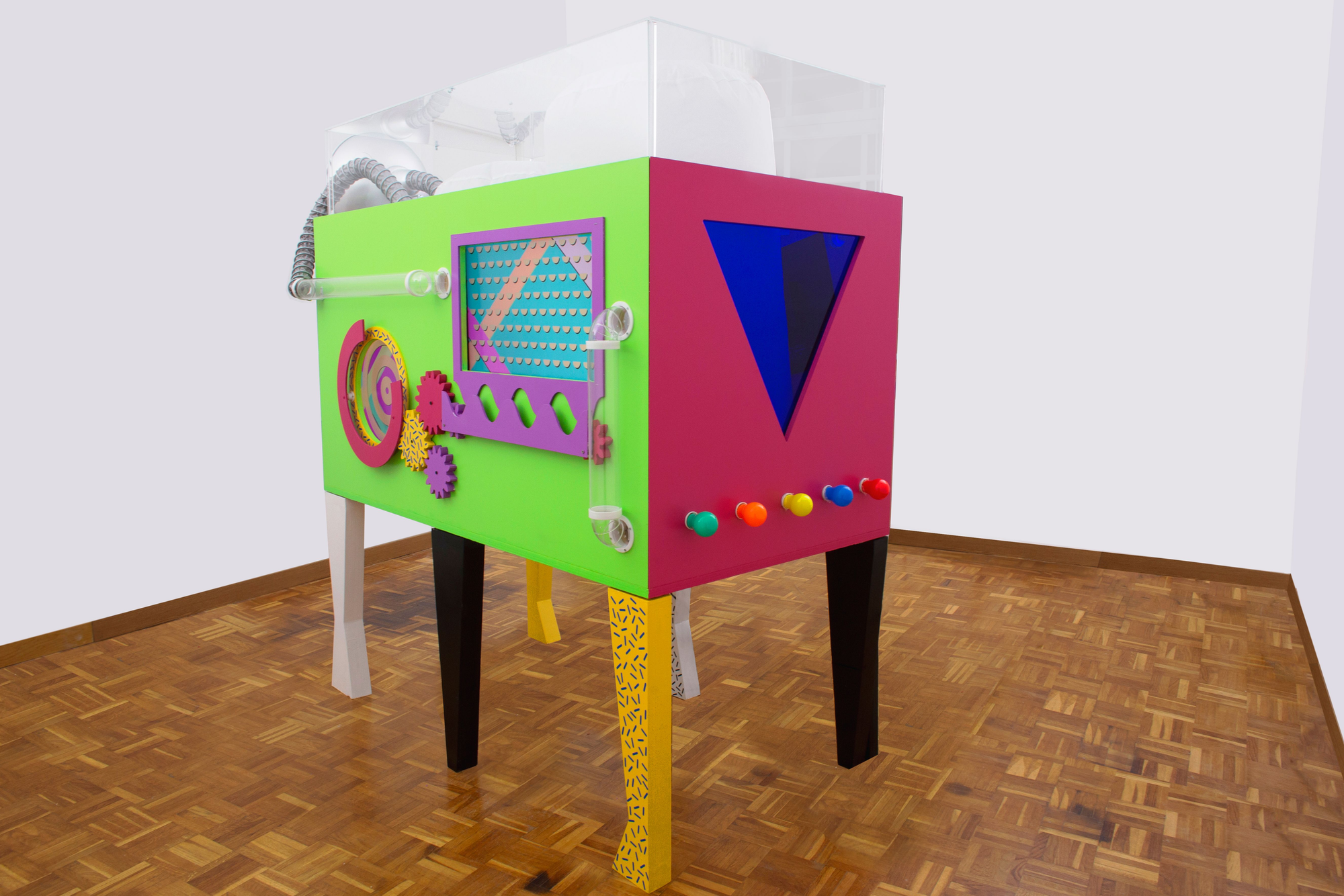
The work acquires additional resonance in relation to Rikić’s wider investigations of autonomous play, particularly her 2021 interactive sculpture La màquina que juga sola. In that project, a machine entertains itself through the interaction of physical mechanisms and digital displays, even reacting to the presence of human spectators.
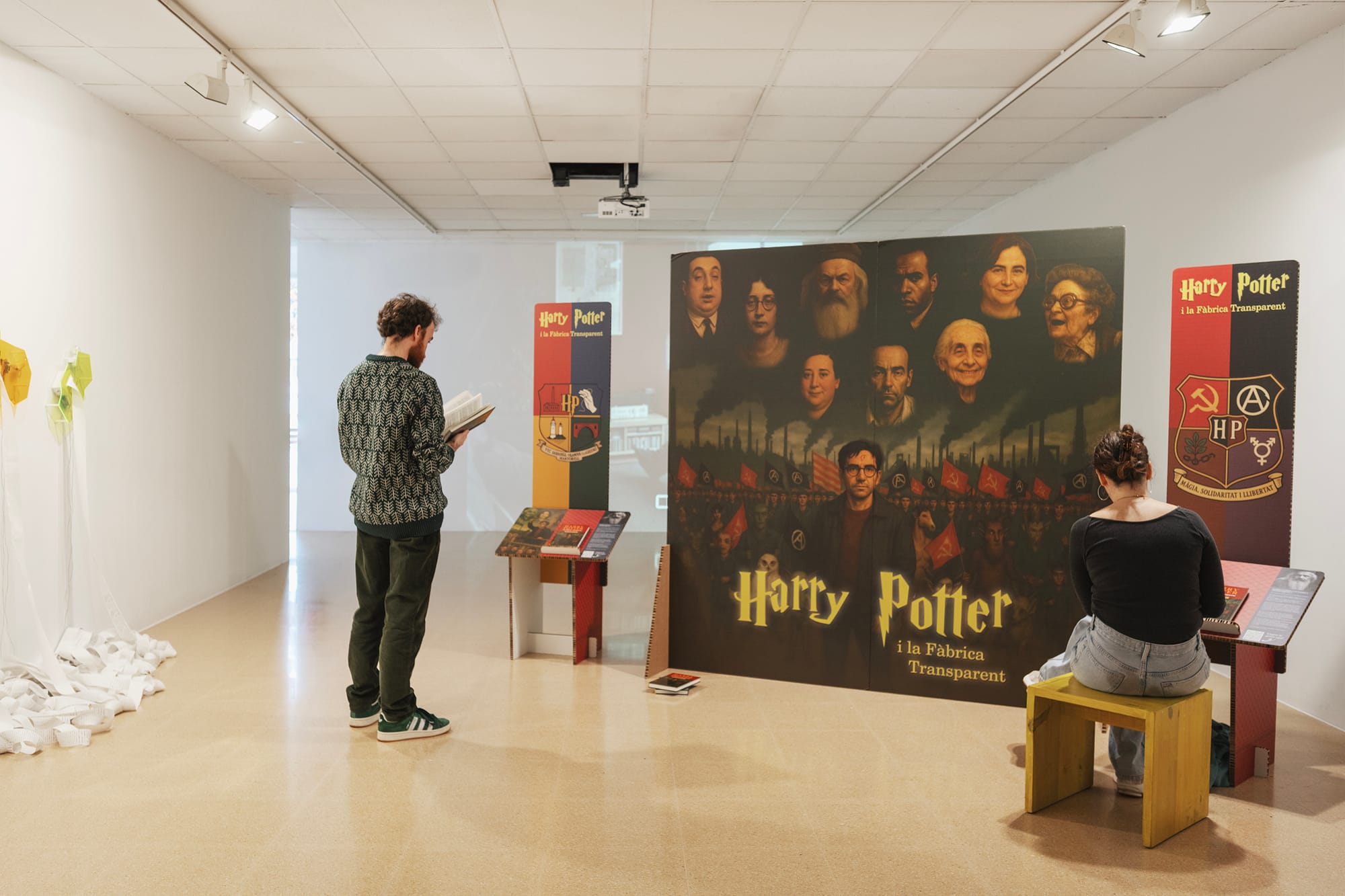
Ezequiel Soriano extends the critique of automated cultural production into publishing. His Harry Potter i la Fàbrica Transparent (2025) consists of artist-produced books generated with artificial intelligence and adapted to the cities on the exhibition’s itinerary.
Soriano, whose research concerns internet folklore and vernacular creativity, approaches mass-produced fiction through the logic of personalization. An internationally recognizable fictional universe becomes the basis for locally customized variants, each offering the appearance of individualized cultural consumption.
The work draws attention to an increasingly important contradiction within contemporary media industries. Automated production permits enormous variation while preserving familiar commercial formulas. What changes is the arrangement of recognizable elements. Originality itself becomes a repeatable procedure.
From Mataró to Martorell
The transparent factory originated at Festival Panòptic in Mataró in 2024, where an initial selection appeared at M|A|C Presó. The festival, established in 2019, takes its name and part of its conceptual orientation from the former prison’s panoptic architecture. Its programming examines digital technologies and contemporary systems of control through cinema and visual art. The exhibition subsequently expanded into an eight-artist project and entered the Generalitat de Catalunya’s traveling exhibitions program, with presentations in Vic, Sabadell and Vilanova i la Geltrú before its arrival in Martorell.
Villanueva’s curatorial approach reflects his background in dramaturgy and artistic research. Games interest him as organized situations that distribute agency through rules and procedures. His participation as an exhibiting artist is consistent with that orientation: The transparent factory incorporates research conducted through artistic production alongside works selected from other practices.
The current venue provides an unusually apt context. Muxart, Espai d’Art i Creació Contemporanis, opened in 2011 in the restored Casa Par, a historic building in Martorell. Named for painter Jaume Muxart (1922–2019), a member of the Catalan Grup Taüll, it combines the preservation and presentation of his work with a program of contemporary exhibitions.
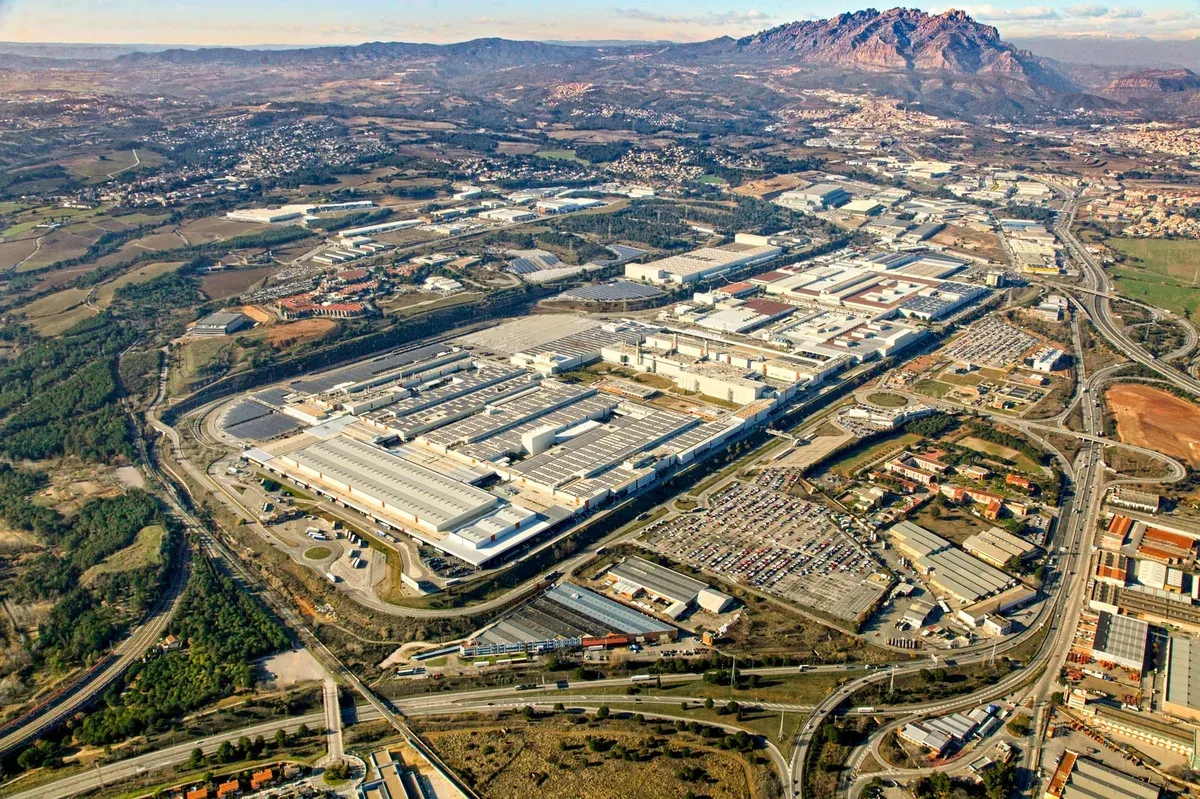
Martorell is also home to SEAT’s Volkswagen Group automobile plant, inaugurated in 1993 and currently undergoing an industrial transformation associated with electric-vehicle production. The geographical coincidence is striking. Comeron’s research began with a Volkswagen factory that converted manufacturing into a carefully controlled image. Nearly two decades after his dissertation, an exhibition borrowing his title reaches another municipality substantially shaped by Volkswagen’s manufacturing operations.
This connection gives the discussion of digital labor a concrete setting. Workers from the local industrial community can enter the exhibition’s public program, while viewers encounter artworks about tasks performed by virtual bodies. The comparison acquires its force through the considerable differences between those experiences.
Julian Kücklich’s 2005 account of playbour and Tiziana Terranova’s earlier research on unpaid digital labor remain useful historical references for understanding the exhibition. Their arguments concerned specific forms of productive participation in digital economies, rather than the entirety of videogame experience. Villanueva’s exhibition extends the discussion to the design of repetitive activity and the social conditions under which such activity acquires economic significance.
There is an additional question that the exhibition leaves open. The non-player characters in Hardly Working perform their routines without the possibility of leaving their assigned roles. Yet those routines were designed, animated and programmed by people whose own labor conditions remain outside the fictional environment. The industrial image has become extraordinarily elaborate, while the workers responsible for producing it are still largely invisible.
Their absence deserves sustained attention.