EVENT: “MILLE ET UNE HISTOIRES” (JANUARY 15–FEBRUARY 1 2026, LAUSANNE, SWITZERLAND)

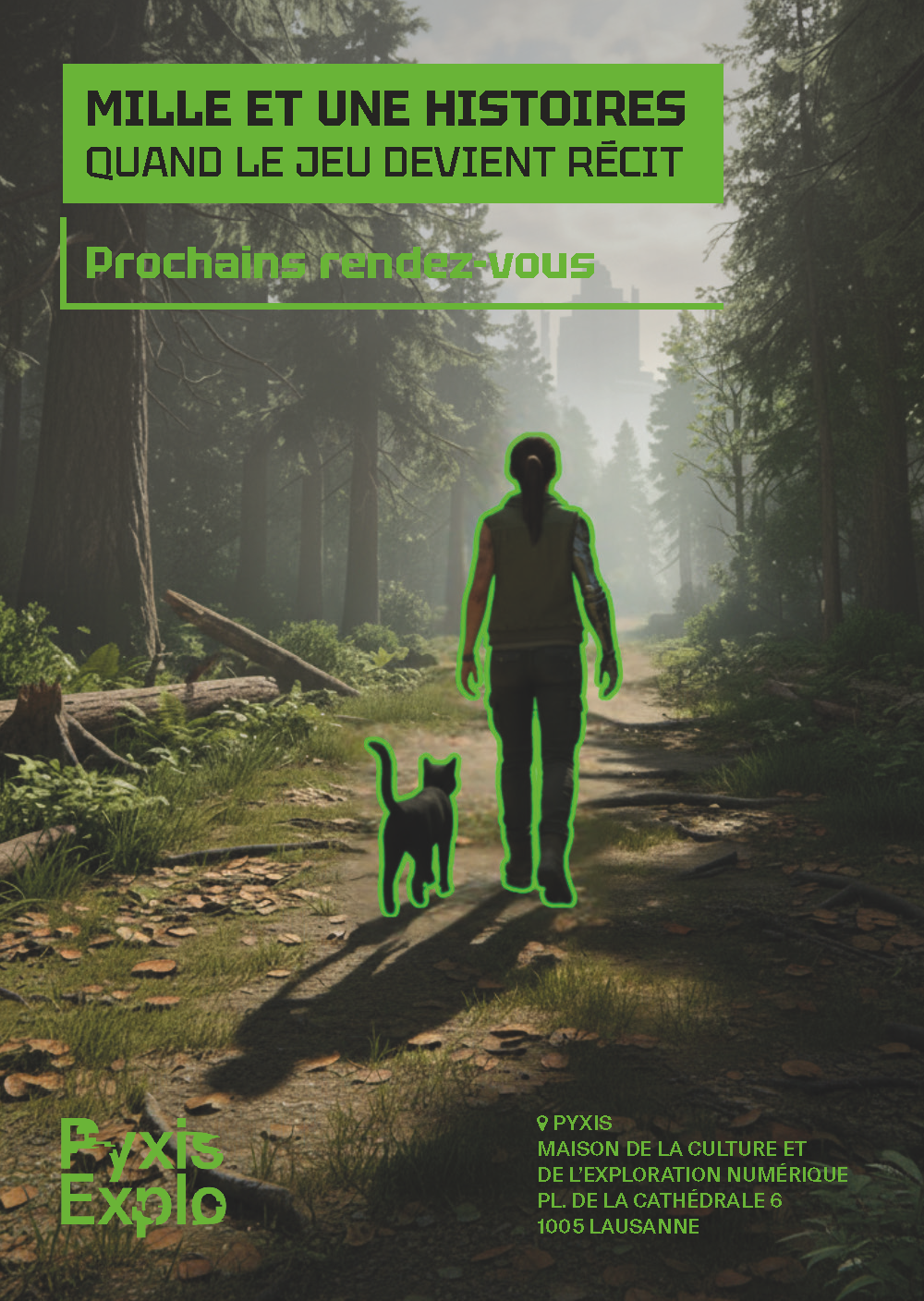
Key information
- Event: Mille et une histoires: quand le jeu devient récit
- Venue: Pyxis, Maison de la culture et de l’exploration numérique, Place de la Cathédrale 6, 1005 Lausanne, Switzerland
- When: January 15–February 1 2026
- Admission: free
- Installations visiting hours: Monday–Thursday, 15:00–18:00
- Programme + registration: pyxis.art/agenda (see links below)
In January, Pyxis, Lausanne’s Maison de la culture et de l’exploration numérique, opens a compact programme dedicated to storytelling in videogames, where play is treated as a narrative medium and game engines are approached as cultural tools. Titled Mille et une histoires: quand le jeu devient récit, the series brings together filmmakers and artists, machinima screenings, a small exhibition of game-based video and VR works, a hands-on workshop, and a research evening devoted to in-game cameras and game-image history.
Hosted at Pyxis (Place de la Cathédrale 6, 1005 Lausanne, Switzerland) the initiative reads as a focused snapshot of current practices: videogames as sites for moving-image production, embodied performance, and camera-led research, without forcing the discussion into a single disciplinary lane.
Below is the full program.
Opening night: Caroline Poggi, Jonathan Vinel, and Pascal Greco
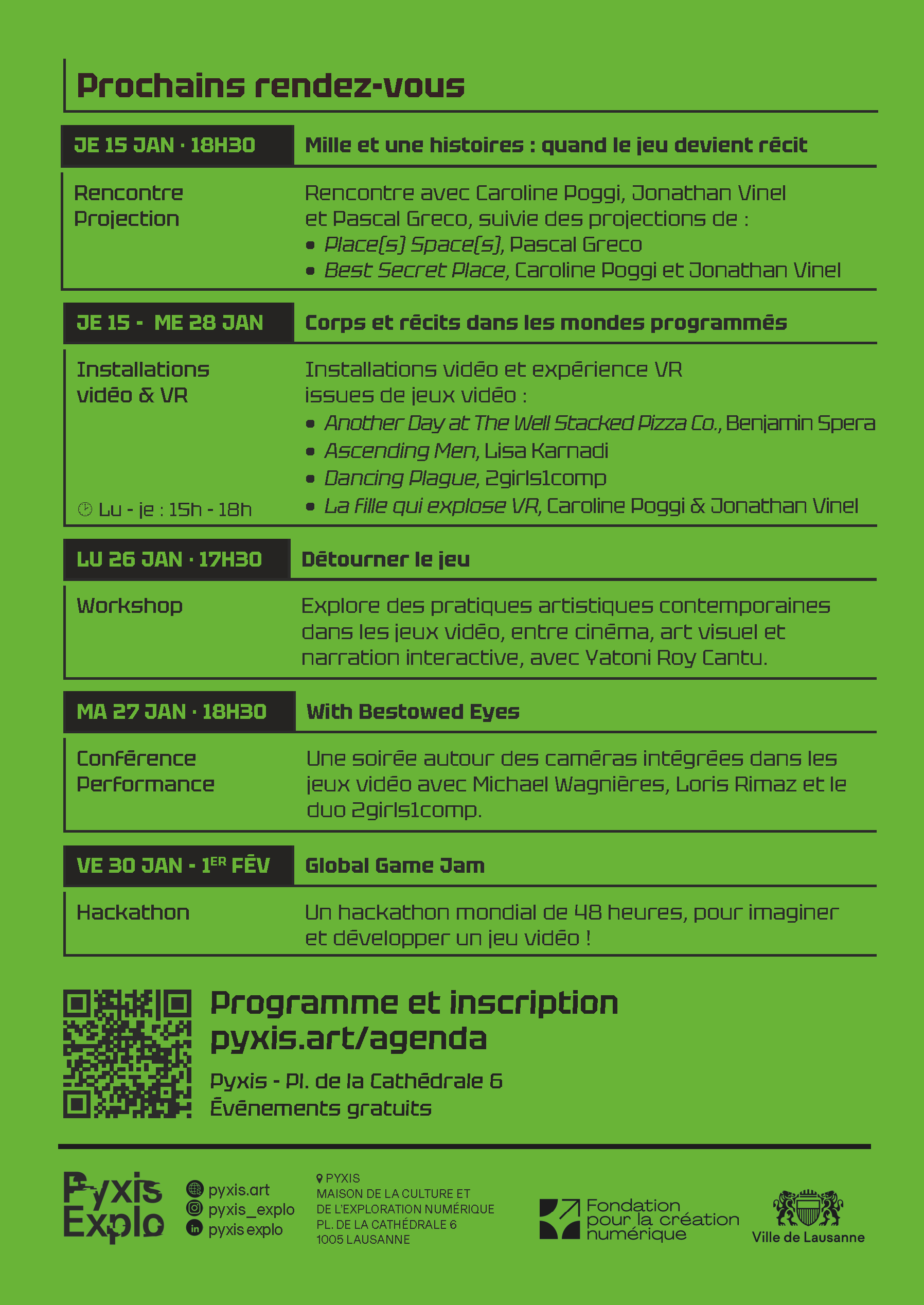
Thursday 15 January, 18:30 — talk + screening
The programme begins with an evening that pairs conversation with projection. Caroline Poggi and Jonathan Vinel join Pascal Greco for a public encounter, followed by screenings of:
The coupling is telling: rather than treating “game narrative” as plot delivery, the event frames the videogame image as something that can be edited, re-authored, and reframed, closer to contemporary cinema and gallery projection than to gameplay commentary.
“Bodies and narratives in programmed worlds”: mini exhibition of video and VR
15–28 January — installations (video & VR)
Opening hours: Monday–Thursday, 15:00–18:00
Running alongside the talks is Corps et récits dans les mondes programmés, a small presentation of works “issued from videogames,” spanning machinima, game-derived video, and VR. The selection includes:
- Benjamin Spera, Another Day at The Well Stacked Pizza Co.
- Lisa Karnadi, Ascending Men
- 2girls1comp, Dancing Plague
- Caroline Poggi & Jonathan Vinel, La fille qui explose VR
This exhibition component is arguably the programme’s conceptual hinge: it treats the game engine less as a neutral container and more as an authored environment, an image system with constraints, rhythms, and biases that artists can exploit, redirect, or push against.
Workshop: détournement as method
Monday 26 January, 17:30 — “Détourner le jeu”
On 26 January, artist Yatoni Roy Cantu leads a workshop centred on the game as a space for artistic creation. The session explicitly situates videogame practice between moving-image work and visual art, with an emphasis on interactive narration and contemporary approaches to game-based production.
For participants, this is the practical segment of the series, less lecture, more practical exercises: how artists appropriate game materials, how interventions are structured, and what kinds of authorial decisions become visible once “play” is repositioned as production.
Research evening: the videogame camera and image history
Tuesday 27 January, 18:30 — “With Bestowed Eyes” (conference + performance)
On 27 January, Pyxis hosts a night focused on integrated cameras in videogames and the histories they enable. Two researchers from the University of Lausanne’s Game Lab (Michael Wagnières and Loris Rimaz) lead the session, joined by modding collective 2girls1comp (Marco De Mutiis and Alexandra Pfammatter) presenting their practice.
The camera topic matters because it shifts the conversation away from narrative as script and toward narrative as visual regime: what the game permits you to see, how it trains perception, and how capture tools (built-in or improvised) structure authorship. If machinima has often been treated as a derivative form, this evening treats it as a critical way of thinking with game images, through framing, repetition, constraint, and selective attention.
Global Game Jam at Pyxis
Friday 30 January–Sunday 1 February — 48-hour hackathon
The programme closes with Global Game Jam, a 48-hour hackathon inviting participants to imagine and develop a videogame within the worldwide GGJ framework.