EVENT: MATRICULE BIS 3D (JANUARY 23-24 2026, ORLÉANS, FRANCE)

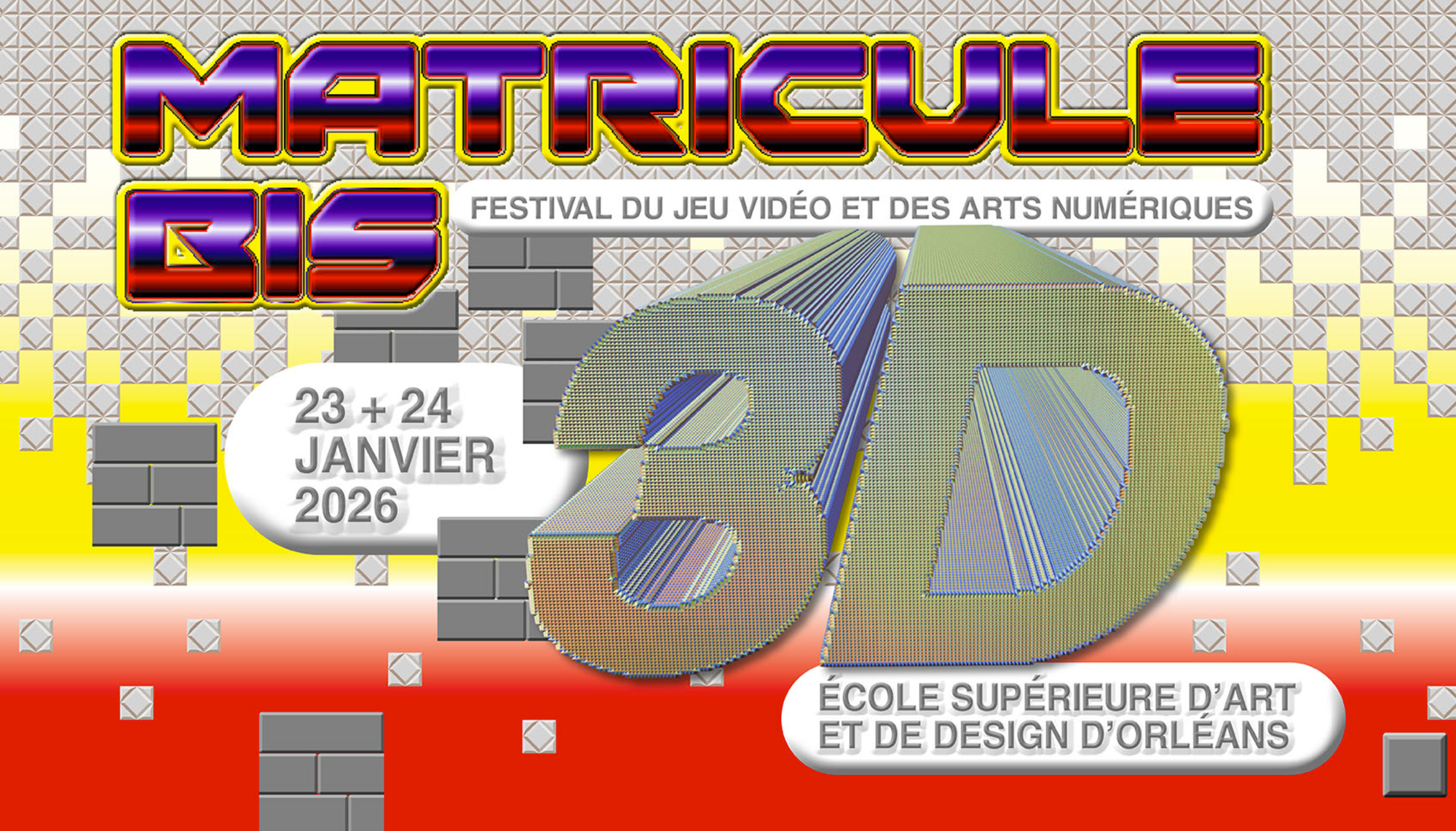
Matricule Bis 3D — Festival du jeu vidéo et des arts numériques (3rd edition)
ESAD Orléans, site de l’Abreuvoir
6 rue de l’Abreuvoir, 45000 Orléans, France
Friday 23 January and Saturday 24 January 2026
Opening hours: Friday 23 January: 19:00–22:30; Saturday 24 January: 10:00–18:00
Matricule Bis 3D is back for its third edition, bringing an expanded programme of experimental videogame culture to ESAD Orléans (site de l’Abreuvoir). Dedicated to playful forms that sit outside mainstream industrial logics – art games, alternative interfaces, performative uses of interactive media – the festival positions the videogame as an instrument for aesthetic inquiry, hands-on prototyping, and public exchange.
Previously organised by the Alliance Française d’Orléans, this new iteration is hosted and led by the École Supérieure d’Art et de Design d’Orléans, in partnership with Loire Games, Hitbox Makers, and Oregami. Across exhibitions, workshops, talks, and open play sessions, Matricule Bis 3D prioritises encounter: audiences are invited to test projects, speak directly with makers, and reassess habitual expectations about gameplay, images, and interactivity.
Running throughout the festival, the exhibition Comment ne pas jouer le jeu ? gathers artists who approach the videogame “otherwise”, as a space for experimentation, critique, and narrative deviation rather than a closed entertainment product. Rather than treating the medium as lightweight entertainment or an industrial commodity, the selection frames it as a site of aesthetic testing and cultural inquiry, capable of generating different ways of playing, perceiving, and interacting. Comment ne pas jouer le jeu ? examines the norms, habits, and imaginaries that organise gameplay and, by extension, everyday conduct; it often does so through humour, but the humour functions as pressure, not relief.
Chloé Desmoineaux’s Lipstrike draws on the social grammar of online games to foreground the misogyny embedded in their communicative routines. Through détournement, the work turns familiar mechanics into a critical instrument, exposing how “banter” and harassment circulate as ordinary interaction.
Marine Drouin presents an alternative-controller game developed through the Violence Ménagère dispositif. By converting domestic gestures into gameplay mechanics, the piece asks how roles are distributed, how labour is naturalised, and how mental load attaches itself to seemingly neutral routines.
A more introspective register appears in Scott Mauger’s ONIRIA, which invites players to accompany a conscious celestial object through a narrative, cosmic passage. Here the videogame operates as poetic space, structured around attention and duration, with contemplation taking precedence over mastery.
Questions of digital infrastructure sit at the centre of Nathalie Lawhead’s Individualism in the Dead Internet Age, a pointed critique of contemporary web culture and the tension between individuality, platforms, and the economies that shape online life.
With Video Games That Don’t Exist, Kieran Nolan offers an AI-generated machinima that plays with incoherence and technical limits. By circling what synthetic images cannot stabilise, the work sketches a fictive videogame and pushes viewers to consider how technological imaginaries get assembled, circulated, and desired.
François Gutherz’s pLLMdered_hearts follows an AI attempting to solve the puzzles of a 1980s text adventure. Playing becomes a form of digital archaeology: a contemporary model rubbing against older logics of interactive fiction, where parsing, guessing, and failure are part of the interface’s historical texture.
In Doom: The Gallery Experience, the SCUM DOG collective (Filippo Meozzi and Liam Stone) revisits the canonical DOOM and reroutes it through the ritual of the exhibition opening. Violence is displaced by an ironic tour through art-world conventions, turning the FPS into a choreography of spectatorship.
This double movement, technical and symbolic détourning, continues in the ESAD Orléans Édition Média Design research programme, GTA V <sub-versions>, which modifies GTA V to interrogate modding practices and the narrative possibilities that appear through graphic transformation.
Florent Deloison’s Ridge Racer: Deleuze Edition reworks a haunted PlayStation title through the figure and thought of Gilles Deleuze. Arcade speed meets philosophical meditation, with the console game recast as a conceptual terrain rather than a nostalgia object.
Alexandre Jouffroy reconstructs props inspired by medieval-fantasy worlds using modest materials, a deliberately “poor” fabrication that questions how myth, popular culture, and the videogame imaginary are built, and what it means to make them tactile again.
Finally, Orphéo Gagliardini brings memory to the fore. Moving between childhood recollection and an exploration of Guinean origins, the work frames play as a method of recomposing identity, where personal history becomes a navigable, revisable space.
Matricule Bis 3D extends across the full Abreuvoir site. A key component is the public restitution of five intensive workshops developed during the preceding week at ESAD Orléans, where students work with invited artists and then present outcomes during the festival. The announced forms range from upcycled arcade terminals and sound-based games to large-scale cardboard constructions, audiovisual installations, and 3D signage.
Partner areas add further points of access:
- Loire Games highlights studios and creators from the Centre–Val de Loire region, with playable demos, live development moments, and project presentations.
- Hitbox Makers presents five jury-selected “Coups de cœur” from its October 2025 game jam, available to test on site.
- Oregami hosts Rétro & Créatif : entre pixels et cubes (Saturday only), combining retrogaming free play and mini-challenges with a collaborative Minecraft workshop built around an event-specific prompt.
Saturday afternoon features two conferences: one on making games outside industrial systems and on collective formats for mutual support (with Théo Le Du Fuentes, Chloé Desmoineaux, and a Loire Games representative), and a second on alternative controllers that rework the relationship between the body and play-space, led by the collective Random Bazar.
On Friday night, the programme shifts into performance. At 21:30, Menu Étudiant (an ESAD Orléans DJ collective) presents Echoes of Wisdom, described as an ambient set informed by English Intelligent Dance Music before moving into a more rhythmic register, accompanied by real-time VJing and an on-site sound installation.
Also announced: “Glitches: Montez votre expo sur le jeu vidéo !”, a participatory workshop inviting attendees to discuss games and related works that have mattered to them, build a small exhibition collectively, and visit the results produced by other groups.