EVENT: FILE SÃO PAULO 2026 INTER-CREATIVITY

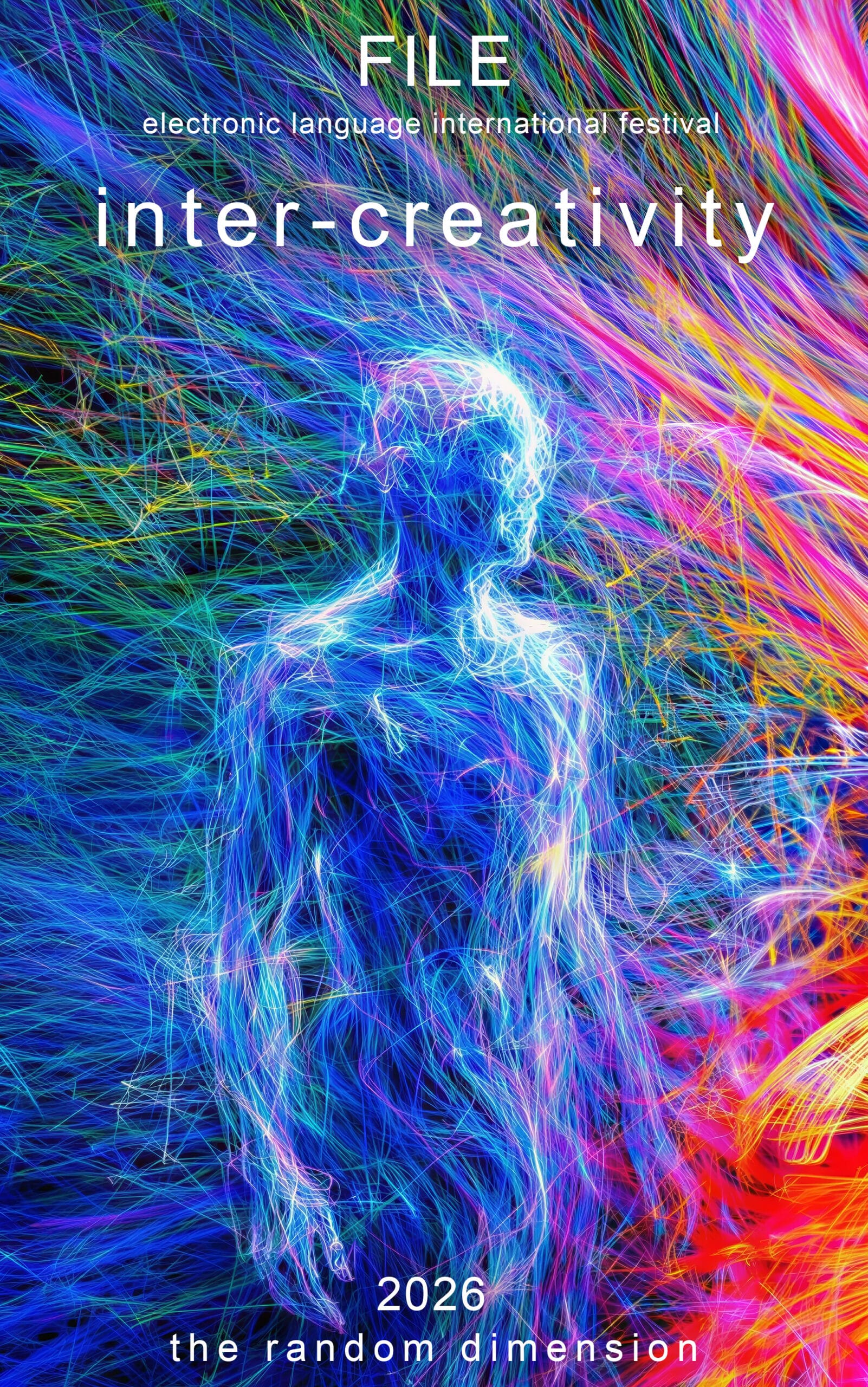
FILE São Paulo 2026: Inter-creativity runs through 11 October 2026 at the FIESP Cultural Center, Avenida Paulista 1313, opposite Trianon-MASP station in São Paulo, Brazil. The Art Gallery is open Tuesday through Sunday from 10:00 a.m. to 8:00 p.m. Admission is free and no reservation is required. The FILE LED Show is visible in the Digital Art Gallery daily from 7:00 p.m. to 6:00 a.m.
Full FILE São Paulo 2026 programme
Visitor information from SESI-SP
A visitor describes personal memories to a machine and receives a newly formulated perfume. Another has their face scanned, becoming the ancestor of a virtual family. Mobile-phone photographs grow into rooms within an expanding digital city, while a virtual-reality work places two brothers in a universe where gravity offers no ground, horizon, or stable direction. These encounters introduce Inter-creativity, the title and governing proposition of FILE São Paulo 2026.
Now open at the FIESP Cultural Center on Avenida Paulista, the 26th edition of the Electronic Language International Festival brings together more than 150 works concerned with artificial intelligence, biological processes, interactive systems, embodied perception, and games. Public visitation runs from 20 August through 11 October 2026, with free admission. Ricardo Barreto, Paula Perissinotto, Clarissa Vidotto, and Victor Sardenberg form the curatorial team. The opening programme on 19 August included a lecture by mathematician and computer scientist Gregory Chaitin and epistemologist Virginia Chaitin on intuition, incomputability, and the epistemological limits of artificial intelligence.
FILE has operated since 2000, building an extensive archive of digital art, animation, interactive installation, electronic music, games, and machinima. Inter-creativity extends this history through a curatorial argument that understands creation as distributed among human bodies, codes, networks, and technological environments. Its opening statement, “Not everything can be calculated”, places an important qualification on the current enthusiasm for generative systems. Technology appears throughout the exhibition as an active participant, although its role changes substantially from one work to another.
Inter-creativity is a capacious term, and such breadth can blur distinctions. A model that generates an image operates under different conditions from a person learning the physical limits of a swing. The diversity of the artworks on display is remarkable.
EveryHuman’s Algorithmic Perfumery offers one of the clearest examples. Visitors respond to prompts concerning memory, preferences, imagination, and identity. An artificial-intelligence system interprets those responses and controls an apparatus that mixes an individualized fragrance. The resulting perfume remains materially dependent on oils, dispensers, and the visitor’s olfactory judgment. The algorithm proposes a composition; a human participant still has to smell and evaluate it.
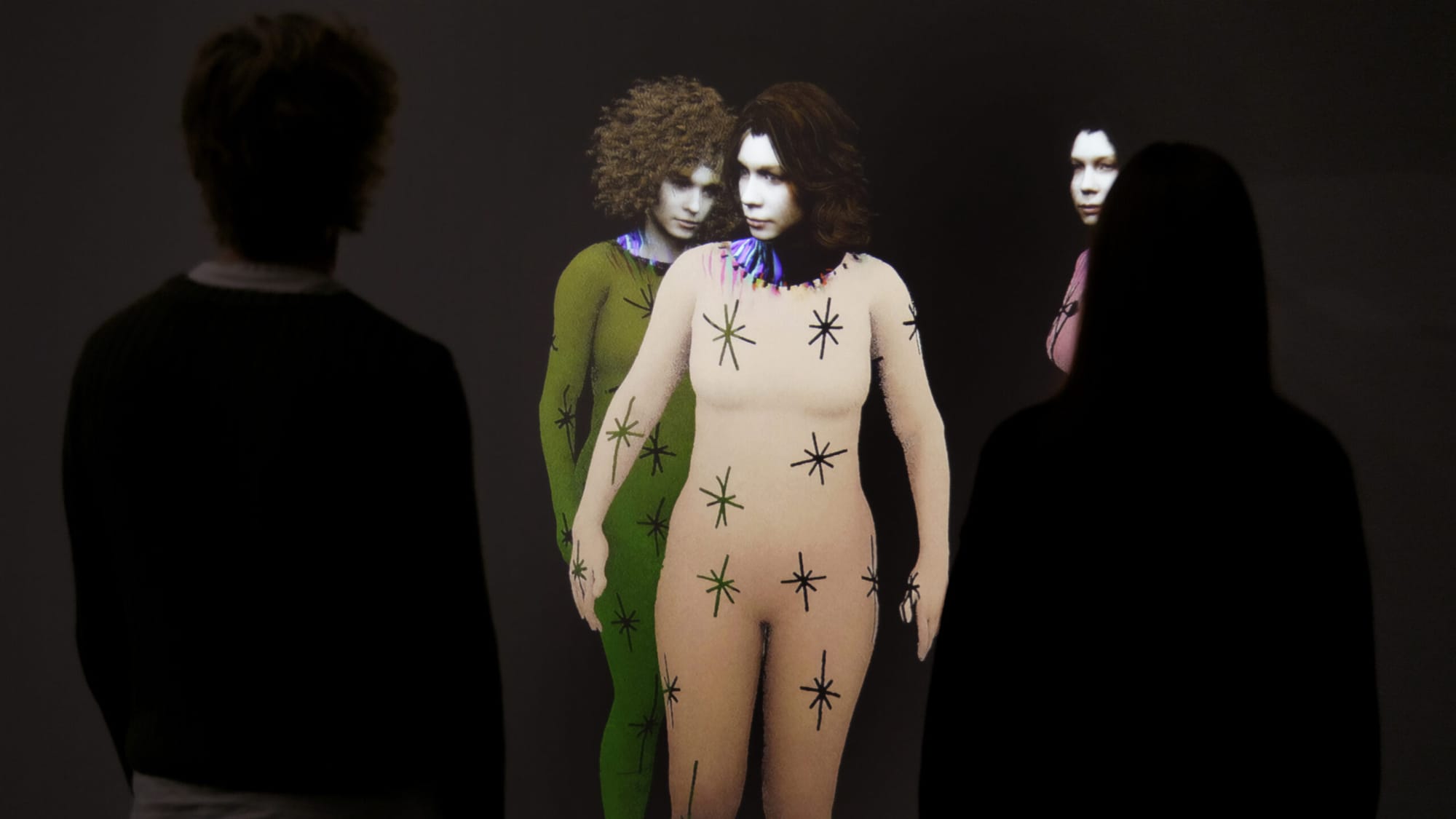
Hanna Haaslahti’s Ancestors begins with a different form of personal input. A facial scan generates a digital double, which enters a simulated community populated by earlier participants. Encounters between these figures can produce descendants whose faces combine features inherited from their virtual parents. The installation turns reproduction into a computational and collective process, while the family tree grows through the temporary presence of strangers. Ancestors premiered at Tampere Art Museum in 2025 and received an honorary mention in the New Animation Art category of the 2026 Prix Ars Electronica.
In A Walled City, Weidi Zhang and Rodger Luo transform participant-uploaded photographs into architectural chambers. A multi-agent AI system assembles these units into a continuously changing virtual settlement. Its organizational reference is Kowloon Walled City, the densely built Hong Kong enclave demolished in the early 1990s. The historical source gives the project a political dimension that exceeds the novelty of image generation. Personal photographs become spatial data, while the accumulated city asks who determines the rules of communal digital habitation.
Non-Linear’s Transmissions into the Void, led by interaction designer Dennis Peter, approaches computation through disappearance. A circular portal responds to hand gestures with light and musical notes, converting the exhibition room into an audiovisual instrument. The installation concentrates on improvisation and the deterioration of information over time. Its signals remain perceptible only while the system, participant, and surrounding space continue to interact.
The programme extends well beyond recent generative AI. Sophia Bulgakova’s INEVITABLY BLUE dates from 2019. One participant at a time enters an environment organized around a swing, coloured light, sound, and movement. As the body oscillates, stable references of balance and position begin to weaken. The work locates invention within proprioception and imagination, without requiring the production of a synthetic image or text.

Amir Admoni and Fabito Rychter’s Gravidade VR, first presented through Venice VR Expanded in 2020, also removes ordinary spatial coordinates. Everything in its fictional universe remains in continuous freefall. Osório and Benedito have adapted their domestic lives to this condition, surrounded by falling furniture and the remnants of an absent civilization. The viewer shares their lack of orientation through the VR headset. By including a work produced six years earlier, FILE places present debates about artificial intelligence beside an established history of embodied virtual media.
FILE’s treatment of videogames has a longer institutional history. The festival organized a dedicated FILE Games exhibition in Rio de Janeiro in 2009 and later maintained a machinima programme under the heading “Maquinema.” Kent Sheely’s Ready for Action Series appeared in the 2013 edition. The following year, FILE presented fourteen machinima works, including Sheely’s Aspect, Ip Yuk-Yiu’s The Plastic Garden, and productions by Baden Pailthorpe and Mary Flanagan. The archive documents a curatorial approach in which games function as playable works, production environments, and sources for experimental moving images.

The FILE 2026 games section includes two completed commercial titles. The Game Bakers’ Cairn, released in January 2026, turns climbing into a problem of route selection, hand placement, equipment, and survival. Its protagonist, Aava, attempts to ascend Mount Kami while the player manages pitons, supplies, and physical exhaustion. Bionic Bay, developed by Mureena Oy and Psychoflow Studio, uses detailed pixel art and physics-based movement to guide a scientist through an ancient biomechanical world.

Studio Lifeforms’ Planet Garden occupies the same category but follows a different institutional and conceptual trajectory. Its central character, GAIA, is described by the studio as a “Large World Model”, a networked environmental intelligence that also coordinates the agents producing the game world. The project imagines a future planetary administration committed to human and non-human flourishing. The optimistic premise warrants scrutiny, since governance delegated to an artificial superintelligence raises questions about authority, visibility, and consent even when the simulated outcome is ecological abundance.
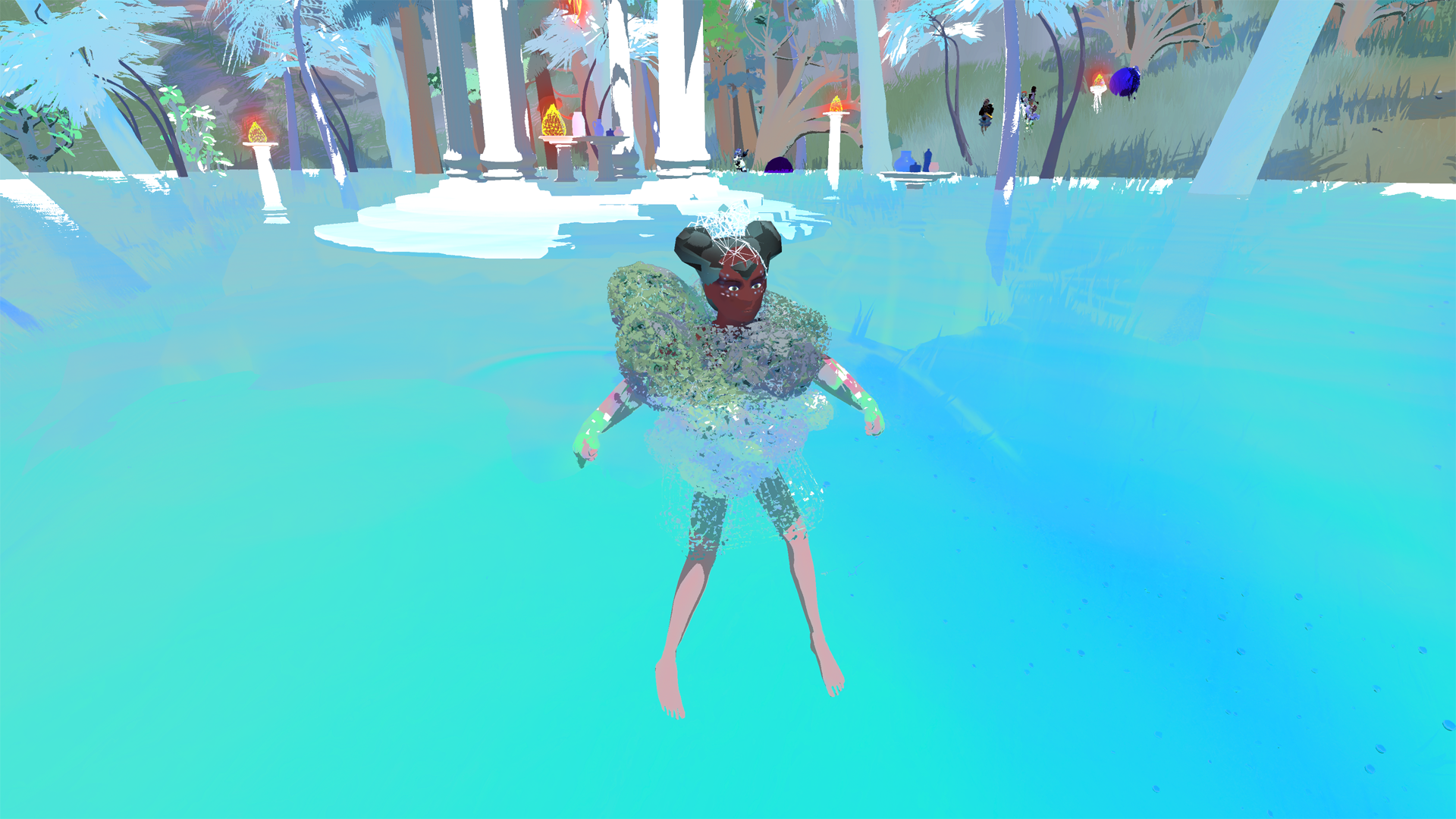
Game logic also appears outside FILE’s formal games category. In PUPPET, 1024 Architecture and Vitalic connect a controllable digital marionette to a synthesizer, allowing gesture to trigger rhythm, melody, and effects. Xenoangel’s Soft Waters adopts videogame conventions for a nonlinear narrative concerning a water deity, ecofeminist writing, and a future solarpunk gathering. Such placements reveal the permeability of FILE’s categories: gameplay can operate as an exhibition format, an audiovisual control system, or a method for organizing speculative fiction.
A temporary outdoor component extends the exhibition onto Avenida Paulista. EchoVision, credited by FILE to Jiabao Li and Botao Amber Hu, uses custom bat-shaped mixed-reality masks to simulate echolocation. Li’s project page also credits sound artist Matt McCorkle. Participants vocalize into the device and receive visual feedback corresponding to the pitch and tone of their voices, allowing them to perceive their surroundings through a translation of reflected sound. The project has also been documented through research presented at IEEE VR and CHI in 2025. EchoVision remains outside the FIESP Cultural Center through 30 August.
FILE’s strongest contribution in 2026 lies in these differences. Artificial intelligence operates beside physical interfaces, game rules, human memory, synthetic genealogy, and non-human perception. The exhibition asks the visitor to identify where an action originates, how it changes through mediation, and who retains the capacity to interrupt the process.