Eddo Stern on machinima and C-Level
Originally published on GameScenes on June 12, 2010.
This email conversation with Israeli-born artist Eddo Stern took place in June 2010 and was conducted by Mathias Jansson as part of Game Artworlds: The Early Years, a GameScenes series devoted to artists working with videogames during the formative decades of game art.
Stern works across computer games, video, performance, hardware, kinetic sculpture, and installation. His practice has repeatedly examined the unstable relationship between physical experience and electronic simulation, alongside the representation of history, violence, technology, and cultural identity through games.
His early machinima includes Sheik Attack, Vietnam Romance, Landlord Vigilante, and Deathstar. Stern was also the founder of the Los Angeles artist-run space and cooperative C-Level, where he collaborated on projects including Waco Resurrection, Tekken Torture Tournament, and Cockfight Arena.
Editor’s note, 2026: This interview is republished as an archival document. Spelling, punctuation, capitalization, and a small number of evident typographical errors have been lightly standardized. The substance and historical perspective of the original exchange remain unchanged.

GameScenes: What is your relationship to videogames?
Eddo Stern: I started playing and making computer games on an Apple II+ in the early 1980s. I was a member of the Be’er Sheva computer club, cracking games and double-siding floppies with a round hole punch until someone built a square floppy disk nibbler.
Some of my more memorable game-playing experiences were with Autoduel, Timezone, Castle Wolfenstein, Aztec, Ruski Duck, Ultima, Zork, Drol, and Karateka.
I’ve been interested in and studied math, philosophy, and then art. In trying to combine all three, games eventually became the solution, a new Gesamtkunstwerk.
My earliest artwork was installation-focused. After that I worked with pretty high-end VR for a few years, but VR seemed so stale compared to gaming culture, and I really like low-tech tinkering. I am very interested in total immersion, but not in a strictly visual or haptic way, and I think my approach to gaming reflects this.
GameScenes: You were a member of the now legendary collective C-Level. What was the artistic fulcrum behind this highly influential group? And how did it start?
Eddo Stern: C-Level was both a group of people and an artist-run space. I started it with a few friends right after graduate school. The initial idea behind C-Level was to create a space and working environment outside of school that mirrored the Integrated Media Lab at CalArts, which most of us had shared.
C-Level was supposed to be a workspace that broke from the tradition of the segregated artist studio. In the beginning C-Level was just that, a space where we worked and shared equipment, an artist co-op.
Eventually things shifted and C-Level became a public space that produced and hosted events, and soon after became better known as a gaming lab and was often miscategorized as an “artist group,” as a few of the gaming projects became well known: Tekken Torture Tournament, Cockfight Arena, and Waco Resurrection. But there was plenty going on at C-Level that had nothing to do with gaming.
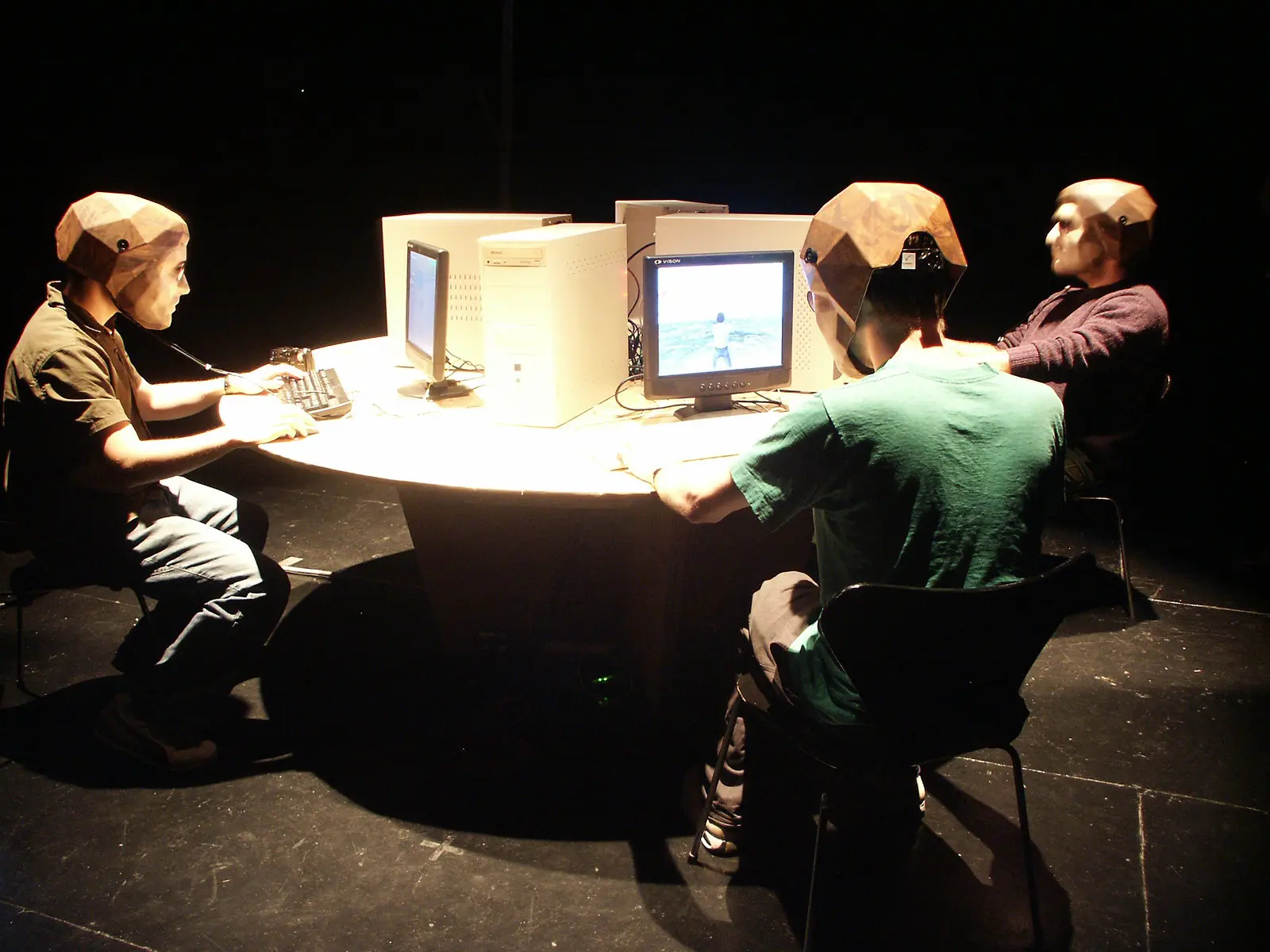
GameScenes: Waco Resurrection is one of the most celebrated works by C-Level. Why create a game about the Waco incident?
Eddo Stern: The idea for the Waco game came into existence as an amalgam of forces and arbitrary events — as does anything, perhaps.
I had been interested in the intersection of real events/history with gaming and had been exploring this using video, machinima specifically, with works like Rock Attack, Sheik Attack, and Vietnam Romance. Michael Wilson, from C-Level, was working on a sound piece about Waco at the time, and this helped spark our interest in researching the specifics of the Branch Davidians.
The connections between religious beliefs, constructed mythologies, and historical fantasy — superpowers and a self-published religious text — were starting points for exploring the Waco events as a “subjective” documentary rather than an accurate historical reenactment through a game.
In addition to this, Mark Allen, Jessica Hutchins, and I had just finished the Tekken and Cockfight physical game performances and were ready for a more ambitious game project that also involved a physical, off-screen component. We then recruited Peter Brinson and Brody Condon to join the team and started working on Waco Resurrection. Three months later we were done.
One of the differences in making a game about a historical event is the nature of identification and implication. Games require users to act and thus appear to implicate the player in the actions of the avatar they are controlling. This is rather obvious, but it does create new emotional experiences.
Imagine a documentary about Hitler versus a fictional film with an actor playing Hitler versus a game where the player plays as Hitler.
The most common criticisms we heard about Waco were that the game was in bad taste, that the game was exploitative, and that the game was pro-Davidian/pro-Koresh. The bad-taste and exploitation criticisms stem from people struggling to consider that games can be made about serious issues while still providing some ambiguity.
The second criticism, that the game is politically skewed, assumes that Koresh as a protagonist equals a hero in the game. This is an issue that games reveal in a particular way: a film about Hitler would likely not draw this criticism, nor would a film about David Koresh.
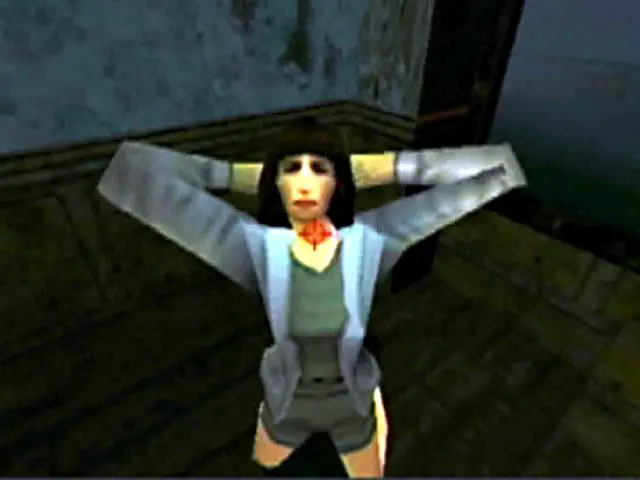
Eddo Stern, Sheik Attack, 1999/2000, digital video, 16 min. 45 sec.
GameScenes: You were among the first artists to experiment with machinima. Think, for instance, of Sheik Attack (1999) and Vietnam Romance (2003). Why were you so fascinated by this format? How did you create Sheik Attack?
Eddo Stern: I made my first “machinima” in 1995 of my girlfriend playing Tetris with a voice-over, recorded on Hi8 off the screen.
I later made Rock Attack, recording a rehearsed scene in Command & Conquer using a VGA-to-TV converter, in 1996, and I thought I had invented something completely new until I was shown Miltos Manetas’ Flames project, recordings of Lara Croft dying on a PS1.
Sheik Attack was a more ambitious project that took about six months to finish. Initially I created a storyboard and then went looking for games that might provide footage to match my storyline. I then played the games over and over, recording the screen and trying to match the shots that I needed, but with some improvisational moments.
I think I have about ten hours of footage for the sixteen-minute final video.
Only midway through this process did I recognize the extra-textual connection between the games’ titles and release dates and their correspondence to the events in Lebanon that I was trying to recreate.
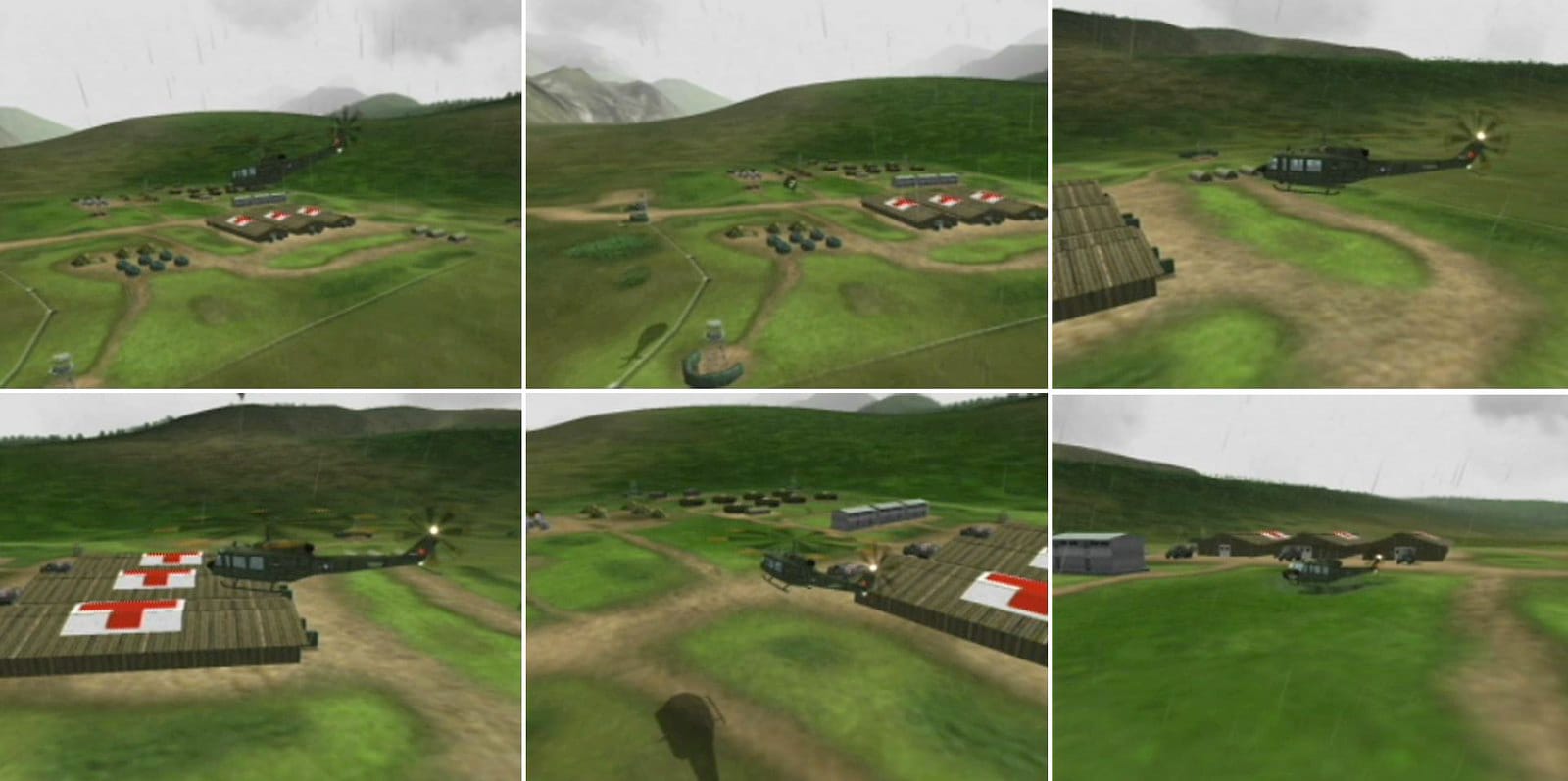
For Vietnam Romance, I had a mix of very precise film scenes that I tried to recreate frame by frame in games, and this was a pretty challenging process from a gameplay standpoint. Trying to match the helicopter landing scene from the TV show MASH* took a few whole days of gameplay.
Also, trying to find the right deer to shoot in the right way to match The Deer Hunter was not so easy, and I was adamant about not resorting to cheat codes to spawn the damn animal at the right place. Even that took about a day :)
GameScenes: Do you see any difference between working with machinima and a more traditional style of video art?
Eddo Stern: I think it depends on the context of the video and what you are trying to say or do. Many machinima works are self-referential, in the sense that they exist in the same cultural context as the game or games they are using.
My choice of specific games for my machinima is determined by something else I want to say. My subject matter is not so much concerned with self-references to game culture — you’ll notice that much machinima is comic in nature — as it is with a wider cultural context for the intersection of history, violence, and simulation.
So, to answer your question, I do think that presenting work as machinima assumes a context of game culture, and a more mainstream or lighthearted expectation from the work. Whereas presenting the same work as video art in a museum or gallery brings another set of expectations and another set of viewers, likely not familiar with the game-culture context and likely used to a shorter, non-linear viewing experience.
Showing the same work in a film festival brings with it yet another set of expectations and viewing practices.
For my machinima films, I find that film festivals have often offered the best viewing context, not unexpectedly in terms of migrating the visual experience away from the computer screen, which is something that is important to me when showing my machinima.
I was inspired to make a video by a piece called Dial H-I-S-T-O-R-Y by Johan Grimonprez. Unlike many works of video art that document a performance or offer footage of repetitive goings-on, Dial was an intensely entrancing, immersive experience and yet did not rely on conventional narrative to achieve its immersiveness.
GameScenes: As an artist experimenting with videogames, what is your relationship with the art market?
Eddo Stern: My work exists in various art/economic contexts. Some of my works are free, some are editioned, some are one-of-a-kind objects, some are distributed, some are self-published, some are sold, bought, and shown by galleries and museums.
All images courtesy of the artist.
Interview by Mathias Jansson
Archival links
Eddo Stern
http://www.eddostern.com/
Sheik Attack
http://www.eddostern.com/sheik_attack.html
Vietnam Romance
http://www.eddostern.com/vietnam_romance.html
Waco Resurrection
http://www.eddostern.com/waco_resurrection.html
Tekken Torture Tournament
http://www.eddostern.com/tekken_torture_tournament.html
Cockfight Arena
http://www.eddostern.com/cockfight_arena.html
Originally published on GameScenes, June 12, 2010.