Miltos Manetas, The first machinimaker
Originally published on GameScenes on July 31, 2010.
This email conversation with Miltos Manetas took place in July 2010 and was conducted by Matteo Bittanti and Mathias Jansson as part of Game Artworlds: The Early Years, a series devoted to artists working with videogames during the formative decades of game art.
Born in Athens in 1964, Manetas developed paintings, videos, websites, and other works around computers, cables, videogames, and network culture. He was also closely associated with Neen, the internet-based art movement he launched at the beginning of the 2000s, and with Whitneybiennial.com, an online project conceived in response to the 2002 Whitney Biennial.
The interview focuses on the works Manetas called Videos After Video Games, made from the mid-1990s onward, and on his early encounters with PlayStation, Tomb Raider, Super Mario 64, simulation, and digital characters.
Editor’s note, 2026: The title and historiographic claims in the original 2010 publication reflected the terminology and available scholarship of that moment. The interview is republished here as an archival document. Spelling and punctuation have been lightly standardized; the substance of the exchange remains unchanged.
GameScenes: Your Videos After Video Games (1996–2006) series is considered the first example of machinima. You started developing these videos in 1996, when you moved to New York. What prompted you to use games as a medium? What did you find in digital games that you could not get, for instance, with video?
Miltos Manetas: In 1996, video games started to exist so heavily that they became impossible to ignore. In the same way that the Impressionists focused on nature, computer landscape became for my generation the most important subject matter. Of course, video games were around from before, but it was only during the late 1990s that we realized that they were part of that computer landscape, and not just yet another bit of visual excrement that was dropping out from television. At that time, video games ceased being entertainment solely and started becoming communication.
GameScenes: What kind of communication?
Miltos Manetas: Video games were not communication between humans, though, but more importantly, they represented communication between humans and intelligent machines. I decided that if I started listening carefully to video games, these intelligent machines would tell me about how they felt and share their views of the world with me.
Miltos Manetas, Flames, 1997, video, 1 min. 10 sec.
GameScenes: Can you explain how you began “listening” to games?
Miltos Manetas: It all started for me after buying my first PlayStation. I remember that after unpacking it and looking at the joystick, I was thinking that it was the first time that a computer was gently offering me its little hand. So I decided to grab that little hand and to start walking together with it.
GameScenes: You were already making videos at that time, right?
Miltos Manetas: I used to make videos, but at that point in time, I had lost my faith in video and photography. These media were reflecting only half of the story, and they were always biased from a human point of view.
Filming Lara Croft while she tried to cross a dark cave and got killed by poisonous arrows (Flames, Manetas-Aftervideogames, 1997), and Super Mario lying asleep (Super Mario Sleeping, Manetas-Aftervideogames, 1998), was an entirely different experience. In those videos, I was not employing human actors anymore.
Before, I was using real people, such as those two guys who were endlessly smoking and drinking coffee in my Soft Driller (1994) video, or myself in Red Satellite (1993). Actors, though they can be amazing to watch, bring with them their limitations.
The characters from video games instead were so multidimensional when they were filmed that it made my head spin. Because you can choose the point of view from which to watch your character, who is nobody else than yourself, these characters were at the same time the actor and the director of the video that I was filming.
But they were also, because of the computer, a kind of early robotic entity. I felt that such an entity would soon grow into something a lot more sophisticated and that it was important to document where everything had started.
Therefore, what I was doing was not anymore about video and, in some way, it was not even about “art” anymore.
Miltos Manetas, Mario Sleeping, 1997, video, 2 min. 54 sec.
GameScenes: So, it was about “listening”?
Miltos Manetas: It was about how to start listening to the newest side of the world! It was about permitting these newcomers, our intelligent machines, to come forward and reveal their stories. The fact that, just a few years later, machinima became a popular art of storytelling shows that many other people, some of them artists, but most of them not, were also interested in listening to these stories.
GameScenes: In the Videos After Video Games series you simultaneously use and subvert some tropes and conventions of video art. Were you trying to make a point about the state of contemporary art? For example, is Mario Sleeping a nod to Andy Warhol’s famous artwork?
Miltos Manetas: No, the problematics related to the work of Warhol did not concern me in the least. At that point, my interests regarding the state of contemporary art were already fading. Contemporary art is cool, but once I started going around the different levels of Super Mario 64, I kind of forgot all about it.
In 1999, I decided to leave New York and move to Los Angeles because, in New York, nobody cared much about all that digital culture. In NYC, people were too absorbed with art to notice that life was changing around them. When a new generation of artists came of age, even New York discovered video games, and now we see some art related to them displayed in the New Museum. Back in those days, no critic, gallerist, or curator had ever played a video game.
Miltos Manetas, SuperMario Sleeping (Under a Painting), 1997, video, 1 min. 15 sec.
GameScenes: Unlike the more recent fan videos that emphasize stunts, breathtaking action, and players’ skills, your videos focus on stasis, repetition, and the triviality of simulated spaces, from sleeping to tapping a foot. Were you suggesting that what really matters in games was inactivity?
Miltos Manetas: In simulation, video games, as well as in life, it is nice when action stops for a little while, so that the player can look around and see the details of the situation. That’s how we actually do our painting, and sometimes photography.
It is our call now to find the perfect medium that can potentially explore the observation of those moments also in simulation. I started myself by exploring with video and prints, but I have to admit that my work is pretty basic, and I hope that younger artists will soon invent more intricate ways to let the simulation talk.
Miltos Manetas, Miracle, 1996, video, 1 min. 13 sec.
GameScenes: In videos like Miracle (1996) you play with glitches and code malfunctions. Do you think that bugs and mistakes represent the essence of new technology? Is the failure of the simulation a trademark of its inner nature?
Miltos Manetas: In Miracle, a Hornet F-18, a light aircraft from a flight simulator, falls onto the sea, but instead of crashing, it starts running over the water’s surface. We can think about that run on the water as a glitch and a malfunction, but we can also see it as a special thing that airplanes can do in a simulation.
I find the second approach more interesting. When I filmed that airplane, it was not because I wanted to speak about game bugs and mistakes, but because I wanted to show what was happening there, and also because I found it very poetic.
GameScenes: How does game-inspired art fit into the “Neen” manifesto?
Miltos Manetas: The work with video games was, for me, an early version of Neen. Up until 2001, I held hope that video games would turn really radical. But that did not happen. The video game industry instead became a kind of “Hollywood 2.0,” where what mattered most was budget and revenue.
So I started investing all of my efforts into the World Wide Web and specifically into what was, back then, its most revolutionary field: Flash animation. Flash was important because anyone, even the programming illiterate like myself, could use Flash to create amazing things.
Still, video games remained my secret love, and I still hold out hope that one day, fascinating video game Neensters will show us stuff that will take our breath away.
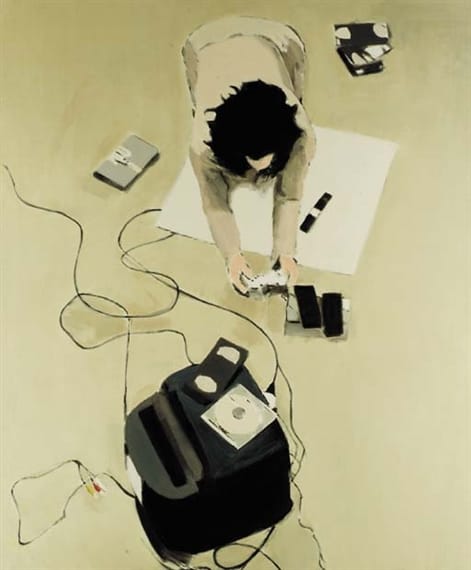
GameScenes: You are also a painter of seemingly trivial pursuits. You’ve painted computer cables, computer screens, and people playing videogames. Why use a traditional medium such as painting to explore the digital world? Why not use digital technology to depict our new digital landscapes?
Miltos Manetas: I started painting in 1995. I decided to abandon art, after being a conceptual artist. Having to deliver works to four final exhibitions that were supposed to be my last, I bought four canvases and painted the same picture on all of them.
These first paintings (Sad Tree, 1995) were successful and I continued painting; first laptops and digital cameras, and later all kinds of hardware. At that point, I did not know how to use computers, but I learned quickly and started becoming a screen-junkie, like all of us are now.
While I was doing my paintings, I actually started “using digital media to portray the digital world.” Indeed, until now, I have produced something like 500 large-format prints from video games, 20 videos after videogames, and more than 30 websites that employ Flash animation and other such programming.
Yet painting still remains for me the important medium that can have a considerable effect on the karma of reality.
GameScenes: How so?
Miltos Manetas: Because a painting does not move. It stays still though everything in it, forms, colors, meanings, interpretations, even its format and composition, is in constant transformation.
People speculate about the existence of quantum computers and hypothesize about what we will be doing once they are invented. I want to close out this interview by sharing my belief that perhaps quantum computers have always been around, and we have been using them from ancient times, and that they are nothing other than what we call “paintings”!
All images courtesy of the artist.
Interview by Matteo Bittanti and Mathias Jansson.
Archival links
Miltos Manetas
http://www.manetas.com
Videos After Video Games
http://www.manetas.com/art/videoaftervideogames/index.html
Neen
http://www.manetas.com/eo/neen/
Originally published on GameScenes, July 31, 2010.