Tale of Tales on the aesthetics of art games
Originally published on GameScenes on July 23, 2010.
This email conversation with Auriea Harvey and Michaël Samyn, founders of the Belgian development studio Tale of Tales, took place in July 2010 and was conducted by Mathias Jansson as part of Game Artworlds: The Early Years, a GameScenes series devoted to formative artists, designers, and works in game-based art.
Founded in Belgium in 2002, Tale of Tales pursued forms of interactive experience that deliberately departed from the conventions of commercial videogames. Their projects emphasized atmosphere, emotional engagement, poetic narrative, and exploratory interaction rather than competition, mastery, or conventional reward structures.
The conversation ranges from The Endless Forest and The Graveyard to Silent Hill 2, Ico, the Realtime Art Manifesto, software distribution, and the complicated position Tale of Tales occupied between contemporary art and independent videogame culture.
Editor’s note, 2026: This interview is republished as an archival document. Spelling, punctuation, capitalization, and evident typographical errors have been lightly standardized. The substance, terminology, and historical perspective of the original exchange remain unchanged.
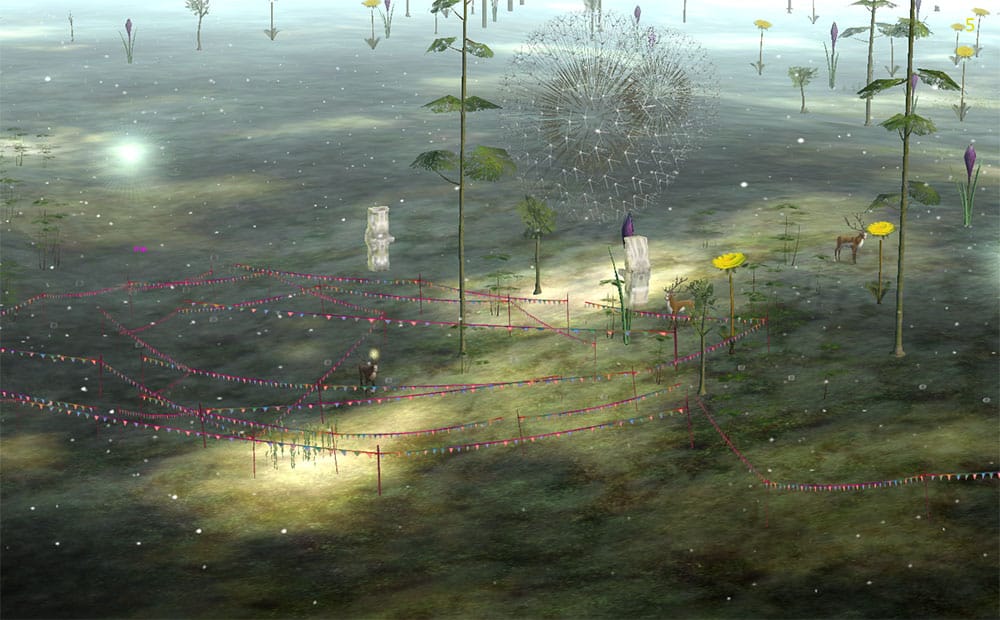
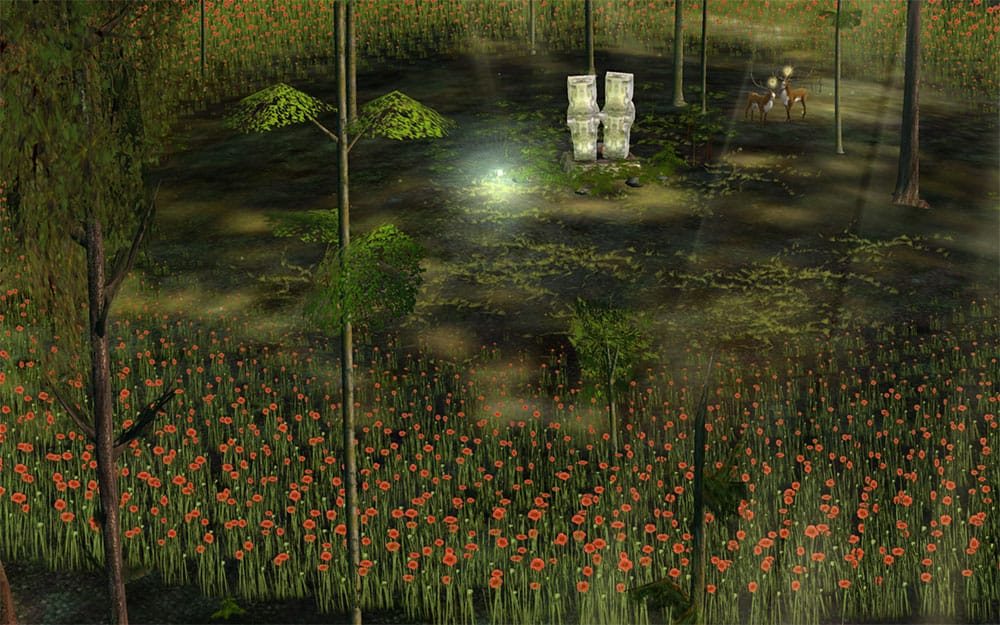
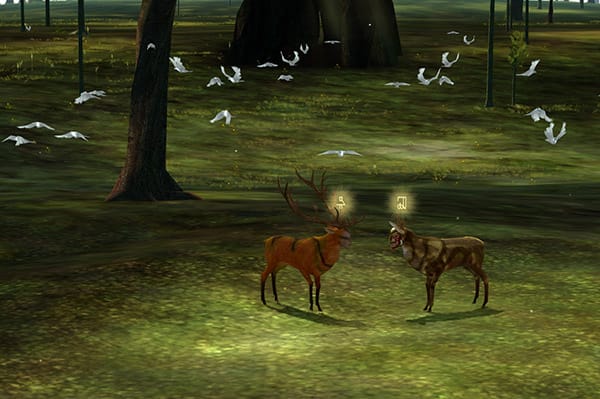
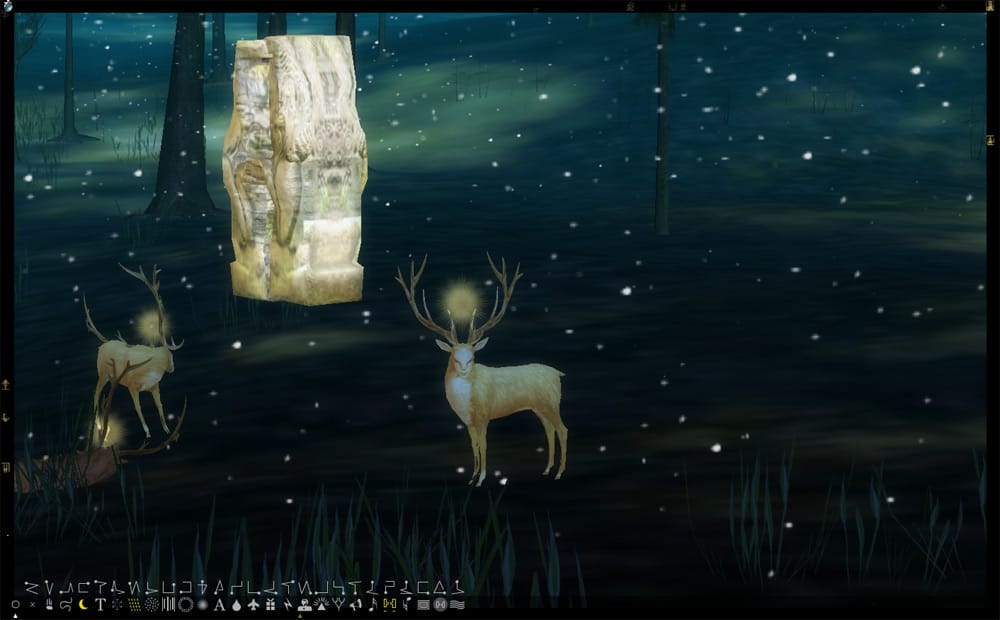
Tale of Tales, The Endless Forest, 2006, video game. Source: Tale of Tales
GameScenes: When and how did you and Michaël meet, and how did you discover that you both had a common interest in making artistic videogames?
Tale of Tales: We met in hell.
In an artists’ collective gathered on the hell.com domain at the turn of the century.
We first started making websites together, both artistic projects and commercial commissions. When the web bubble burst and Web 2.0 started, we lost faith in the web as a creative medium and community, and turned to videogames.
We both want to create immersive, interactive art.
So the choice was a natural one.
GameScenes: As game designers, I assume you played a lot of games before you began creating new interactive experiences, not unlike most writers reading many books before they start shaping their own fictional worlds. Can you recall your first videogame experience? What kinds of games do you enjoy, and which do you find inspiring for your own artistic exploration?
Tale of Tales: Would you ask a fiction author about his first reading experience? What are the chances that this is relevant to his current work?
Early videogames don’t inspire us at all.
Sure, we have played them, next to other games that children play. But it was only when videogame technology developed some aesthetic sophistication that we became interested.
For us, the history of videogames starts with Tomb Raider and Doom, not Pac-Man or Space Invaders, however much the latter amuse us as games.
And even then, we didn’t think of making games ourselves.
We were inspired by the way games immersed us in a virtual environment and allowed us to interact with autonomous virtual creatures. But we were always taken out of that enchantment by the demands of the game as game.
We didn’t care about challenges and rewards, about developing skills or acquiring goals.
We wanted to live the story in the game.
To be another person in another place for a while.
So when we started making videogames ourselves, that became our focus.
We wanted to design videogames that offered the potential of immersion and interactive narrative without the demands of competitive gameplay.
Many videogames contain elements that inspire us. But very few serve as a sort of reference.
Silent Hill 2 and Ico would be the most important ones because they demonstrate the entirely new power of this medium as a way to share emotions and explore narratives.
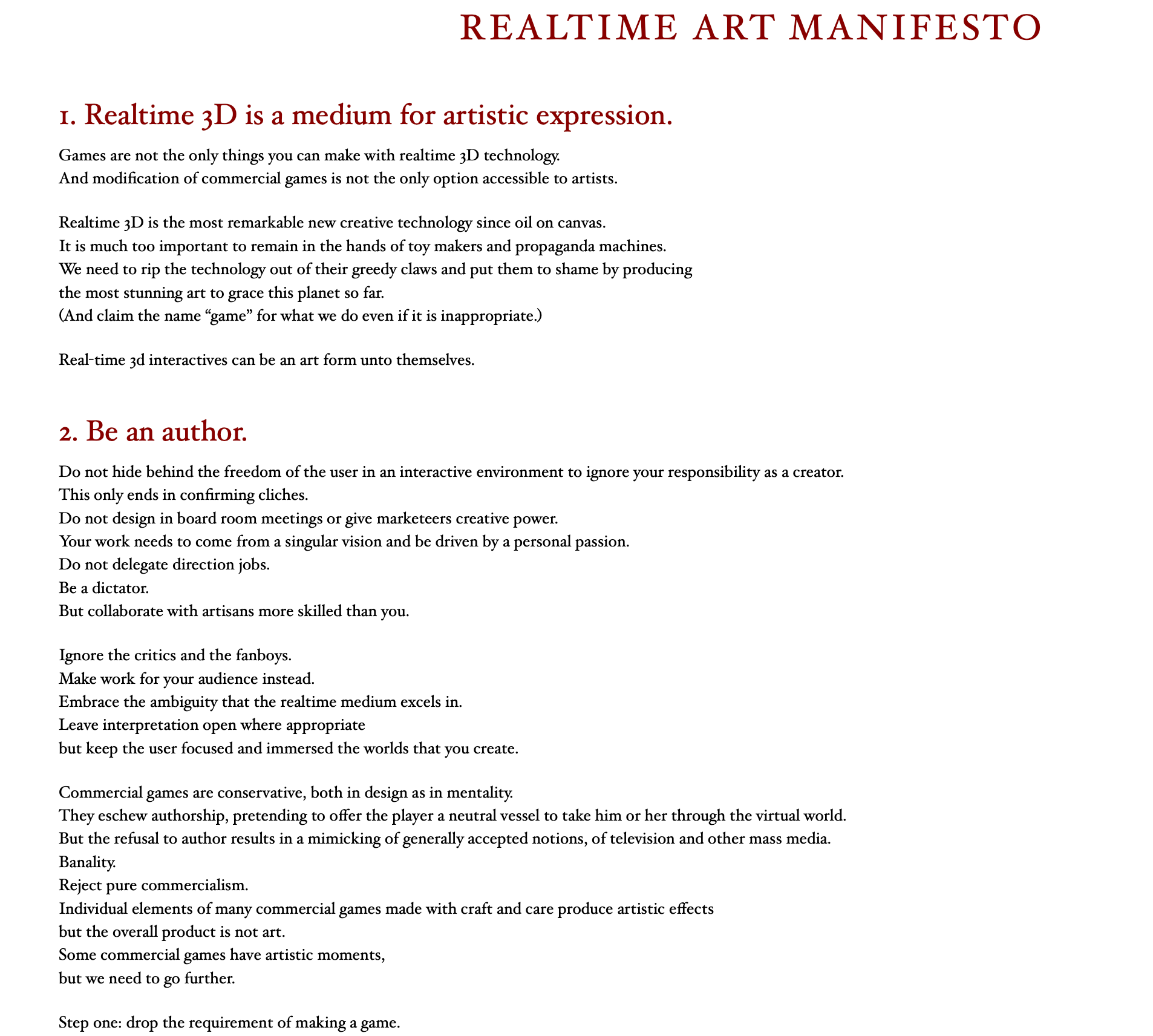
GameScenes: Your games have been displayed in art exhibitions around the world. Do you consider them primarily “art objects,” in the sense that videogame technology is simply a medium conveying a particular vision, or do you think the videogame is an autonomous art form comparable to film and literature? In your widely read Realtime Art Manifesto you state: “Make art-games, not game-art.” This sounds like a clear indication that one should use game technology to create artistic videogames rather than art objects. Am I completely off track?
Tale of Tales: We sometimes say that there are only two things in this world: good art and bad art.
So we don’t mind if our work is compared to Renaissance paintings or children’s games. All connections can be interesting.
When we chose to use computers and digital distribution for our art, it was primarily because we didn’t believe in the fine-art system.
The computer offered us a way to create and share our work directly with an audience, without critics, curators, galleries, or museums.
This is still the driving force behind our choice of medium.
All the exhibitions are really just icing on the cake, and sometimes a way to reach a different audience. But our focus is firmly on the creation and distribution of software.
Not just because of the wonderful potential of data to be duplicated endlessly, removing the need for the fetishization of the objet d’art, but because we are very interested as artists in the situation of software use.
A single user in front of a screen, interacting for hours on end in full concentration, is a superb situation for an artistic experience.
We’re enchanted by the intimacy of videogames.
GameScenes: In your manifesto, you also encourage designers to use “poetry” rather than “prose” as their modus pensandi and operandi, since realtime is a poetic technology. The Graveyard perfectly captures this philosophy as it is, first and foremost, a poetic game. What kinds of experiences are you trying to create with your work?
Tale of Tales: We’re not so much interested in communicating certain experiences as in creating circumstances for players to have their own experiences.
Of course our own emotions and opinions color our work and draw it in a certain direction. And so does the choice of subject matter.
But we don’t want to send a particular message with our work.
We only want to offer questions, opportunities.
What would it feel like to be this person in that situation?
The interactive medium allows us to simply create the person and the situation and allow the player to come to a conclusion about what that feels like, what it means.
This capacity for elegantly dealing with ambiguity and complexity makes the medium currently used by videogames one of the most powerful artistic tools for facing the challenge of postmodernism, a challenge that other art forms only flirt with at best, or simply ignore.
The medium of videogames is non-linear in nature.
Videogames are software. Like Photoshop and Word. Videogames are applications.
They are not movies.
They are not books.
Videogames deal with narrative the way that paintings and architecture deal with narrative. And indeed poetry.
When done well, videogames create an infinite potential for stories and meaning.
The experience of a videogame can be different for every player, and different every time.
This is an amazing quality, and perhaps even a realization of the dream that all previous art forms have had.
With this medium, we can finally do what Michelangelo, Rubens and Monet could only approximate and hope for.
GameScenes: You are situated in a liminal space between the art world and the game world, which probably makes fundraising extremely difficult. If you were to choose your natural or ideal environment, where would you locate your practice: in the art world or in the indie game scene?
Tale of Tales: As mentioned before, we don’t have much interest in the art world.
Though it is correct that one of our feet is in it, if only because we get funding from the art world.
It’s a pity that this is necessary.
It’s a pity that the games industry cannot organize artistic evolution of the medium from within. But luckily, some outsiders are not so narrow-minded about the medium as the insiders are.
Since our focus is on software distribution, a lot of art-minded people never get to see our work.
Sometimes they might encounter it at a media-art festival or in a gallery. But those are hardly ideal circumstances in which to appreciate it.
We really do want to make work that appeals to people who don’t play games.
But in practice, we’ve found it very difficult to reach that audience.
So, for better or for worse, we get the most response from within the games community. Often from the fringes, though, which makes us happy.
We often hear people say, “I don’t play games, but I would play yours.”
And this makes us very happy.
But we’ve also learned that within the gamer audience, there is a strong desire for other types of interactive experiences.
Even many fans of shooter games or racing simulators like taking a stroll through a less stressful and more fulfilling artistic piece once in a while.
They are not as obsessive and juvenile as many publishers and developers may think.
It’s a mistake to believe that the angry children who pollute the comments of game blogs represent any sort of critical mass.
It’s perfectly safe to ignore them.
GameScenes: Do you ever think about the future of games? What could they become in the next ten to twenty years? Do you expect them to mature and grow, both in form and style? Will game designers evolve and become as culturally influential as acclaimed filmmakers such as Kubrick, Fellini, and Bergman?
Tale of Tales: Oh, we sure hope so!
But we doubt that this can evolve out of the games industry as it is now.
Despite the desire in the public and the enormous potential for growth of the market, the industry does not seem to have much interest in anything but producing standard games.
Preferably the same games, over and over again.
Exclusively motivated by profit.
It’s a self-destructive strategy, as such an attitude suffocates all creative invention.
So you could say that it is certain that there will be Kubricks and Fellinis and Bergmans in the games industry of tomorrow because without such auteurs, there will not be a games industry tomorrow.
Let’s just hope that the games industry realizes this soon and starts to actively support and encourage artistic exploration of its medium.
Interview by Mathias Jansson.
All images courtesy of Tale of Tales.
Archival links
Tale of Tales
http://www.tale-of-tales.com/
Realtime Art Manifesto
http://www.tale-of-tales.com/tales/RAM.html
Originally published on GameScenes, July 23, 2010.