Suzanne Treister on videogames and virtual worlds
From the archive: Suzanne Treister on videogames and virtual worlds
Originally published on GameScenes on August 9, 2010.
This email conversation with British artist Suzanne Treister took place in August 2010 and was conducted by Mathias Jansson as part of Game Artworlds: The Early Years, a GameScenes series devoted to formative artists and works in game-based art.
Born in London in 1958, Treister studied at St Martin’s School of Art and Chelsea College of Art and Design. A painter throughout much of the 1980s, she began working with computers and digital media at the beginning of the 1990s, developing fictional systems, speculative worlds, and networked projects concerned with identity, history, technology, power, and the construction of reality.
Long before videogames had secured a place within contemporary art discourse, Treister was already examining their visual language and cultural logic. Her videogame paintings date to 1988; her Amiga works followed in the early 1990s. The interview traces this development through imaginary games and software, No Other Symptoms: Time Travelling with Rosalind Brodsky, and the fictional Institute of Militronics and Advanced Time Interventionality.
Editor’s note, 2026: This interview is republished as an archival document. Spelling, punctuation, capitalization, and evident typographical errors have been lightly standardized. The substance and historical perspective of the original exchange remain unchanged.
GameScenes: Suzanne, you’re considered one of the first artists who fully embraced gaming as a form of artistic expression. How and when did you begin to explore this medium for means different from pure entertainment? And what did you find fascinating about videogames?
Suzanne Treister: From the mid to late 1980s I spent several nights a week hanging out in amusement arcades in London’s Soho with my boyfriend, who was hooked on videogames.
Over time, waiting around for him to finish so we could go and eat or see a film, I started to think about the games, their structures, their objectives, their themes, their addictiveness. I started to consider their cultural subtexts, antecedents, the effect they may have on society and how they might develop and connect to other mechanisms, developments and fantasies or projections of the future.
At first I wasn’t so crazy about playing the games myself, until I got addicted to Tetris. Then, when I got my Amiga computer in 1991, I started playing some of the platform games, similar to the ones in the arcades, which had come free with the games magazines I was buying for research.
In 1995, when I visited Los Angeles for the first time, staying with friends for a week, I barely left the house. I spent almost the whole time killing and escaping from the Nazis and their dogs in the videogame Castle Wolfenstein, which my hosts were also hooked on.
GameScenes: Did you create your first game-inspired paintings back in the ’80s? Why did you decide to transfer digital interactions onto a canvas? What games did you find most inspiring?
Suzanne Treister: Yes. Just to backtrack a moment, in the 1980s, before I became interested in videogames, I made paintings using appropriated imagery from history and popular culture to describe hypothetical narratives, or possible ways of reading the world.
An early series had used themes and imagery relating to the USSR/Russia, while other works referenced literature, art history, war and religion in the mapping of imaginary scenarios. I saw them as a form of contemporary history painting.
On one level, much of this work originated from a desire to negotiate my family history, specifically the issues and historical events surrounding the relocation of my father from Poland/France to the UK during WWII, which in turn inevitably produced a fascination with the Cold War and the Eastern Bloc.
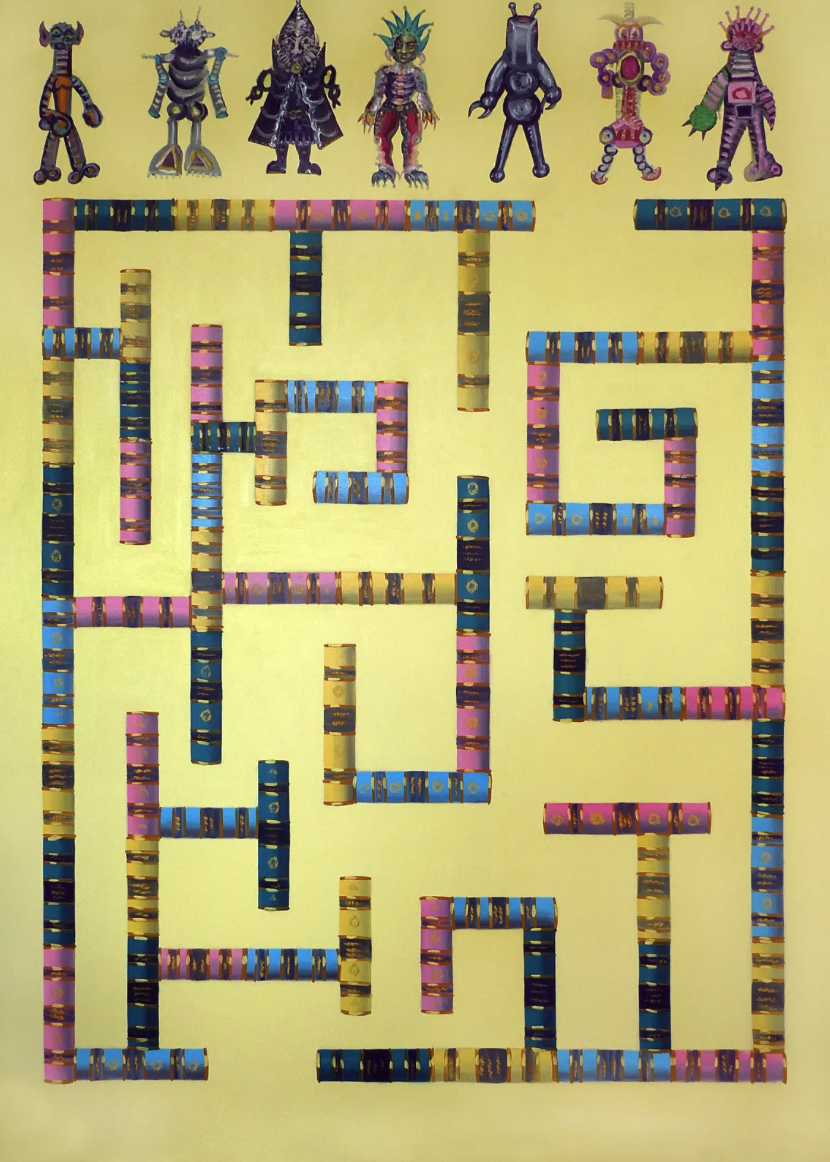
By the end of 1987 my paintings had begun to develop a more repetitive visual structure. Images such as book spines, candles, metal bolts and fluorescent lights were repeated in rows, blocks or mazes, housing other images or scenes. These works sometimes referenced ludic structures as ways of mapping space and encouraging the viewer’s interaction in a psychological sense.
In 1988 I made the first videogame paintings, substituting the characters or forms found in arcade games for historical characters or living persons and everyday objects.
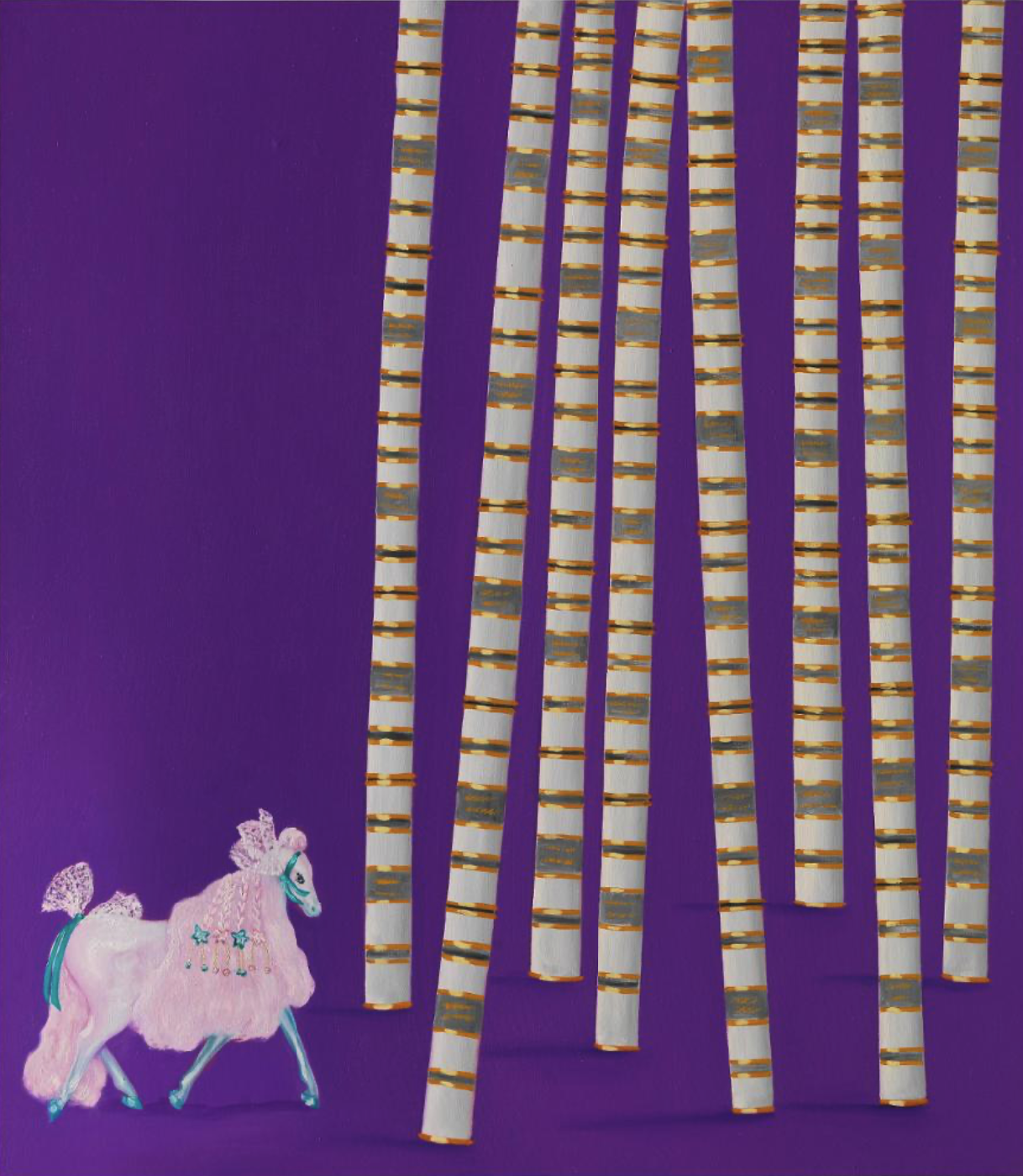
For example, Koons Kiefer Videogame, made in 1989, represented the US artist Jeff Koons as a kitsch toy horse about to enter the space of German artist Anselm Kiefer, depicted as a virtual forest of birch trees made up of end-to-end painted book spines.
The inclusion of “Videogame” in the title aimed to provoke an anticipation of a goal-oriented narrative at play, and in the case of the painting, and other related works to come, the development and outcome of this narrative was to be projected by the viewer.
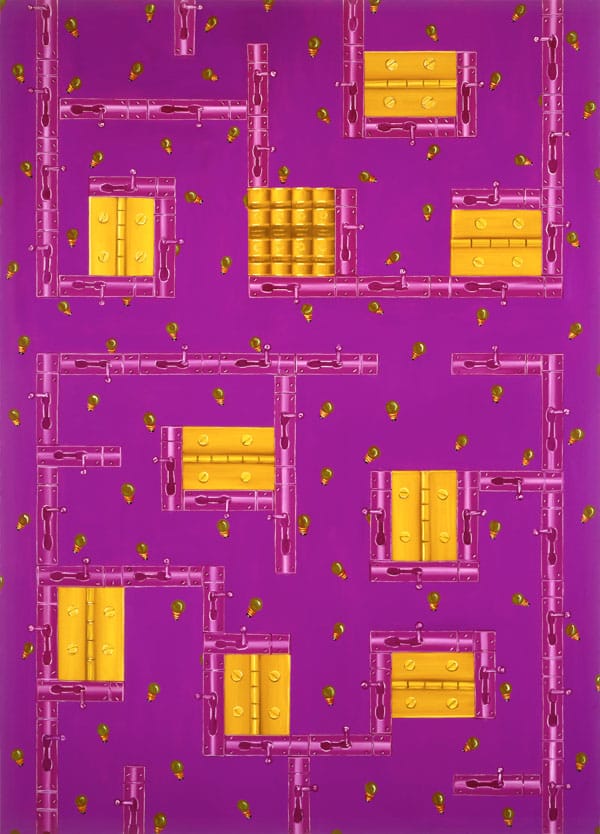
The second painting in the series was titled Videogame for Primo Levi. Levi was an author I admired, writing about his survival of the Holocaust.
I set up the structure of the painting/game as a maze of bolts and hinges through which clusters of green light bulbs had to make their way. The painting was stylistically overtly kitsch, but monumental in scale and reference, highlighting the problematics of artistic representations of history in relation to the corresponding horrific actuality of events, and in turn commenting on the anaesthetizing effect of videogame narratives, which were based for the most part on the idea of continuous killing or destruction in the pursuit of an ultimate and singular goal.
GameScenes: Were there other artists around at that time also interested in creating art inspired by videogames? Or did you feel that you were somehow alone in your exploration?
Suzanne Treister: In the 1980s there were no artists I knew of who were interested in making work about videogames, and curators who visited my studio didn’t even know what they were.
Nor did there seem to be any interest in the subject from within academia, although this changed abruptly a few years later with the expansion of the cultural studies industry.
Also, at the time of making my first digital works, I felt quite alone.
In 1991, when artist friends came to my studio and I showed them for the first time my Amiga computer humming on the paint-stained workbench, they would ask worriedly, “Of course you’ll only be using it to work out your paintings, won’t you?”
I was severely warned of the dangers of being “taken over by the machine.”
There seemed to be a misconception that the computer actually made the work, rather than the artist, and one could partly blame this on the term “computer generated,” which seemed to have mysteriously entered the language.
I wasn’t seduced as such by videogames or computers, but I felt I had to deal with them as they were not going to go away.
I had been, however, since childhood, seduced by science fiction, from the British TV series Doctor Who, The Tomorrow People and Adam Adamant Lives! to the writing of George Orwell, H. G. Wells and J. G. Ballard.
These, along with writers who interested me several years later, for example Bulgakov, Bassani, Umberto Eco, Borges, Bruno Schulz and William Gibson, plus my interest in psychoanalytic theory and obsession with the Holocaust and Eastern Europe, all these I would say in one way or another, however oblique, contributed to my move into the new-media world.
Within that, more explicitly, they contributed to a belief in the idea that narrativity and “reality” were becoming fluid and mutable within these new technologies, and to a suspicion that somehow the “interactive” videogame was an early embodiment of a whole new paradigm which needed to be observed and interrogated.
GameScenes: Between 1991–92, you created a series of fictional videogame stills using the Amiga’s Deluxe Paint II, and between 1993–94 you produced Software, a series of thirty-six imaginary software packages. What was the idea behind these fictional games?
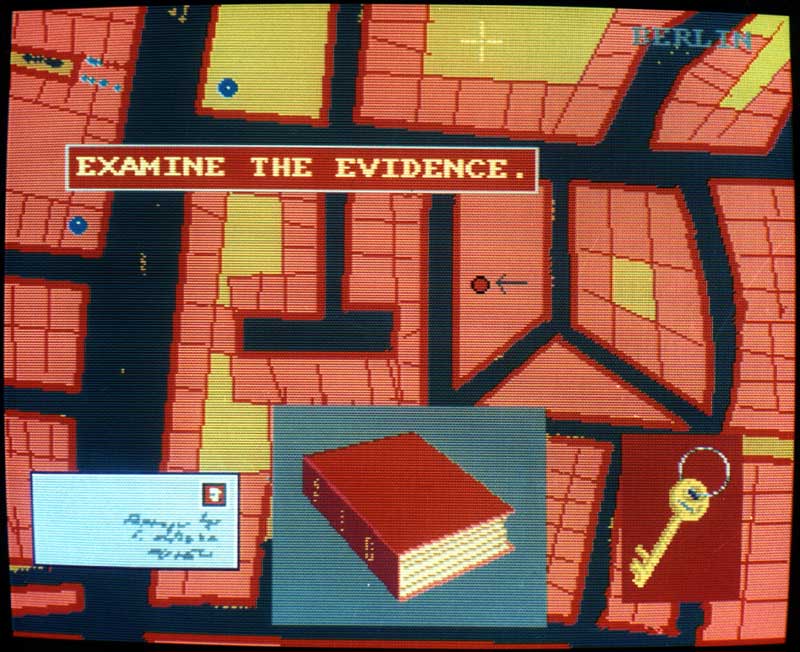
Suzanne Treister: The works I made on the Amiga computer were similar to the recent paintings but now incorporated digital effects, text and inevitably resembled far more closely the games themselves.
The titles of the works echoed the game titles on the screen. For example: Are You Dreaming?, Dream Monster, Easyworld 5, Examine the Evidence, Have You Been Sentenced to a Fate Worse Than Death?, You Have Reached the Gates of Wisdom – Tell Us What You Have Seen, Incidents Reported, Do You Know?, Lost in Space, Blinded by the Text, Monster Visions/Song Titles, Identify the Murder Weapon, Mutant Territories – Grand Prix, Quiz 2, No Quiz, and Quiz – 10 Questions.
In Mutant Territories – Grand Prix, the screen showed an aerial view of a racetrack made of jewels and the instructions on the screen read, “Drive around the map until you run out of petrol,” rather than the usual goal-oriented challenge of regular games.
Text was able to enter the works in an organic sense, in that the computer screen was a natural site of text: word processing, text messages, programming. All these manifest text on the screen, and I could play on this directly in the works whilst intimating broader subtextual narratives and readings.
Easyworld 5 contained only text instructions.
In front of a royal blue curtain appeared the words:
Determine your position on the screen and proceed at an even pace. So long as you know where you are you will be ok. Wait until you have decided where you want to go first. When you have made your decision move player 1 into a vacant box. Then the curtain will open slowly to reveal the object of your dreams. Wait for a few seconds and then press “EXIT”. You will have arrived at the scene of a crime. Welcome to Easyworld 5.
Rather than depict the usual suspects from actual games, or versions thereof, in many cases the scenarios were abstracted so that the viewer would have to insert their own hypothetical narrative and become themselves the protagonist. They would have to imagine their own persona rather than being given the role of a fighter or comic character.
I photographed these early Amiga works straight from the screen. The photographs perfectly reproduced the highly pixelated, raised needlepoint effect of the Amiga screen image.
Conceptually, this means of presentation was appropriate in that it made it seem like I had gone into a videogame arcade and photographed the games there, lending authenticity to the fictions.
In 1992 I worked on a new Amiga-based series which presented stills from a single imaginary videogame. This piece played on the phenomenon of computer system messages counterpoised with the cultural fear/fantasy of a technological future paradise.
Individual screen texts read in sequential order: Would You Recognise a Virtual Paradise?, Not Enough Memory for Operation, Presume Virtual Breakdown, You Have Entered a Virtual Wilderness, Software Failure..., Error Finding Question, No Message – Proceed.
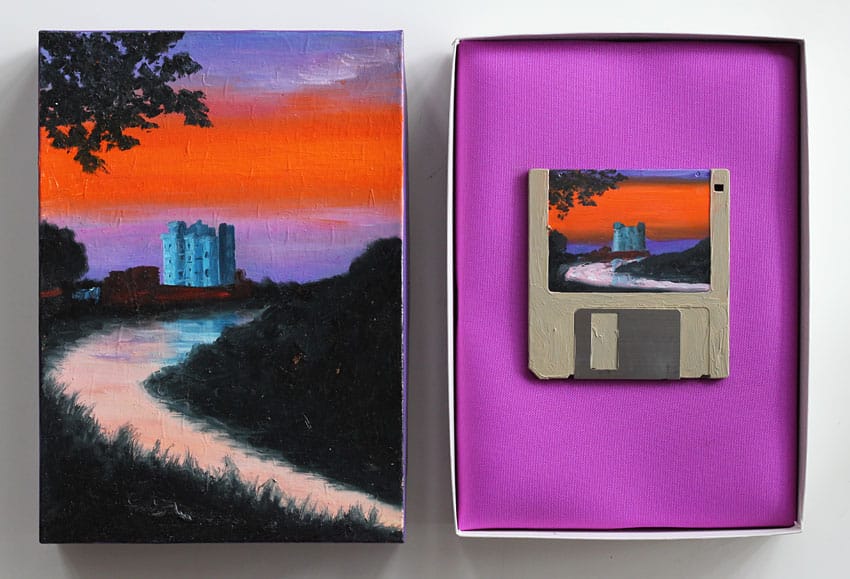
Between 1993–94 I made a series of fictional software boxes, each cardboard box and floppy-disc label painted to describe an imaginary game or piece of software where various things may happen, where a whole range of virtual experiences could be possible, from pornography to perpetual paranoia, from ethical hallucinations to torture.
GameScenes: Have you ever felt the desire to join the game industry or create art games? Can you share something about Rosalind Brodsky, a virtual persona responsible for a remarkable amount of your artistic production? What’s the story behind her conception? How is Rosalind connected to gaming?
Suzanne Treister: No, I never had the ambition to join the gaming industry, but I did make a game.
From 1997–99 I developed, in line with the developing games industry, an interactive CD-ROM, No Other Symptoms – Time Travelling with Rosalind Brodsky, which in many ways echoed the structure of quest games such as Myst.
I invented Rosalind Brodsky as an alter ego in 1995, and first I made her a set of time-travelling costumes.
The original biography of Brodsky went like this:
Rosalind Brodsky, with whom I share Anglo/Eastern European/Jewish roots, was born in London in 1970 and survived until 2058. Her first “delusional” experience of time travel supposedly occurred while she was in the middle of a session with the psychoanalyst Julia Kristeva in Paris, at the moment she noticed the similarity of Kristeva’s face to the photographic portrait of her Polish-Jewish grandmother who had been murdered in the Holocaust.
By 1995 Brodsky is a delusional time traveller who believes herself to be working in London at the Institute of Militronics and Advanced Time Interventionality (IMATI) in the twenty-first century.
IMATI is a controversial government-funded organisation which develops equipment and carries out time-travel research projects whose results are for use primarily by the military and other government research organisations.
Established in 2004, its mission is to carry out interventional historical, anthropological and scientific research through means of time travel.
Working with virtual technologies which render the users’ bodies invisible in their own time and space, the Institute develops virtual simulations of key moments in history. Researchers at the Institute then carry out simulated interventions/experiments within these virtual times/worlds.
In academic circles there is controversy as to the validity of this form of “anthropological” research, but there are many who suspect that IMATI has actually found the secret of authentic time travel.
The CD-ROM journey takes the form of a tour organised by IMATI in memory of Brodsky’s contribution to time-travel research.
In the introductory scene there is an announcement that a demonstration of armed academics is taking place outside the Institute, threatening the building, staff and visitors within. You, the player, now risk remaining in suspended time travel for the rest of your life.
The aim is to survive by navigating the space of Rosalind Brodsky, with escape eventually only possible via her satellite spy probe, from where a shuttle will transport you back to Earth to an underground home in the mining town of Coober Pedy, South Australia, in the present day.
The tour uncovers biographical and historical data focusing on much of her life, work and personal interests.
During her lifetime Brodsky carried out major research in areas of film, TV, music, architecture, genetics, the history of Eastern Europe, the Holocaust, the 1960s and the Russian Revolution, as well as contributing to the research and design of a range of time-travel equipment.
From Brodsky’s study, concealed behind a memorial wall, you are able to travel to her home in Bavaria, journey from there to her satellite in outer space — constructed from Christo’s wrapped Reichstag, teleported by IMATI from Berlin in 1995 — access her electronic time-travelling diary, her feature vibrators, and discover the time-travelling costumes and attaché cases in her wardrobe.
The wardrobe conceals the entrance to a lift which takes you down to the Clinics.
The Clinics is an underground laboratory where, for analysis, due to the decline of psychoanalysis in the twenty-first century, stressed time travellers must travel back in time to the homes of Freud, Jung, Klein, Lacan and Kristeva.
Brodsky’s case histories with these analysts are documented, as are recordings of her time-travelling cookery TV show and the music videos of her band, who were popular in Eastern Europe in the 2030s.
The CD-ROM was completed and published with a book in 1999.
Since then I have not made any game-based works except for the inclusion of three video “training demos” in the 2009 project MTB [Military Training Base], which used footage of actual geographical sites: Donald Judd’s ex-military base/art foundation in Marfa, Texas; the ruins of the Palace of the Queen of Sheba in Ethiopia; and the Unabomber’s cabin in Montana.
Since 2001 I have made works developing from the Brodsky project, documenting and displaying, in installation, web and DVD form, the IMATI Time Travel Research Projects which had supposedly been carried out at IMATI.
These include Golem/Loew – Artificial Life, Operation Swanlake, and HEXEN 2039. I am currently working on the sequel, HEXEN II.
All images courtesy of the artist.
Interview by Mathias Jansson.
Archival links
Suzanne Treister
http://ensemble.va.com.au/Treister/
Amiga Work: Selected Fictional Stills 1991–1992
http://ensemble.va.com.au/Treister/Ampages/Amenu.html
Treister’s essay on Amiga Work: Selected Fictional Stills 1991–1992
http://ensemble.va.com.au/Treister/Ampages/Treister_Essay.pdf
MTB [Military Training Bases]
http://ensemble.va.com.au/Treister/MilitaryTrainingBases/MTB.html
Rosalind Brodsky Time Travel Research Project
http://ensemble.va.com.au/tableau/suzy/TT_ResearchProjects/TTRP_menu.html
Originally published on GameScenes, August 9, 2010.