Robert Nideffer on The Tomb Raider Patch and early game art
Originally published on GameScenes on April 13, 2010.
This email conversation with artist, researcher, and educator Robert Nideffer took place in March 2010 and was conducted by Mathias Jansson as part of Game Artworlds: The Early Years, a GameScenes series devoted to formative works, exhibitions, and practitioners in game-based art.
At the time of the interview, Nideffer was Professor of Studio Art and Informatics at the University of California, Irvine, Co-Director of the Art, Computation and Engineering program, Director of the UCI Game Culture and Technology Lab, and affiliated faculty in Visual Studies.
The conversation centers on his contribution to Anne-Marie Schleiner’s landmark online exhibition Cracking the Maze (1999): a work that intervened in the circulation of the infamous Nude Raider patch by “patching the patch.” From there, Nideffer reflects on SHIFT-CTRL (2000), the institutional reception of game-based art, and the rapid transformation of the field during the 2000s.
Editor’s note, 2026: This interview is republished as an archival document. Spelling, punctuation, capitalization, and evident typographical errors have been lightly standardized. The substance and historical perspective of the original exchange remain unchanged.

GameScenes: In 1999 you took part in the seminal exhibition Cracking the Maze. For that event, you developed a now legendary patch for Tomb Raider. Can you tell me something about the exhibition, how you got involved, and whether you had earlier experiences with videogame-based art?
Robert Nideffer: As you probably know, the exhibition was curated by Anne-Marie Schleiner, a very interesting artist in her own right. It was the first online, specifically game-art-focused exhibit I’m aware of.
I found her concept really interesting. If memory serves correctly, she put out some sort of call and I responded to it, and she was gracious enough to let me do something for the show.
At that point I’d certainly played a lot of videogames, and had been doing some work that either had elements of games in it and/or was inspired by games, but it wasn’t really the main focus of much of the work in the way it’s become over the past ten-plus years since.
For example, I’d done my PhD in the social sciences a few years earlier, Bodies, Nobodies, and Antibodies at War: Operation Desert Storm and the Politics of the “Real” (1994), as an interactive CD-ROM dealing with the mediation of the Gulf War of ’91.
The role that the trope of “gaming” played in that project was a pretty big part of the analysis, as was the inclusion of actual game media that was being produced at the time and which was part of the general “discursive terrain” of the war effort, so to speak — not to mention all the war-game simulation General “Stormin’ Norman” Schwarzkopf was using to prep soldiers for the battlefield down in Florida.
Post-PhD, as an MFA student, I got the chance to production-manage and art-direct another CD-ROM project in collaboration with the noted physicist Stephen Hawking called Life in the Universe. In addition to the overall UI being pretty playful and game-like, it incorporated a couple of Director-based games: one to replicate RNA sequences, and another to decode radio signals, inspired by Hawking’s liking and support of the Search for Extraterrestrial Intelligence, or SETI, Institute’s mission.
Other than that, it was mostly just little hacks and experiments for fun.
GameScenes: What was the intention behind the Tomb Raider patch? It played a very influential role in the history of Game Art.
Robert Nideffer: Ummm, well, I’m not sure I would dare claim it as such, but gee, thanks!
The theme of Schleiner’s show was the game “hack,” “patch,” or “crack.” In that context, the crack became a means to reflect on gaming culture from another angle, and to attempt to contribute to the formation of new configurations of game characters, game space, and gameplay.
At the time of the show, the real Tomb Raider, published by Eidos Interactive, and its main heroine Lara Croft, was an extremely popular videogame franchise.
So popular, in fact, that it had become the target of one of the most famous underground game patches called Nude Raider, which stripped the title character of what little clothes she had.
I decided I wanted to “patch the patch” for my project.
In that interest, Tomb Raider consisted of three parts:
- An appropriated website where I repurposed the existing commercial site.
- A spoofed mail server that rerouted messages submitted to her fan-club website to the Director of Development at Eidos UK as if they were coming from the Director of Marketing in the US branch.
- A patched version of the Nude Raider patch, which placed police-blotter-style bars across Lara’s private parts — and gave her a goatee as a Duchampian homage — thwarting the game player’s expectation of seeing her polygonal private parts.
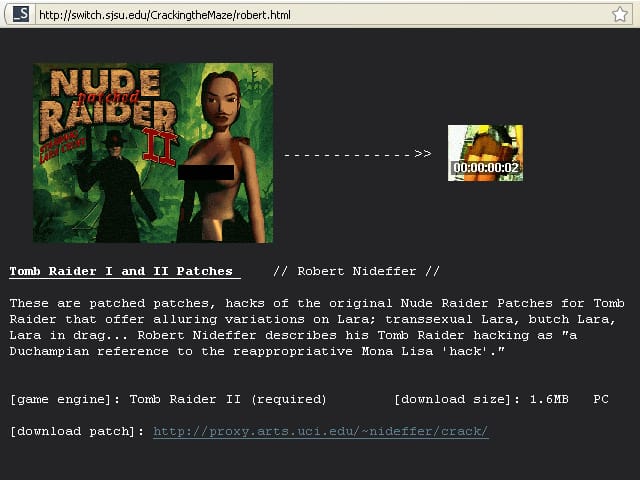
GameScenes: Did people back then “get” this particular artwork? I mean, it paid homage to Duchamp’s L.H.O.O.Q., but in a videogame context. However, if the viewer was not familiar with the original artifact or did not have a clue about Lara Croft, she or he was bound to miss out on a significant part of the artwork.
Robert Nideffer: Well, comprehension is always an issue, isn’t it?
There are certainly plenty of times, after it’s all said and done, that I’m not even sure I understand what my work’s about. Usually I just try to make up compelling enough stories after the fact — for merit and promotion, for interviews, or simply for my own need to feel I’ve done something worthwhile with my time!
Seriously though, you’re absolutely right, and such things as tongue-in-cheek — or Van Dyke on chin — nods to Duchamp, or my patch’s relationship to the original Nude Raider patch, for example, are often easily lost in the mix.
I remember one critical review where the piece was mentioned and the author, though she was quite flattering — and an extremely smart theorist — interpreted the piece in a completely unexpected way, and certainly not one I’d thought much about when making it.
That’s not to say it wasn’t a perfectly valid reading; it was just comprehension of another sort.
So I guess all I’m trying to say is that “getting it” is a tricky game, and often has little, if anything, to do with authorial intent, goals, and objectives. That can be the beauty and/or the horror of it.
GameScenes: The following year you organized an equally important exhibition with Antoinette LaFarge titled SHIFT-CTRL. What was the idea behind this event? And why was it held at the Beall Center for Art and Technology?
Robert Nideffer: SHIFT-CTRL was the inaugural exhibition for the Beall Center for Art and Technology, then a brand-new media-art facility at the University of California, Irvine campus.
It was one of the first international exhibitions to showcase the use of game metaphors, design principles, and technologies as part of a critical art practice. We felt this was particularly important to do as games exploded from a niche market dominated by a youth demographic to occupy cultural center stage.
The exhibition showcased a broad array of creative work related to gaming and provided alternative models for looking at how computer games and gaming culture were affecting the larger society.
We had a pretty good budget, so we could do it right. The show was supported by Rockwell International, the Beall Family Foundation, RareCSP, Attachmate Corporation, Antenna Design New York Inc., Apple, and Toshiba America.
The works were clustered into three main conceptual categories: “role-playing games as shared social spaces,” “evolvable and emergent systems,” and “world hacks.”
SHIFT-CTRL was pretty well received and got coverage in a variety of media, including the Los Angeles Times, OC Register, OC Weekly, GameFace Magazine, NPR, and PBS affiliate KOCE-TV.
The Beall Center was, interestingly enough, endowed by Donald Beall, who was the retired Chairman and CEO of the Rockwell Corporation — a transnational corporation renowned for the manufacture of electronic controls and communications, particularly in the fields of avionics, munitions, and manufacturing.
However, Mr. Beall is credited with streamlining Rockwell’s management program and steering the company away from its dependence on the defense industry to focus on commercial electronics.
My understanding was that he gave the grant to UCI as a gift to his wife Joan, who had been very active in promoting K–12 arts education in Orange County. Apparently, rumor has it, they at least liked the show!
In general it was very well received by the campus, the surrounding community, and the media, which was great since it was a bit of a risk at the time.
People came from all over the Southern California region, and beyond, to see it. Lots more kids and families came than was expected or usual for art shows on campus; teachers brought classes on field trips, and so on.
We were pretty pleased with how popular it was while up.
GameScenes: How would you describe the North American Game Art scene a decade ago? Was there any interest in ludic-artistic interventions, or was digital gaming largely ignored in artistic contexts?
Robert Nideffer: Well, it still can be hard to convince some people that videogames can be art objects. But it remains equally hard to convince them that urinals can be art objects too!
Convincing people what should or shouldn’t count as art is at least as thorny a problem as comprehension.
I remember soon after coming to the UCI campus, around the time frame you mention, or maybe a little before, I gave a talk to a group of very smart people from all over campus interested in information technology, computing, HCI, social theory, and so on.
At the end of my presentation, which included a number of game-related projects, the first question I got asked was: “Well, that’s all very interesting, but what makes it art?”
Not missing a beat — I suppose because such a response was not entirely unexpected — I queried back: “Because I’m in the art department?”
At least they laughed.
But to try to respond more directly to your question, my sense at the time was that, at least in terms of the people I was dealing with — which included other artists, as well as colleagues from a variety of other disciplinary locales, critics, historians, and the general public — people were quite curious about what was going on.
The fact that it was happening within a “fine art” frame of reference didn’t seem to be an issue. If it was, I never heard about it.
GameScenes: Looking back at the early years of Game Art, is there anything that you find surprising about its evolution?
Robert Nideffer: It’s certainly been exciting to watch how much it’s grown, and how sophisticated and facile new generations of artists are in working with the medium, both technically as well as conceptually, particularly those who come out of a strong critically informed background and training in the arts.
It’s also been interesting to watch various cultural institutions — galleries, museums, universities, just to name a few — make moves to embrace game-inspired art, culture, and technology.
My sense is that many people and places are struggling to make sense of and situate what’s happening “on the ground.”
That struggle often reflects a variety of mixed motives: games being presented as “art” as a way of bringing more bodies through museum doors; courting resource-rich game companies into sponsoring cultural events by framing the visual components of their products as fine art; game-centered academic programs being developed to boost flagging enrollments in certain disciplines and/or to try to get corporate kickbacks, and so on.
But those mixed motives, and the attempted sense-making, are a big part of what keeps it interesting.
I just wish I could be around fifty years from now to see what’s going on.
Interview by Mathias Jansson
Archival links
Robert Nideffer
http://nideffer.net/
The Tomb Raider Patch
http://nideffer.net/proj/crack/
SHIFT-CTRL
http://nideffer.net/promo/pdf/leonardo.pdf
Related: Anne-Marie Schleiner on Cracking the Maze
https://www.gamescenes.org/2009/12/interview-annemarie-schleiners-cracking-the-maze-1999-10-years-later.html
Originally published on GameScenes, April 13, 2010.