Martin Berghammer on RELOAD and the early game art scene
Originally published on GameScenes on February 7, 2010.
This email conversation with artist and curator Martin Berghammer took place in January 2010 and was conducted by Mathias Jansson as part of Game Artworlds: The Early Years, a GameScenes series devoted to formative exhibitions, artists, and works in game-based art.
Berghammer founded Shift e.V. in Berlin in 1995 with a group of local artists. During its six years of activity, the independent non-profit organization presented approximately twenty-five exhibitions, lectures, and events concerned with crossover tendencies in contemporary art.
In 1999, Shift presented RELOAD, an exhibition that approached videogame modification, networked play, virtual architecture, and the emerging culture surrounding Quake as material for contemporary artistic practice. The project subsequently traveled to other European venues.
In this interview, Berghammer reconstructs the exhibition’s development, its relationship to the modding culture of the late 1990s, Stefan Wieland’s exhibition architecture, and the sometimes unexpected responses of visitors encountering playable game spaces inside an art gallery.
Editor’s note, 2026: This interview is republished as an archival document. Spelling, punctuation, capitalization, and evident typographical errors have been lightly standardized. The substance and historical perspective of the original exchange remain unchanged.
RELOAD @ Shift, Berlin, opening night, September 25, 1999
GameScenes: Can you tell me something about the creation of Shift e.V. gallery in 1995?
Martin Berghammer: Shift e.V. was a privately held non-profit art organization founded in 1995 by myself and a group of Berlin-based artists.
We provided a platform for exhibitions, lectures, and events that dealt with crossover tendencies in contemporary art. After six years and nearly twenty-five exhibitions, Shift closed its doors in spring 2001.
GameScenes: What’s your relationship to art and videogames?
Martin Berghammer: I am an artist. I started as a painter in the 1980s, later switched to installation, and worked with different media including Super-8 film and video.
I founded Shift in 1995 and ran it as director and curator for six years.
I became interested in videogames in the early 1990s. I played some “harmless” adventure games, like Myst. At that time I discovered CD-ROM projects from artists and musicians that were built around a game aspect, such as Freak Show by The Residents.
The game Quake caught my attention not because of its furious action, but because it was the first game to allow networked, IP-based gaming. It seemed like a good example of a 3D environment providing real-time interaction and communication through chat.
After becoming a gamer myself, which I felt was a necessary step in order to be able to work with it, I became aware of the various peculiar and creative aspects of gaming culture.
Any modification of the game, its levels and characters, required a lot of coding experiments with buggy editors and handcrafted tools released by other gamers. Everything was “learning by doing.”
I noticed an interesting momentum here: a growing subculture connected to a technical revolution had begun to enter the mainstream.
Such a wave could serve as a metaphor for how culture mutates in general, as well as how cultural borders are transgressed.
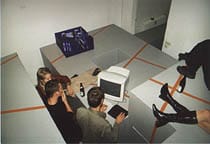

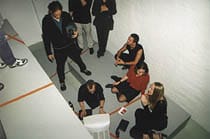
RELOAD, SHIFT, Berlin, September 25–December 12 1999. Source: Reload
RELOAD, Shift e.V., Berlin, 1999
RELOAD examined videogames as networked environments, social spaces, and emerging cultural forms at a moment when online gaming was still widely dismissed as a marginal or unproductive activity. The exhibition moved between three registers: physical space, architectural model, and virtual environment. Four artists modified Quake to create new playable spaces. Tom Ehninger reconstructed Robert Mallet-Stevens’s 1923 Sketch for a House; Holger Friese replaced the game’s conventional textures with imagery from his personal archive; Christine Meierhofer transformed an existing level into a disorienting wireframe environment; and Florian Muser and Imre Oswald, working as NoRoom Gallery, recreated the Hamburger Kunsthalle extension as a game space. Stefan Wieland designed an exhibition architecture that required visitors to navigate the gallery much like a game level, while Astrid Herrmann produced physical models derived from videogame screenshots, a process she described as “de-virtualizing.” Four networked stations allowed visitors to play the modified levels locally and online, extending the exhibition into a shared digital space.
GameScenes: I found this comment about RELOAD very interesting: “Despite their enormous economic and social relevance, online games are still reduced to being a waste of time and appropriate only in the realm of nerds and slackers.” It seems to me that the idea that videogames could indeed be art must have been regarded with disbelief and scorn at that time. On the other hand, RELOAD toured Germany during 1999–2001, so there must have been a growing interest in this new form of art?
Martin Berghammer: In the early 1990s gaming was still an underground phenomenon, unnoticed by the mainstream and not taken seriously in the contemporary art world.
Only a few media artists worked with modifying computer code, HTML pages and games, and formed an outsider group within the art world.
Working in that field required quite a lot of technical skills, and the audience also needed a certain amount of expertise in order to fully understand the work.
By the mid-1990s the aesthetics of computer, game and web interfaces slowly started to invade mainstream media like news television, advertising or MTV music clips, and artists became more aware of the potential of the web and virtual space as sources of material and inspiration.
Through researching the topic on the web, I discovered the work of some of the other artists mentioned earlier in this interview series who had worked in 3D game space, but the intellectual processing of that whole phenomenon had not yet really begun.
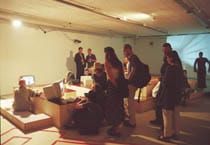
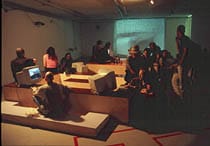
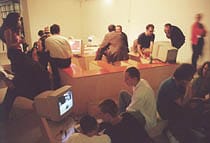
RELOAD, Kunstbunker/Nürnberg, June 3– July 2 2000. Source: RELOAD
RELOAD, Kunstbunker, Nuremberg, 2000
The second version of RELOAD was presented at the Kunstbunker, Nuremberg, from June 4 to July 1, 2000, as part of log.in – netz|kunst|werke, a project organized by the Arbeitsgemeinschaft Kultur im Grossraum Nürnberg in cooperation with the Institut für moderne Kunst. As in the Berlin edition, Stefan Wieland developed a walkable structure conceived specifically for the exhibition space, functioning simultaneously as sculpture and display architecture. This time, the oversized letters formed the word LOADED, supporting the monitors and keyboards used throughout the installation. The works by Tom Ehninger, Holger Friese, Christine Meierhofer, and NoRoomGallery again consisted of modifications of Quake. Six computers were connected through a local network, allowing visitors to explore the artists’ virtual environments and play against one another. The subterranean setting of the Kunstbunker created a particularly charged context for the exhibition. Its enclosed, claustrophobic architecture echoed the spatial tension of Quake itself, intensifying the relationship between physical site and virtual game space.
Produced by Shift e.V., Berlin / Martin Berghammer.
GameScenes: How did you select the artists for the exhibition?
Martin Berghammer: When I started to play Quake myself, I immediately knew that there was an art project somewhere in there, but didn’t quite know how to approach it.
In 1998, while playing online, I met Florian Muser and Imre Oswald, who had built a Quake level representing the Hamburger Kunsthalle.
That was a starting point.
I invited them and several other artists whose work dealt with architecture, 3D and/or internet-based media art to contribute to a gaming project. Only some of them had experience with gaming and/or Quake.
A bunch of blinking computer screens in an empty room always looks a bit odd. I therefore decided to go for a “real space versus hyperspace” concept for the show, since I thought it was important to base it within actual, physical space.
The main conceptual decision we made in modifying Quake was not to deconstruct — that is, destroy — the game, but to work within the given environment and let the software remain “playable,” to keep it fun.
The group working on the digital pieces quickly became a team, helping each other with the many technical challenges they were facing.
Muser and Oswald’s “Hamburger Kunsthalle” level was basically finished when I invited them. The piece was later acquired by the museum.
The other Quake levels were commissioned for the show, and production time was several months.
We had a public Quake server running during the exhibition that allowed players from outside to join in. You had to download and install the modified levels from our website.
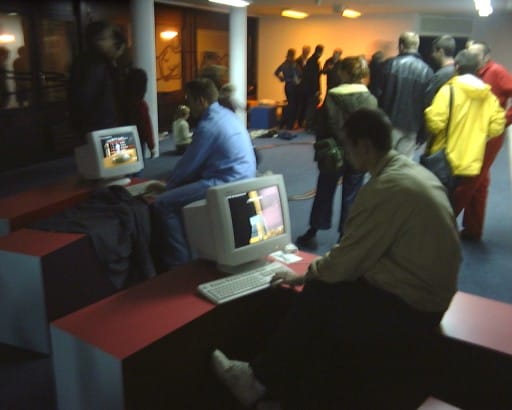
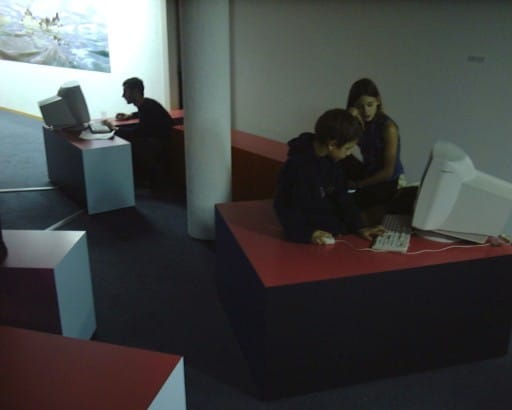
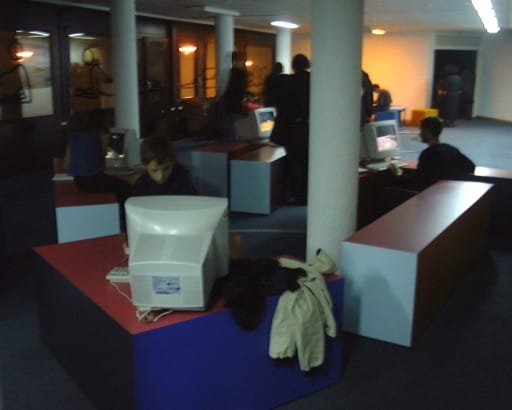
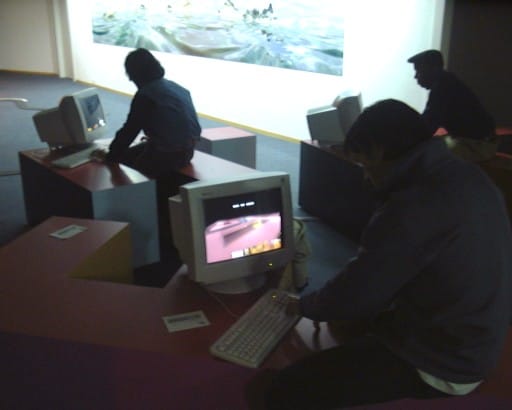
RELOAD,Geneva, November 3– December 17 2000. Source: RELOAD
RELOAD, Geneva, Switzerland, 2000
Presented within version_2000 at the SGG – Centre pour l’image contemporaine in Geneva, RELOAD_2000 was a streamlined iteration of the earlier RELOAD project. This version shifted from Quake to id Software’s Quake III Arena, enabling a closer integration of physical exhibition architecture and virtual game space. At its center was Stefan Wieland’s sculptural structure composed of the oversized letters F U C K !. Mounted on wheels, the elements could be rearranged to form LOST, while also functioning as supports and interfaces for the computer stations. The same transformation appeared inside a Quake III Arena level jointly developed by Tom Ehninger, Holger Friese, Christine Meierhofer, and NoRoomGallery. Up to four visitors could enter the environment through a local network and play against one another, linking movement through the gallery to navigation within the game. Barak Bar-Am’s Flash 4 animation fuckin’ lost visualized the transition from “FUCK!” to “LOST” and functioned as both web interface and digital translation of Wieland’s architecture. The Geneva edition concentrated the central idea of RELOAD: the reciprocal construction of real and virtual space through sculpture, software, networked play, and interface design.
GameScenes: The exhibition designer was Stefan Wieland. Can you explain the main idea behind his innovative and original design?
Martin Berghammer: Stefan Wieland’s piece was a hybrid between sculpture and exhibition architecture, spread across all the rooms, and consisted of six giant letters forming the word RELOAD.
As often in his work, he used a word or text fragment as a starting point, reducing it to a simple object that still subtly referred to its original meaning.
Working directly with the proportions of the exhibition space, he transformed it into a sort of real-world game level, playfully forcing the visitor to navigate through the gallery by climbing over and around the sculptural components.
Furthermore, the sculpture, while elegantly hiding the computer hardware, served as a stand for the four terminals running the Quake mods, as well as providing a pedestal for Astrid Herrmann’s architectural models of game-space interiors.
In the second edition of RELOAD, which traveled to Geneva, Nuremberg, Munich and Frankfurt, we tried as a group to merge the two realms a little more.
Using the new version of the game, Quake III, we designed a virtual representation of Stefan Wieland’s new sculpture as a single game level in the form of the word LOST.
GameScenes: What was the reaction of the public to the exhibition?
Martin Berghammer: Well, as is often the case when people encounter a screen in an exhibition, here they were also initially in more of an observation mode.
Then they would hesitatingly grab the mouse and begin to click it.
Others would ask me what to do, so I would give them a brief introduction and show them how to get around... and off they went on a virtual stroll.
Visitors familiar with games immediately felt comfortable, as did some Turkish teenagers who came to play every afternoon with their McDonald’s food in hand, as if the gallery were a gaming arcade.
After a few weeks we had to kick them out, though...
Once a curator stormed in and loudly declared himself to be a pacifist.
Later that night he was the last person to leave and we had to pull the plug on him.
GameScenes: What surprised you most?
Martin Berghammer: I was definitely surprised by how quickly and seriously the whole topic of games and virtual space was taken over by academia and theorists.
I am stunned — and at times dismayed — by the momentum of this technical (r)evolution, in particular by the extent to which it now overstimulates and governs our lives.
The boundaries between reality and virtual space are blurred more and more: head-up displays in cars, air-tags for cell phones, military equipment, etc.
You might even say that we’re already living in a gamer’s science-fiction world today.
Video gallery
Florian Muser and Imre Oswald: Hamburger Kunsthalle
Muser and Oswald created a 3D version of the Hamburger Kunsthalle as a game space and arena.
https://www.youtube.com/watch?v=SM-AXBhX16o
Holger Friese
Web artist Holger Friese built a level from scratch, ignoring the conventions of level building and using textures and graphics recalling his previous work, thereby creating a kind of walkable catalogue.
https://www.youtube.com/watch?v=iV8D5_r4Fxc
Tom Ehninger
A fan of French avant-garde architect Robert Mallet-Stevens, Tom Ehninger recreated the architect’s 1923 “Sketch for a House” as a Quake level that proved very popular among players.
https://www.youtube.com/watch?v=uAQl21ZfCX8
Christine Meierhofer
Christine Meierhofer modified and abstracted an existing Quake level by replacing its textures, objects and player figures with black-and-white wireframe drawings.
https://www.youtube.com/watch?v=ee_NkITegO4
Interview by Mathias Jansson
Originally published on GameScenes, February 7, 2010.