Margarete Jahrmann on Synreal, Nybble-Engine, and ludic intervention
Originally published on GameScenes on March 4, 2010.
This email conversation with artist and researcher Margarete Jahrmann took place in March 2010 and was conducted by Mathias Jansson as part of Game Artworlds: The Early Years, a GameScenes series devoted to formative artists, exhibitions, and projects in game-based art.
In 1995, Jahrmann and Max Moswitzer launched Konsum Arts_Server, setting up a Linux server connected to a local network of servers in Vienna. Their subsequent projects investigated multiplayer environments, game-engine modification, network infrastructure, and the relationship between virtual systems and physical exhibition spaces.
The interview looks back at the influential Synreal exhibition of 1999, Jahrmann’s early modification of the Unrealengine, the development of LinX3D and Nybble-Engine-ToolZ, and her later work with the Ludic Society, where urban play became a means of examining networked space, surveillance, and invisible infrastructures.
Editor’s note, 2026: This interview is republished as an archival document. Spelling, punctuation, capitalization, and evident typographical errors have been lightly standardized. The substance, terminology, and historical perspective of the original exchange remain unchanged.
GameScenes: When did you start playing videogames? And why did you decide to use them for your artistic interventions?
Margarete Jahrmann: Well, when I was still at school, playing with my first computer — that was in the mid-’80s.
The first game which impressed me was a black-and-white game for Macintosh called Cosmic Osmo. It was a sweet alien, aesthetically appealing and clever, and reminded me of comics.
In terms of gameplay I liked Shuffle Puck at this time — a nice, relaxing reaction booster.
The switch to working with games came later. In 1999 I created the first game-engine modification, which was then exhibited at the Synreal show in Vienna and other places.
GameScenes: The Synreal: The Unreal Modification exhibition in 1999 was a starting point for many artists experimenting with Game Art. Can you tell me something about your experience?
Margarete Jahrmann: I started artistically to work with games with Synreal.
The game I made was called “superfem” sth. It was playing with textures of different operating systems and aimed to establish a sort of “identity” by showing the login-screen surfaces of the machine you started your application on.
It was quite sophisticated already, involving multiuser functionality based on the Unreal engine.
For example, if you came from a Unix system, or Windows or Macintosh system, you could shoot your surface onto others.
Synreal was a very rich experience, especially one night when we invited non-art people for a tournament to play in artists’ levels.
I was moderating live on stage, like in a boxing ring, together with Hans Wu, a Viennese journalist, who with his Asian long hair looked like a real game nerd.
It was an interesting experience that players said artists’ levels are unplayable ;)
Later I made LinX3D in collaboration with Max Moswitzer.
This was then integrating the question of the interface already, exhibiting it with a retro-style console, because we noted the problem of the adequate exhibition mode for game-based works.
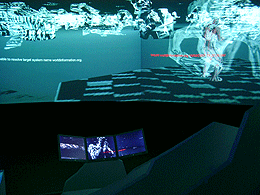
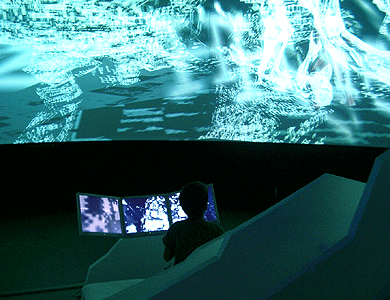
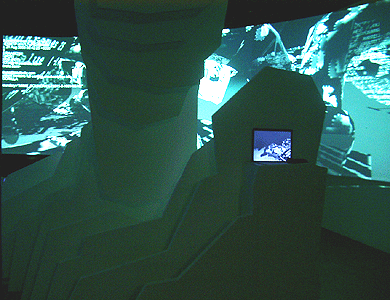
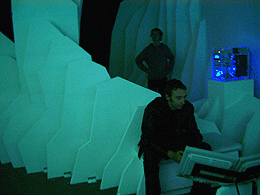
Margarete Jahrmann, Max Moswitzer, Nybble-Engine-ToolZ, installation, Ars Electronica, 2003. Source: Max Moswitzer
GameScenes: Your artworks had been displayed in several European museums and galleries during the previous decade. Did you notice a change in attitude towards Game Art? Were critics and visitors reacting differently to your ludic artworks compared with the early days?
Margarete Jahrmann: Museums need certain logics of arts and public display to be fulfilled.
But for me this was always a positive challenge — to quit the boring pure virtuality and to make it more dirty by integrating the physical body, the art-coded installation.
Ars Electronica at the OK Center Linz in 2003 was a very great opportunity. We built a player-generated architecture of a shooter game, only the carved-out shapes in human size. A complete room of about sixty square meters was filled with that. That was wonderful!
Also the experience at V2_Lab Rotterdam, at the Las Palmas exhibition space, and at Gallery Mama in 2003/04 was perfect.
We also had the opportunity to build a circular screen of about twelve meters for a real immersive experience, combined with a living-room situation, to seduce players to send out anti-war mails by shooting.
And we showed an art-coded printout of the game architecture, the generative architecture of course, in a vitrine like a modern sculpture.
So the attitude of the art public and critics was that Game Art was hard to understand for both sides, because gamers were surprised that we were still working within the logics of arts, and in the art world it was still not recognized as artwork and appeared as too nerdy.
Maybe today that has changed. I don’t know.
The last show was in Aarhus in a big museum, ARoS, and it was a game work among classical media-art works and was at least received very well by a big audience.
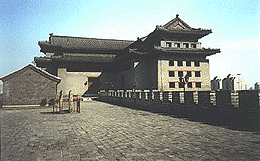

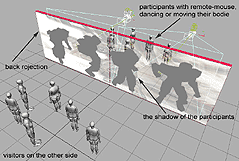
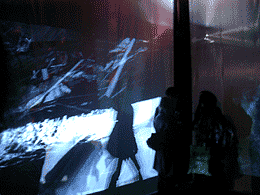
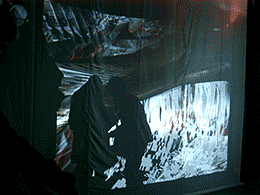
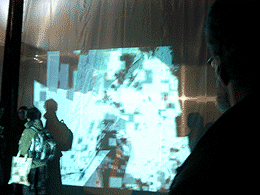
Margarete Jahrmann, Max Moswitzer, Taunting Bots Dance on a Red Square Machinima Towards Heavenly Peace!, installation, Red Gate Gallery, Beijing, China, 2004. Source: Max Moswitzer
GameScenes: Today you work as a professor of Game Design at Zurich University of Arts. One thing that strikes me is that many of the artists who started to work with Game Art in the mid-1990s now work at universities with videogames. Why?
Margarete Jahrmann: I think this is quite normal, because due to market mechanisms only a few people can deal with the art market.
Playfulness is the main focus of insight, a method from my point of view.
This is expressed in works such as the very recent Toygenosonic.
Urban Plays as interventionist art play critically address the surveillance dimension of electromagnetic topographies in present-time urban space.
The “invisible city,” which in the sense of Italo Calvino is a narrative lived space, becomes a materialist topic and playing field.
While users were playing a game in urban space, namely competing with each other over who would find the most accessible hotspots in an urban environment and documenting this with a photo, awareness of the invisible topography layered over the existing visible city was made clear.
A side effect of political explosiveness was the fact that by entering and scanning such points each player leaves traces.
This was not the topic of urban plays such as Objects of Desire (2008), Blitz Play Bergen (2007), and Toygenosonic (2009), which were realized with different collaborators under the label Ludic Society.
However, the mentioned art projects have in common that a non-art audience is also touched by the performances and play in public space and networked media, where dissemination of the play takes place.
GameScenes: Tell me about the Nybble-Engine project. It reminds me of The Matrix: an engine whose goal is to expose the hidden information of the network and construct an architecture made of bits.
Margarete Jahrmann: Yes — you got it pretty well.
But in our case it was not ONLY textures. It was really a total conversion of the engine, which fully integrated commands of a Linux server as working functions into a game engine.
So you REALLY could start commands from inside the game — such as NS lookup, traceroute, send mail, receive mail — only by shooting or bumping into objects.
We introduced a second text layer, which displayed all those features live in real time inside the engine.
This was developed during a three-month residency at V2_Lab in Rotterdam and supported by them.
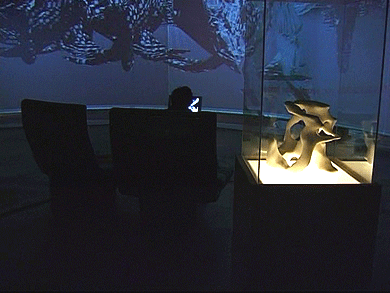
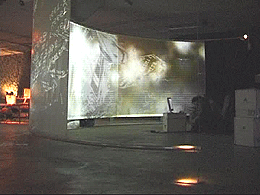
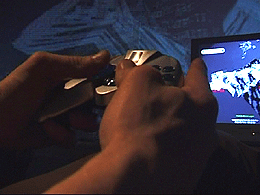
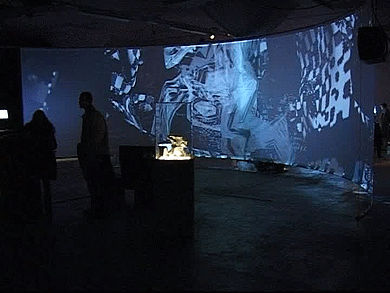
Margarete Jahrmann, Max Moswitzer, Nybble-Engine-ToolZ, installation, Dutch Electronic Art Festival (DEAF), 2003. Source: Max Moswitzer
GameScenes: Where would you say that Game Art stands today?
Margarete Jahrmann: Well, it is more integrated into the art world, maybe.
Young artists quickly get invited into shows if they label their work as “game art,” and in parallel designer games are more art-like nowadays.
There is a whole strain of authors who create mini-games which are award-winning. This is a big difference from team-work-based big games.
I don’t see the return of the author very positively in this concern.
I am a too old-fashioned idealist artist, I know ;)
All images courtesy of the artist.
Interview by Mathias Jansson
Archival links
Margarete Jahrmann
http://framework.v2.nl/archive/archive/node/actor/.xslt/nodenr-66873
Konsum Arts_Server
http://www.konsum.net
Related: Konrad Becker on Synreal: The Unreal Modification
https://www.gamescenes.org/2009/11/interview-konrad-becker-about-synreal-the-unreal-modification-1998.html
Originally published on GameScenes, March 4, 2010.