Joseph DeLappe on online game performance and intervention
Originally published on GameScenes on May 20, 2010.
This email conversation with artist Joseph DeLappe took place in May 2010 and was conducted by Mathias Jansson as part of Game Artworlds: The Early Years, a GameScenes series devoted to formative artists and works in game-based art.
At the time of the interview, DeLappe was Associate Professor in the Department of Art at the University of Nevada, where he directed the Digital Media program, and had recently been a Commissioned Resident Artist at Eyebeam Art and Technology Center in New York. Working with electronic and new media since the early 1980s, his practice had already encompassed online performance, electromechanical installation, drawing, and real-time networked projects.
The conversation traces the development of DeLappe’s interventions inside multiplayer games, from The Artist’s Mouse and Howl: Elite Force Voyager Online to War Poetry and dead-in-iraq. Across these works, the videogame becomes a public environment in which poetry, political dissent, remembrance, and performance interrupt the routines of competitive play.
Editor’s note, 2026: This interview is republished as an archival document. Spelling, punctuation, capitalization, and evident typographical errors have been lightly standardized. The substance, terminology, and historical perspective of the original exchange remain unchanged.
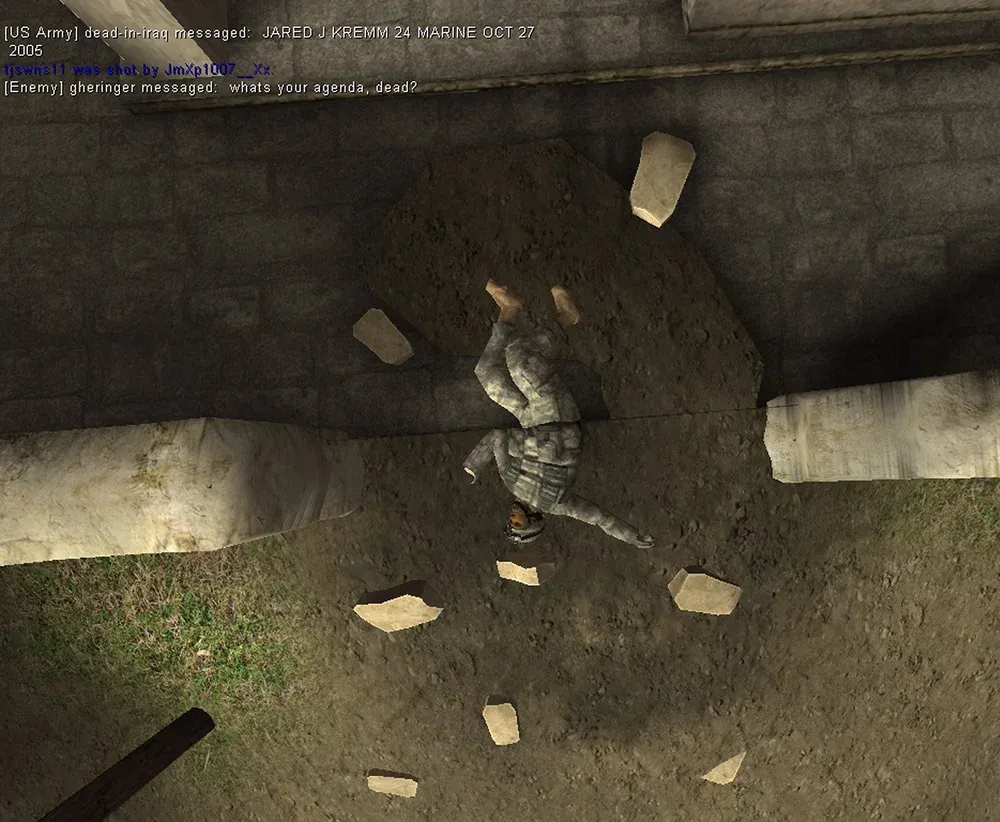
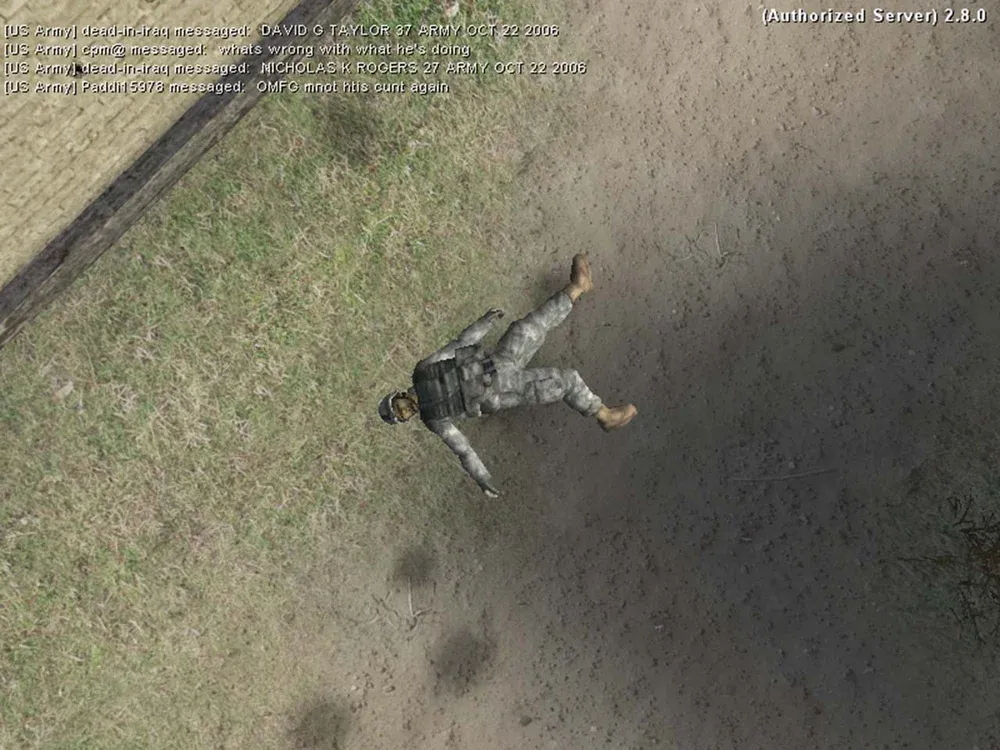
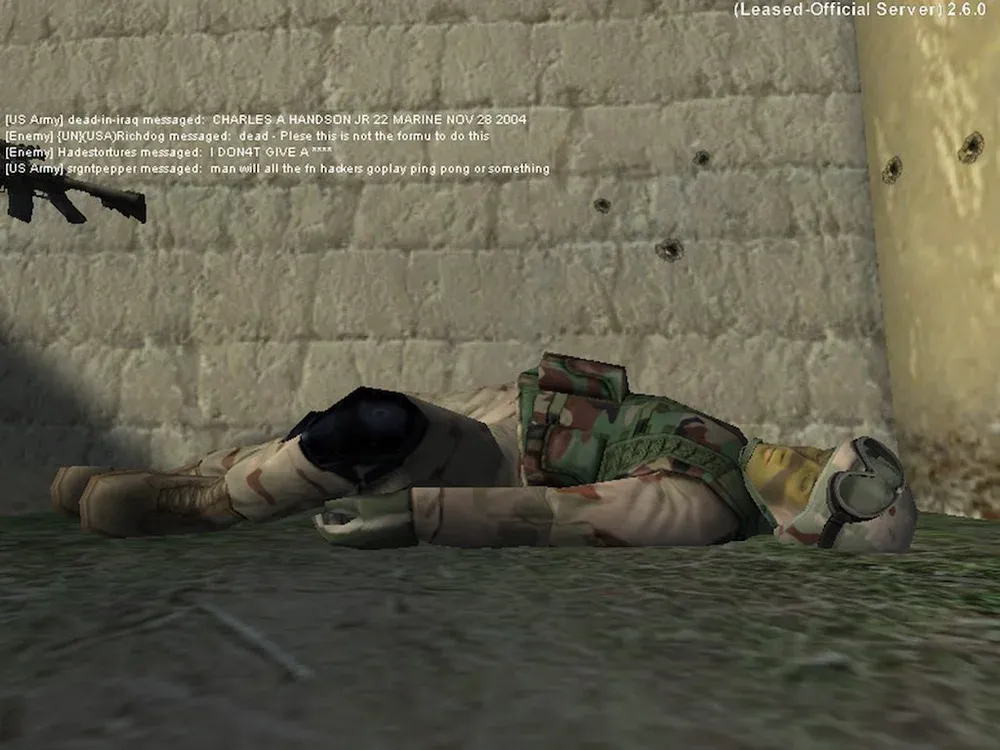
Joseph DeLappe, dead-in-iraq, Game based performative intervention and memorial, 2006-2011. Source: Joseph DeLappe
GameScenes: You were among the first Game Artists to perform online. Why did you choose this format? What games did you use and why?
Joseph DeLappe: The first works I created that involved computer games were in 1998–99.
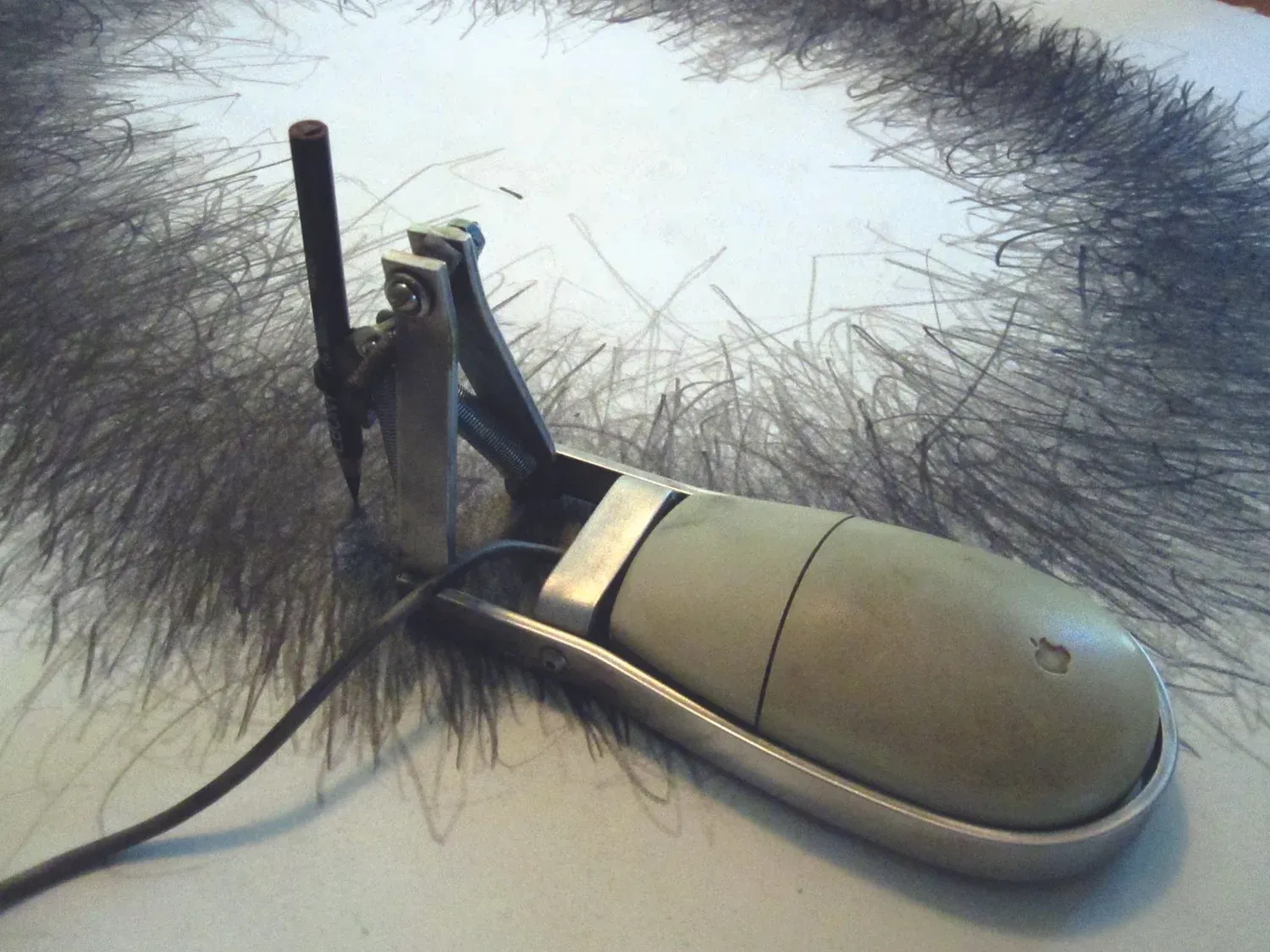
I created an appendage to my computer mouse that allowed for the attachment of a pencil and later brushes. The Artist’s Mouse was invented as a way of reverse-engineering this ubiquitous interface device.
Probably two or three years prior to this I had first started to seriously play computer games. As I recall, one of the first was a free game that came with my Apple laptop. I think it was a version of Battlezone. I had briefly played this game and a Star Wars game on arcade systems in the early 1980s.
After Battlezone I played through Bungie’s Marathon series, games that came for free with equipment that was ordered for my lab at the university where I teach. There were other games, X-Wing and such, that were played along the way.
The invention of The Artist’s Mouse created a situation where I logically moved towards using this device while playing a computer game, as the mouse action was rather intense during gameplay.
As such, the first game engaged in this manner just happened to be what I was playing at the time, the first iteration of Unreal.
I replaced my mouse pad with 10 × 10-inch sheets of fine-art rag paper and proceeded to play using the mouse with pencil attached.
The results were quite pleasing and unexpected: abstract drawings that literally mapped the experience of going through several levels of this very popular and violent FPS game.
Sometime thereafter games were released that utilized online gameplay. I think the first of this type that I tried was Quake.
I was immediately struck by the use of texting to communicate between players.
Typing on a keyboard while immersed in a fully realized 3D graphic virtual game space, on the face of it, seemed wonderfully anachronistic.
Anyway, to make a long story short, the texting is what stood out to me.
In the end, similar to utilizing graphite pencils to map gaming experience — an intentionally anachronistic conceptual gesture — engaging in text-based performance in online game spaces soon emerged as an idea.
It was in the spring of 2001 that I engaged in my first online gaming performance, Howl: Elite Force Voyager Online.
I entered the game as Allen Ginsberg and proceeded to perform the entirety of his seminal Beat poem Howl, word for word.
I had no idea whether this was interesting or important or innovative.
I was not aware of any other artists at that time engaged in using FPS games for artistic purposes. I very well may be the first to engage this particular genre for performative actions, although artists such as Anne-Marie Schleiner and Eddo Stern were engaged in game-based projects around the same time frame.
I am not so sure about the timelines here. It might be worth looking into, but for sure I was unaware of any other artists at the time working with chat performances in shooter games.
I did later learn of a wonderful project to perform Waiting for Godot that took place in a chatroom well prior to my work. I can’t seem to find anything about this online.
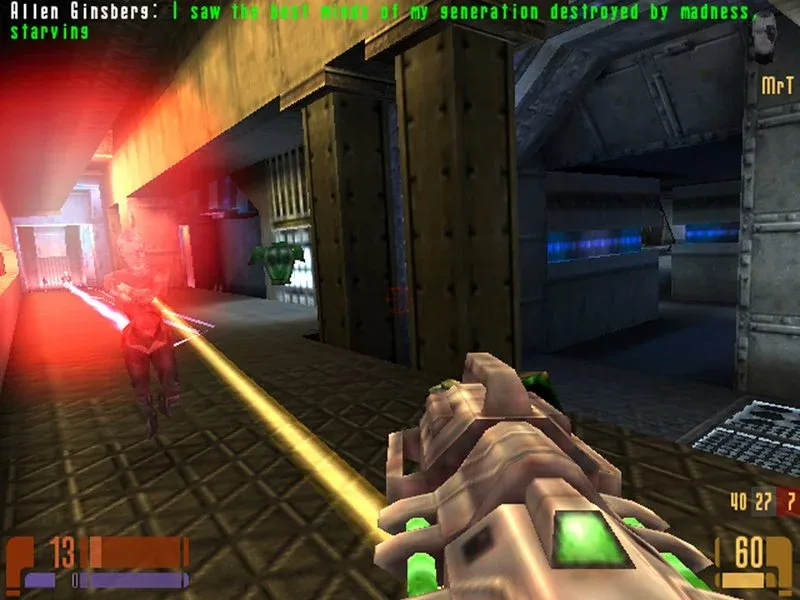
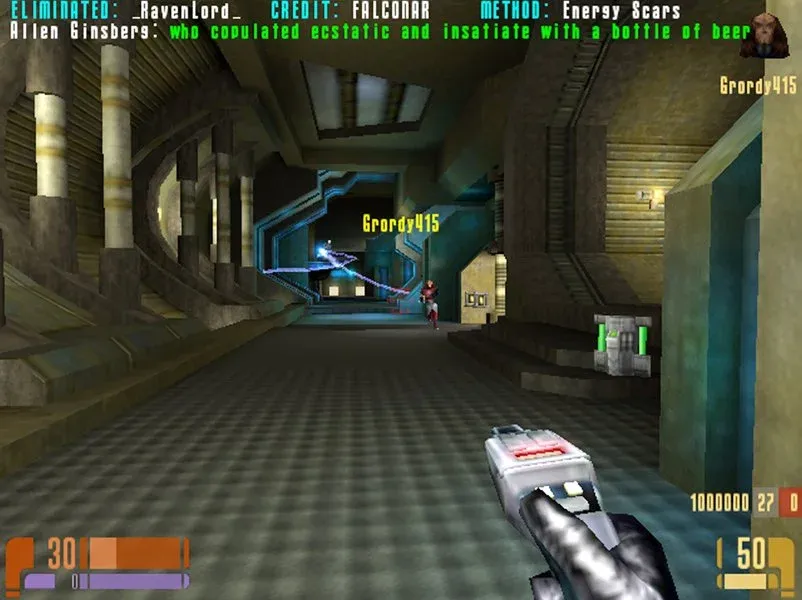
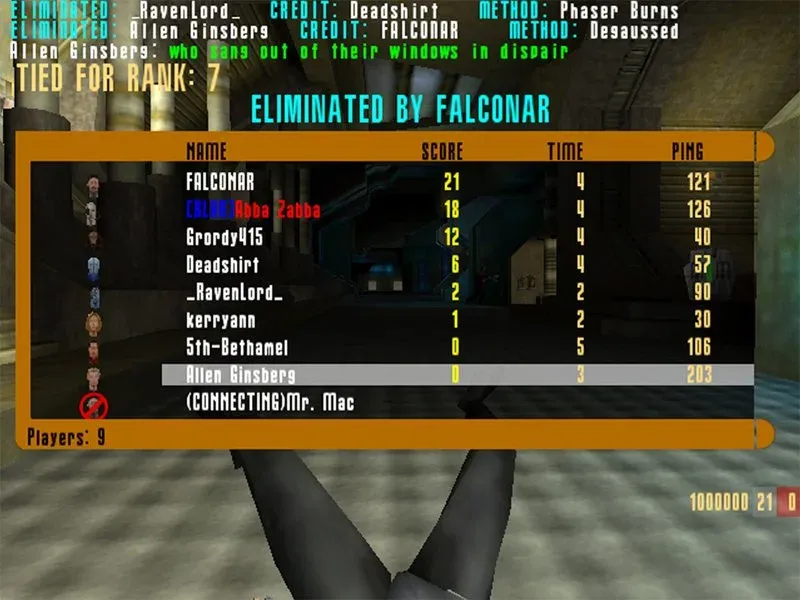
Joseph DeLappe, Howl: Elite Force Voyager Online, 2001, Online gaming performance/poetry reading, 2001. Source: Joseph DeLappe
GameScenes: There is a long tradition in performance art of stretching the boundaries of what is commonly understood as “art.” The same trait is clearly visible in your own work. Which performance artist do you admire most, and perhaps had the biggest impact on you?
Joseph DeLappe: Most definitely.
Linda Montano visited my university while I was in graduate school.
Her work in bringing art into life as performance — spending a year living with everything being the same color, being tied to the artist Sam Hsieh for a year, etc. — these works I found very inspiring.
As well, Laurie Anderson’s early NYC street-based performance Duets on Ice.
Oddly, it has been primarily women performance artists who I find most interesting. Excluded from the galleries and museums, they took to the streets and to life to make their creative statements.
I first engaged in performing in game spaces upon the realization that these online environments could be considered a new type of public space.
I definitely consider my work to have a direct lineage to street theater, interventions, etc.
GameScenes: What should artists look for in online spaces? Is there something inherently challenging about online performances compared to, let’s say, real-life performances?
Joseph DeLappe: The internet presents artists with a new territory for creative engagement.
Online games and communities are attractive to me as an artist for any number of reasons.
There is definitely an intentional interest in reaching an audience outside of the art world while at the same time being keenly aware of my context as a contemporary artist practicing in a complex history of interventionist performance art.
I am also an artist living in an area that is possibly about as remote from the art world as you might imagine.
Living in the high desert of Nevada, the internet, and gaming in particular, has presented me with a venue for creative exploration that allows my isolation as an artist to be negated.
The potential for reaching a global audience is very seductive, although I must say that upon starting these works with Howl I had no sense that I was engaging in works that would eventually reach said audience in a very big way.
Another motivation is that I have been working in computer media since 1983.
I recall vividly my first experience of artists working with the internet, likely in 1989, while at the same time coming of age as an artist during an era where “virtual reality” was the topic de rigueur.
I have always been skeptical of the utopian underpinnings of the art, science and technology community.
Something that most attracted me to computer games, shooters in particular, was that for me these games somehow represent the popular realization of the over-hyped promise of virtual reality.
That is, it is very curious that we can create amazing 3D simulated environments for internet-based interactions, yet these interactions seem so primarily focused on killing each other over and over again.
As well, it is a subversive stance to say that online gaming environments represent a new type of public space.
I am an artist very concerned with reaching an audience, with affecting change. One cannot do so working in a vacuum, whether that vacuum is the private artist’s studio or the art world.
It is very important to me that the work gets out there in a way that both represents taking agency and presenting creative experiences that interrupt or intervene within these online contexts.
GameScenes: How did the audience react to your performances? And how about the critics? Back then there were not that many artists subverting the dynamics of online games.
Joseph DeLappe: I think it was in 2000 when I was invited to show documentation of the Howl: Elite Force Voyager Online performance at the Art Fair in Santa Fe, New Mexico.
I was invited by Refusalon of San Francisco to actually re-perform this work but discovered that the convention hall lacked internet access.
As such, we played a looping document of the reading of Howl with the game, at times at quite a loud volume.
This was quite fun and actually garnered quite a bit of attention from the visitors to this event.
I do not recall any criticism being written specifically about this showing.
My work in computer games really took off after the publication of an article by Matt Mirapaul of The New York Times regarding the Quake/Friends performance in 2003.
I was threatened with legal action by Warner Brothers TV and quite excited by the exposure.
GameScenes: Your performances break the players’ illusion of what is commonly called “the magic circle,” the idea that game spaces are somehow sacred and separated from “real life.” You deliberately break this fantasy, making the players aware of the reality that lies outside the simulation, a kind of Brechtian Verfremdungseffekt. How do players react to your interventions?
Joseph DeLappe: I see these works as a way to break through and perhaps expand the notion of “the magic circle” in gaming.
We do not “play” in contexts that are unrelated to our political, social and economic realities.
Reactions during the first performance, Howl, were mostly humorous.
I recall one player noting, “Wow, poetry and shooting!”
Reactions to my work have been most fierce within the context of the ongoing project dead-in-iraq, commenced in 2006.
Other players routinely insult me, demand to know why I am doing what I am doing and are generally very hostile.
There have, however, been instances of other players defending my actions, saying things like, “What is wrong with what he is doing?”
I even know of two players who at one point decided to stand in front of my avatar and take bullets so that I could continue my reading.
What has been very interesting and unexpected has been engaging in debates on the internet outside of the game proper.
These have evolved with the publication of numerous online and print articles about the work.
Upon reading some of the comments from the readers, I decided to join the ensuing debates.
These have proven very interesting and, as I see them, they represent a particular opportunity for me to engage in dialogue with those either experiencing the work firsthand or interested in commenting upon the project, whether pro or con.
GameScenes: I am really fascinated by War Poetry: Medal of Honor, Allied Assault Online, a performance in which you read Siegfried Sassoon’s poetry during a session of Medal of Honor. Why did you choose this artist and this game?
Joseph DeLappe: Siegfried Sassoon and Wilfred Owen are two famous British soldiers who, during World War I, wrote amazing poetry regarding their experiences in the trenches.
Both of them were sent to a mental institution, where they met, due to their resistance to the war.
Their poetry is amazing, moving and timeless.
The notion of reciting their poetry was a specific reaction to the start of the War in Iraq in 2003.
This was my first step in computer games into works that I would consider anti-war activism in computer games.
The other works, Howl, Quake/Friends and such, have perhaps more of an ironic stance that indeed creates critical contexts for the consideration of culture. They are a bit more fun.
With the War Poetry project my work began to take on a more serious tone, again reflecting the drumbeat to war.
Most definitely this work should be considered a precursor to the dead-in-iraq intervention.
Interview by Mathias Jansson.
Archival links
Joseph DeLappe
http://www.unr.edu/art/delappe.html
The Artist’s Mouse and online game performances
http://www.unr.edu/art/DELAPPE/DeLappe%20Main%20Page/DeLappe%20Online%20MAIN.html
dead-in-iraq
http://www.unr.edu/art/DELAPPE/Gaming/Dead_In_Iraq/dead_in_iraq%20JPEGS.html
Quake/Friends
http://www.unr.edu/art/delappe/gaming/Quake%20Friends/QUAKE%20FRIENDS%20MAIN.html
War Poetry: Medal of Honor, Allied Assault Online
http://www.unr.edu/art/delappe/gaming/MOH%20online/MOH%20screen%20shots%20JPEGS.html
Joseph DeLappe’s YouTube channel
http://www.youtube.com/user/delappe
Originally published on GameScenes, May 20, 2010.