John Paul Bichard on in-game photography
Originally published on GameScenes on November 27, 2010.
This email conversation with British artist John Paul Bichard took place in September 2010 and was conducted by Mathias Jansson as part of Game Artworlds: The Early Years, a GameScenes series devoted to formative artists and works in game-based art.
Bichard has worked with digital media, videogames, photography, performance, and installation since the early 1990s. He curated and produced On a Clear Day in 1996, an early British project devoted to digital game art, and served as games editor for Mute between 1995 and 2001. His practice has repeatedly examined the spaces that videogames produce, the bodies that occupy them, and the residue left by simulated violence.
The interview focuses on Bichard’s early experiments with photography, Evidência, the Max Payne 2 series The White Room, his participation in the 2007 Game Art exhibition at Mejan Labs in Stockholm, and the performance Inverse Forensics.
Editor’s note, 2026: This interview is republished as an archival document. Spelling, punctuation, capitalization, and evident typographical errors have been lightly standardized. The substance and historical perspective of the original exchange remain unchanged.
GameScenes: You were among the first artists interested in “upgrading” — or at the very least, “rethinking” — the medium of photography in the videogame age. Others who come to mind include Marco Cadioli. How do you explain your fascination with photography and gaming?
John Paul Bichard: I have had an interest in the 2D pictorial space for years. I enjoyed photos as a kid but didn’t have the patience or money to enjoy film rolls and processing, so no romantic stories about developing rolls of film in my parents’ bathtub.
I went to St Martin’s art school, where I got a degree in painting, then stopped painting but retained an interest in the conceptual 2D planar space that pictures create.
I had been playing Dungeons & Dragons since it started and played my first videogame in the ’70s: Pong at Southampton Airport. It was fascinating and set in motion a slow but enduring chain of events.
My interest in videogaming grew through the ’80s with a home computer and arcade games, which I couldn’t really afford to play, so I totally sucked at them.
It wasn’t until Doom II came out that I really took a step forward and started the journey I am still on with videogames. It fascinated me that believable worlds could be created, that you could be immersed in even a crappy story as long as there was enough action.
I started writing for the influential art and technology paper Mute and even did a few game reviews for Wired, which gave me the excuse to be sent bucketloads of new games as a games editor and reviewer.
My interest in writing was to put forward the notion that videogames were a cultural phenomenon and not just a means of stopping teenage boys from jerking off.
So I carried on my work as an artist, started a couple of design companies, mainly working with game clients, and played a lot of video and computer games.
I did one of the first viral marketing campaigns for the launch of Grand Theft Auto 2, did a small viral campaign for Pokémon: The Movie, Thomas the Tank Engine, and a bunch of games that died and were quickly buried.
But the big turning point was Half-Life.
A great story where you really felt immersed on a psychological level, as an everyday person, not some over-pumped hero, just a simple and rather inadequate employee expected to save the world.
The genius of Half-Life was that around the halfway mark, you suddenly realized that you had been betrayed. It was a setup. The people you thought you were running to were firing at you.
That is a moment I will never forget. It still gives me goosebumps.
So I still haven’t answered your question.
Videogames simply became a way of life from quite early on. The 2D pictorial space has also been a place for exploring and understanding the world for as long as I can remember.
The two collided when I did an art exhibition in Lisbon.
I was invited to show a game I had made. It was a process-based work: start with an empty 3D space and see how far you get building some kind of game-related environment or experience in ninety days.
The result was odd, an empty, stacked game world where you could see the levels as you dropped out of them.
But when I got to the gallery it was so beautiful, with marble floors and gardens and huge glass windows, that I couldn’t bear blocking out the world and showing an interactive artwork.
So I talked the director into letting me do an installation.
Three days, chicken blood, police tape, bits of a dead cow, some fabric and a lot of adrenaline, and I came up with a real-world equivalent of what would happen if you could see a game level at the end of the level, in real life.
It was an installation. It stank after two days, so I had to photograph it and clean it up.
This was the first time I used photography, art, and gaming together.
[Insert images: John Paul Bichard, Evidência #001, 2004. Installation with aluminium, turf, tree stump, earth, leaves, feathers, and bullet cases.]
Evidência takes as its starting point an ending: a forensic space, a place in which remains and material take on new significance. From the objects and images, there are no definite conclusions, no clear narratives, just the threads of something that could have happened. The viewer is invited in, but in doing so enters the scene to witness part… of a crime, a conflict, a game?
— John Paul Bichard
GameScenes: With The White Room (2004), your photographic interventions became more explicit and daring. You toured Max Payne 2, took pictures of the locales and environments, removed the innumerable corpses that furnished those spaces, but left traces of virtual blood as a memento of past interactions. Why did you specifically choose this action-adventure?
John Paul Bichard: The White Room is complicated.
The show was a conceptual response to domesticity and the new wave of art photography called The House in the Middle at Towner Gallery, Eastbourne, in England.
It was a photographic group show based around notions of postwar domesticity and social, mainly class-based, constructs, so I was invited to show with British heavyweights like Martin Parr and Richard Billingham.
I was meant to do an “art game” which engaged the conceptual framework of the show, but that felt too much like a “token game-art freak show” than a serious reflection on the videogame space, so I decided to produce a series of photo-based objects.
My earlier works had explored the relationship between the forensic, or crime, space and the violent videogame space.
These were still, reflective works that questioned consequence, the nature of violence and violent narrative, as well as the aesthetics of violence and blood in particular.
These earlier works were also real-world explorations that drew inspiration from, queried and deconstructed videogames in a real-world setting.
So I decided to deconstruct the violent game space from the inside, from within the game space.
I went back through all my then-current games and settled upon Max Payne 2, mostly for its social realism, the wonderfully atmospheric interiors, and the ability to easily edit the game.
[Insert images: John Paul Bichard, The White Room, 2004. In-game photographs of manipulated interiors created in Max Payne 2, digital prints, 8 × 6 in.]
The White Room is a set of photographic prints resulting from an in-game photoshoot that documents a series of constructed disasters. These interiors were set up by the artist using the videogame Max Payne 2, a “film noir” thriller that tells a tale of lost love, deception and betrayal. The shoot took place within the game’s developer mode using the GOD and GETALLWEAPONS cheats and BenDMan’s Bloody Mod 1.2.
— John Paul Bichard
The White Room was, for me, a step further.
As I was looking through the game for locations that looked like crime scenes, I came across a really bloody game mod that exaggerated the bloodstains.
So I used the game as a canvas, shooting bodies around a potential crime scene to create grisly locations.
It struck me as I was doing this that I could also arrange the locations and the position of the camera as I would in a shoot. In other words, I could treat the game as both a canvas and a photo location.
People criticized me at the time for ripping off the game and just taking screenshots, but I was seriously trying to take a step further within the game space and explore my own ideas through the captured image.
To a lesser extent, and within the conceptual ambitions of the exhibition, I also used the work as a very oblique and arguably obscure critique of the stereotypical, mildly racist and sexist narratives and tropes that have influenced the very male videogame world from the start.
Hence the high contrast between the White Room, which is a typical white, upper-middle-class apartment, and the rundown Black/Hispanic/white-trash lower-class apartments that were present in the game and that arguably reinforce the social prejudices propagated in videogames.
I got permission from the game publisher to use the work but was not allowed to sell them, so I donated a set of the images to the Contemporary Art Museum in Tampa after I showed the works there.
GameScenes: You also participated in the exhibition Game Art at Mejan Labs in Stockholm, which remains one of the largest exhibitions in Sweden entirely focused on Game Art. How did you get involved in the exhibition? And what was the impact of this event on the Scandinavian Game Art scene?
John Paul Bichard: Well, I knew Björn Norberg and Peter Hagdahl, who were running Mejan Labs, through my work at the Interactive Institute.
Since coming to Sweden five years ago, I have been a games designer and creative/artistic director on four high-profile pervasive games at the Institute, games that pull the digital experience into the real world with mobile technologies, live-action role-playing and narratives devised for the new genre.
I think the show was influential within the rather limited media-art “world” in Sweden, but one of the few critics here wrote a very unenlightened — read: bullshit! — review in one of the biggest international art magazines, which didn’t help expand the scene.
This is a criticism I have of the scene here. It is controlled by too few people in influential positions, which is disastrous for a small but energetic scene in a small but ambitious country.
Mejan sadly ended, as it couldn’t raise enough funding.
The term “Game Art” is problematic. In my opinion it should be seen as part of the wider art scene and not a separate branch. It is “interesting,” but too marginal to be treated as an isolated genre.
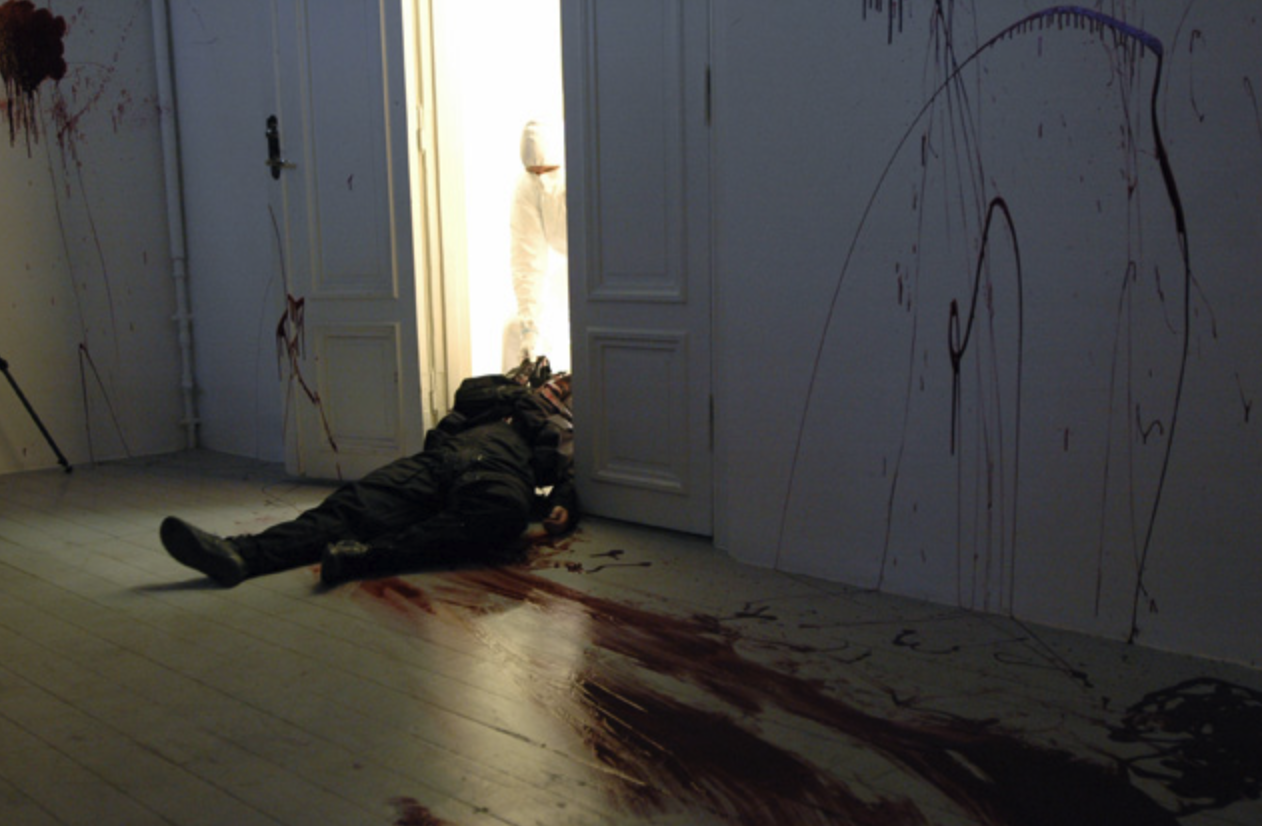
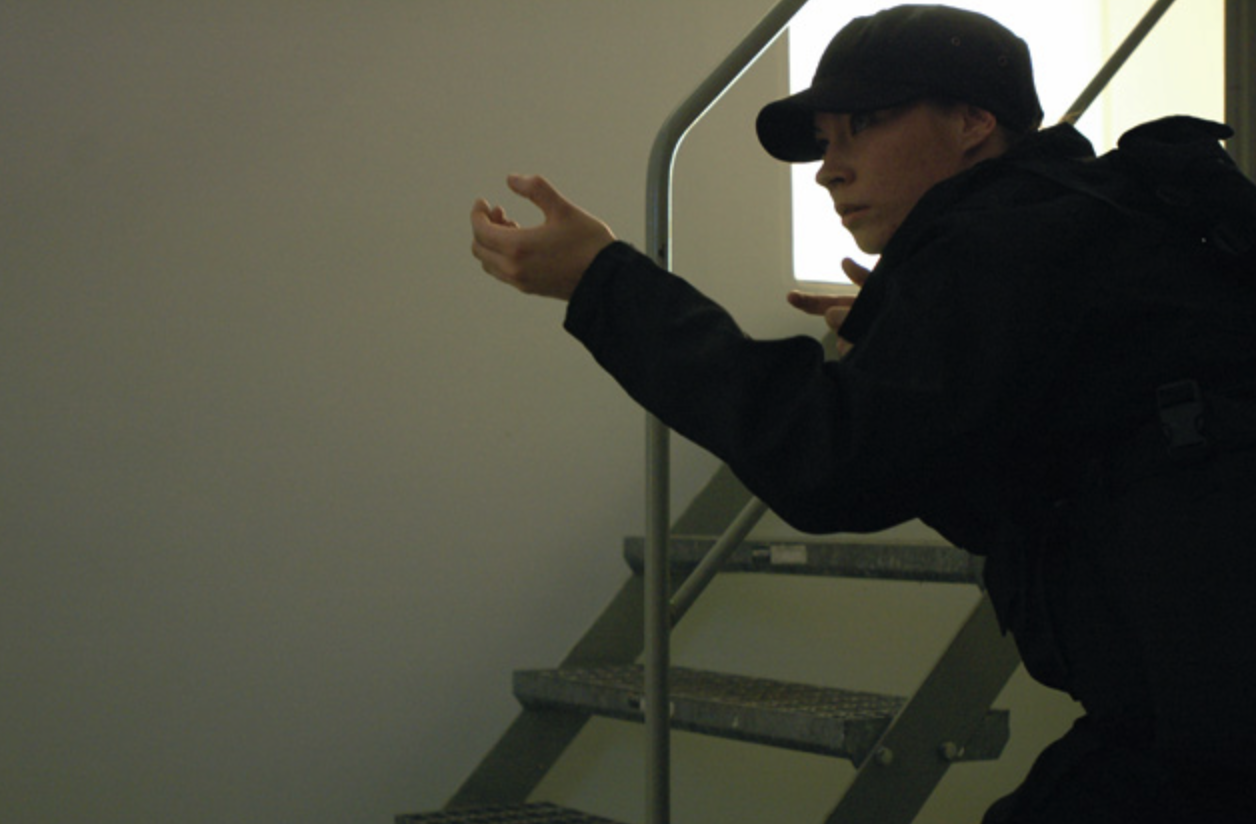
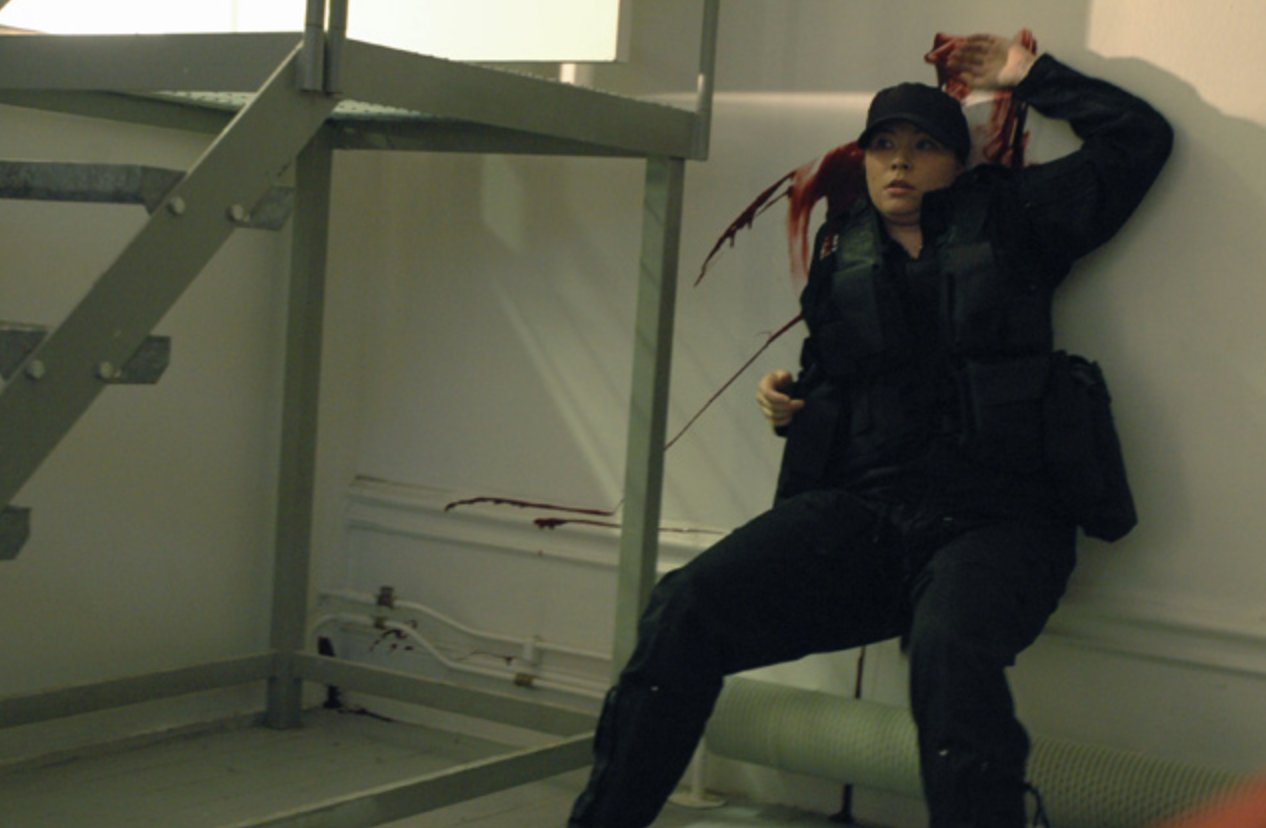
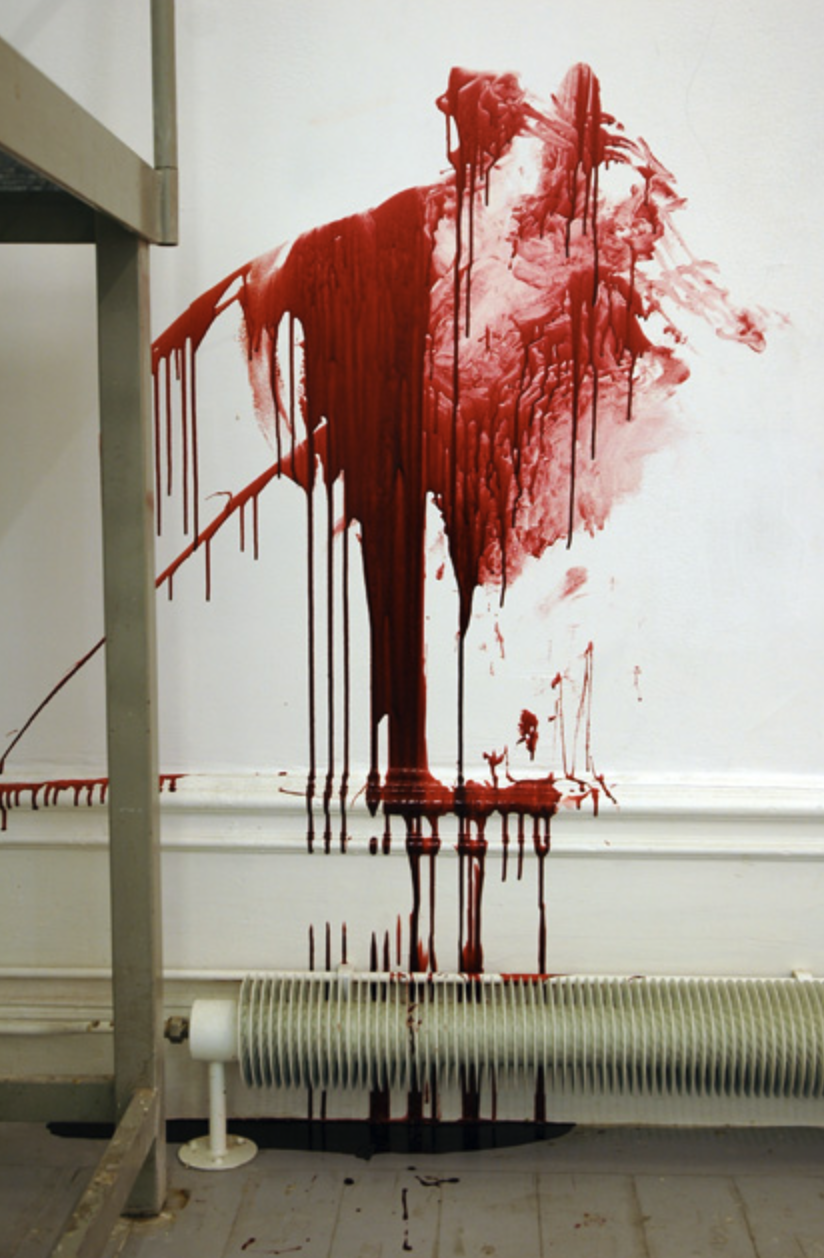
John Paul Bichard, Inverse Forensics – Performance #01, 2007. Experimental game performance at Mejan Labs, Stockholm. With Mira Mutka, dancer, and Edwin Morris, composer. Source. John Paul Bichard
Inverse Forensics utilizes movements, methods and behaviors from first-person-shooter videogame characters and environments to construct an experimental videogame dance performance. The work is centered upon a dancer who assumes the role of the player character, a generic special-forces combatant, and her opponent, an implied non-player character, invisible, who is revealed only by the gaze of the dancer and the generated blood traces left on the wall post-shooting.
— John Paul Bichard
GameScenes: On the opening evening at Mejan Labs you presented a bold performance piece titled Inverse Forensics (2007). What was your intent?
John Paul Bichard: I was approached initially to do the cast Severed Hand piece, which is a lifelike waxwork cast of my hand severed as I hold a computer mouse.
But I figured that the show was a great opportunity to do something a bit more ambitious.
So six weeks before the opening, I looked around on Myspace for a dancer and found Mira Mutka, an excellent Stockholm-based contemporary dancer to collaborate with.
The process and resulting performances were inspiring and an eye-opener.
I saw not just my own work but also gaming and male violence from an entirely different perspective.
Mira took the role of a special-forces operative in a typical seek-and-destroy scenario.
She was playing against an invisible foe with an invisible gun, and I showed where the headshots had taken place by splashing theatrical blood onto the walls.
What could have been somewhat humorous was in fact tense, powerful and engaging for the audience, many of whom had never played a first-person shooter.
I repeated the performance in a different format in Umeå with the hand sculpture and the documentary video, which was also shown when the show toured to Piteå.
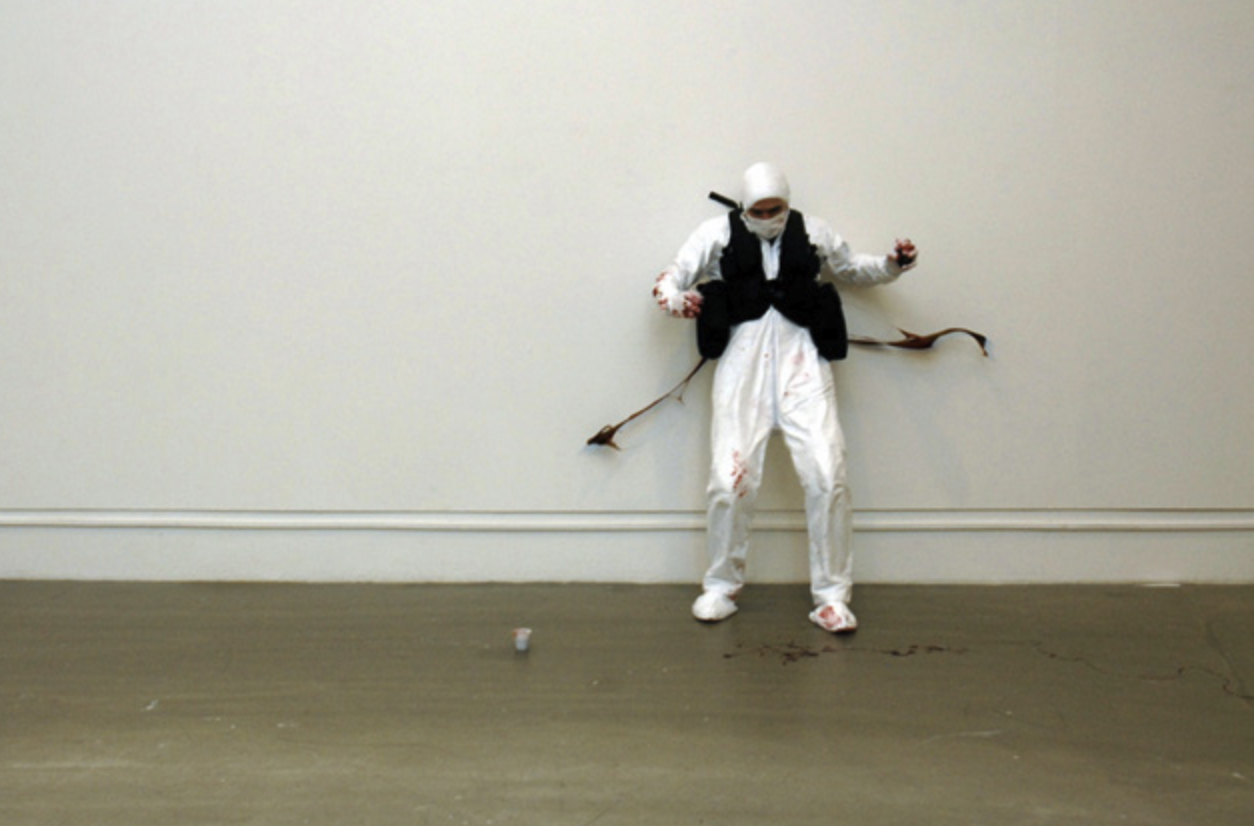
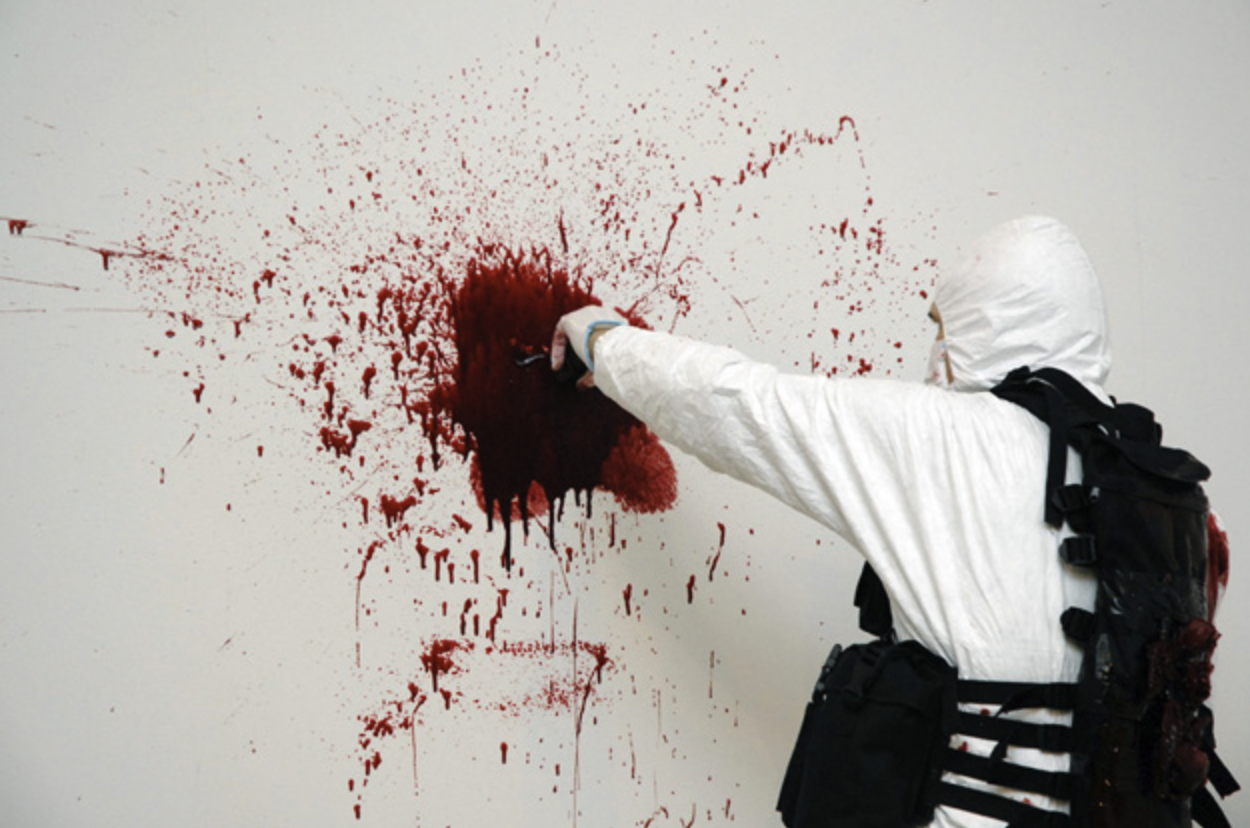
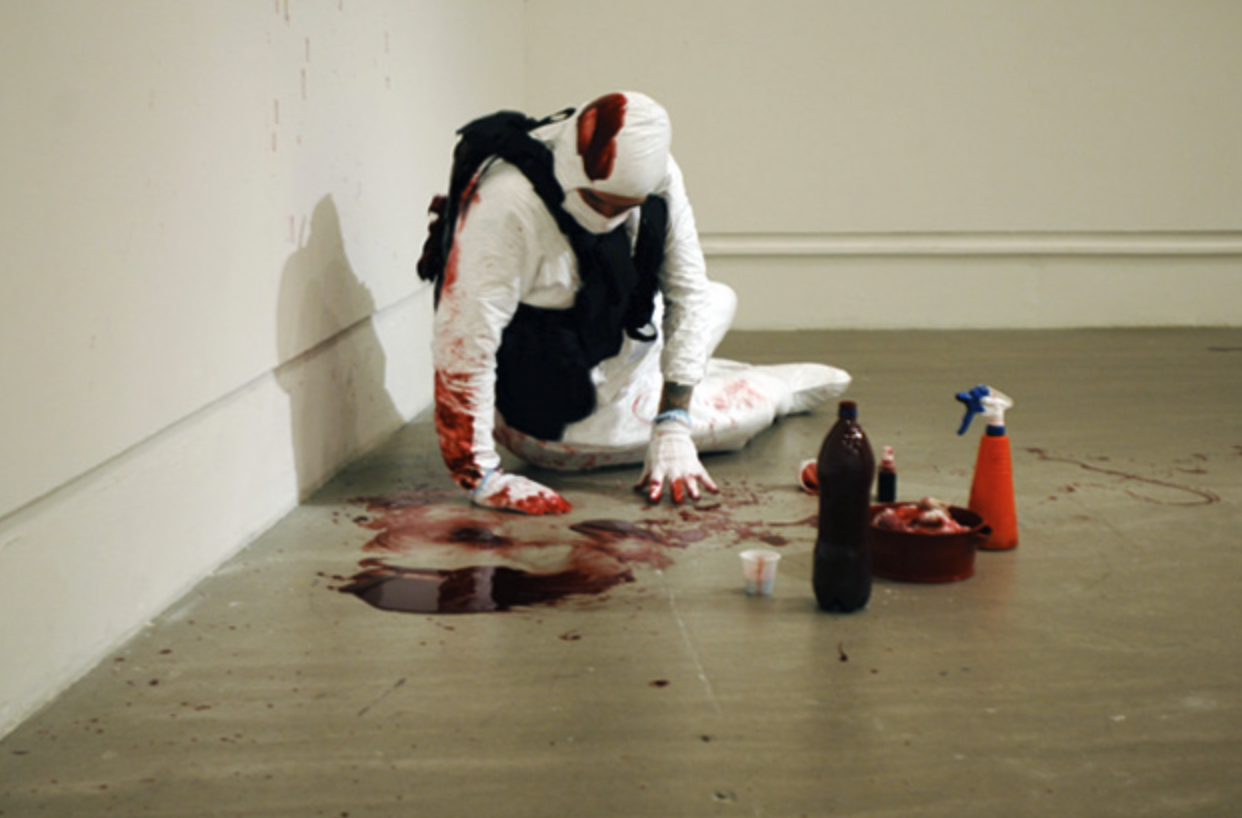
John Paul Bichard, Inverse Forensics – Performance #01, 2007. Experimental game performance at Umeå's Bildmseet. Source. John Paul Bichard
GameScenes: You are now an artist in residence at the Interactive Institute Art & Technology in Stockholm. What are you working on these days?
John Paul Bichard: Actually, as I sit here writing, I am a freelance creative advisor, working on digital and photographic art installations for property developers around Sweden.
I also continue to work as artistic director for a parkour-based pervasive game at the Institute, but the Art and Technology department where I was based has been dismantled, as it no longer fitted into the wider research agenda.
This is a fairly typical fate for art, which is not a bad thing.
Art is a catalyst, a flavor, an initiator that moves on once the place where it is based matures.
As far as my game art is progressing, well, I am working mostly with photographic series around identity and roles/role-playing.
So I shoot a lot of people in the LARP scene, the burlesque and fetish worlds, and a series where I invited people to cover themselves in fake blood in my bath.
The ideas continue to draw influence from gaming, but perhaps they have grown further towards real games and identities in the real world.
I still play role-playing games and a wonderful MMO called Dofus, but have become somewhat tired of the over-formulaic mainstream game scene.
I want games that move beyond simple destroy-for-points mechanics.
Not that I want to see an end to game violence, but rather more intelligent narratives and mechanics that favor exploration or imaginative solutions to difficult situations.
One day...
All images courtesy of the artist.
Interview by Mathias Jansson.
Archival links
John Paul Bichard
http://www.idealmilk.com/artgame.htm
Evidência
http://www.idealmilk.com/project/evidencia/evidencia_01.htm
The White Room
http://www.idealmilk.com/project/evidencia/evidencia_02.htm
Inverse Forensics
http://www.idealmilk.com/project/evidencia/evidencia_03.htm
Severed Hand
http://www.idealmilk.com/project/evidencia/evidencia_03a.htm
Originally published on GameScenes, November 27, 2010.