EVENT: KARA GÜT IN FOCUS AT GOSHORT 2026 (10-11 APRIL 2026, NIJMEGEN, THE NETHERLANDS)

My Desert Heart. A performance in Red Dead Redemption 2
Friday 10 April, GoShort festival, Lux 2, 7.15—8.30 PM
Digital Intimacy: Kara Güt
Saturday 11April 2026, GoShort festival, Lux 6—7.45 PM
At this year’s Go Short festival in Nijmegen, The Netherlands, Ohio-based artist Kara Güt is one of the event’s Filmmakers in Focus. The 18th edition runs from 7 to 12 April 2026 and Digital Intimacy: Kara Güt is scheduled for 11 April at LUX 2, gathering five films and concluding with a conversation with the artist. Güt’s practice is presented through a set of recurring figures — speedrunners, streamers, chain mails, modded Skyrim NPCs and broken hardware — each treated as a site where desire and attachment surface in forms digital culture habitually obscures.
Güt’s work has, for several years now, occupied a distinct position within game-based art and digital moving-image culture. She describes her practice as centred on image-based digital media and the altered forms of intimacy produced by internet life, mediated detachment, and the power relations embedded in virtual space. Her work has circulated through the Museum of Contemporary Art Detroit, Singapore Art Museum, Hybrid Box in Dresden, and Hesse Flatow in New York. For Güt, video games are acutely diagnostic of contemporary social feeling.
Whatever warmth the title Digital Intimacy may imply, the films don’t supply it. Intimacy, in Güt’s work, rarely arrives as ease: it comes under conditions of latency, distortion, repetition, and anonymity. The online world is never imagined as cleanly disembodied: it is crowded with avatars, scripts, interface conventions, platform habits, fan vocabularies, and technical debris. Within these compromised systems, Güt keeps looking for contact: for moments when one subject reaches another, or fails to.
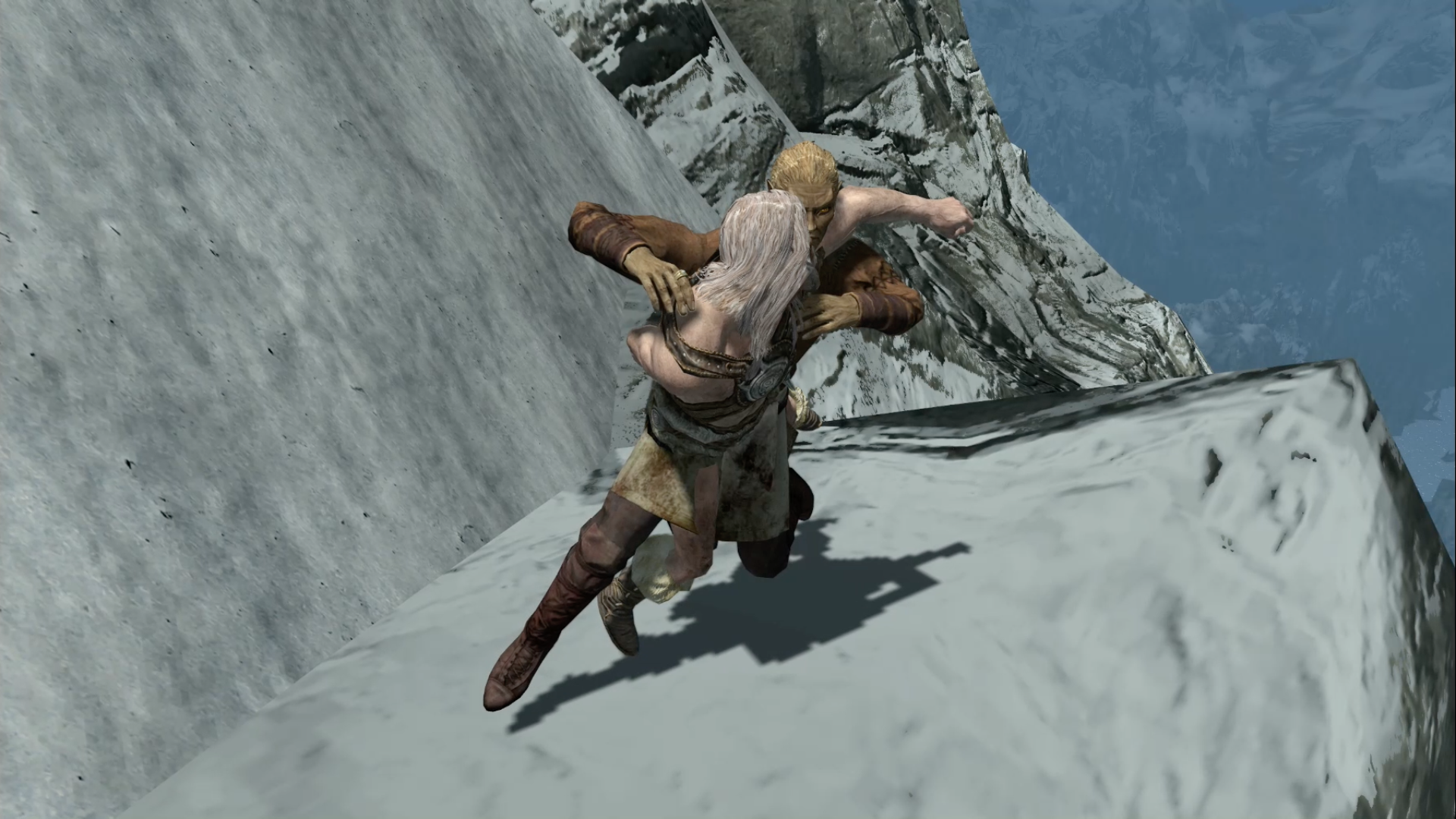
The selected films pursue that question across divergent formal situations. In Intimacy Mod II (variations on a theme) (2020), Güt uses the Skyrim mod Immersive Lover’s Comfort to interrupt the game’s intended narrative flow and replace it with an in-game performance between the player-character and an NPC. Each encounter, according to the programme notes, is determined by precariousness, visibility, and absurdity. The inherited game system, nudged toward an encounter it was never built to sustain, produces something the genre cannot absorb, awkward proximity and stubborn duration, an encounter made visible at every point as artifice.
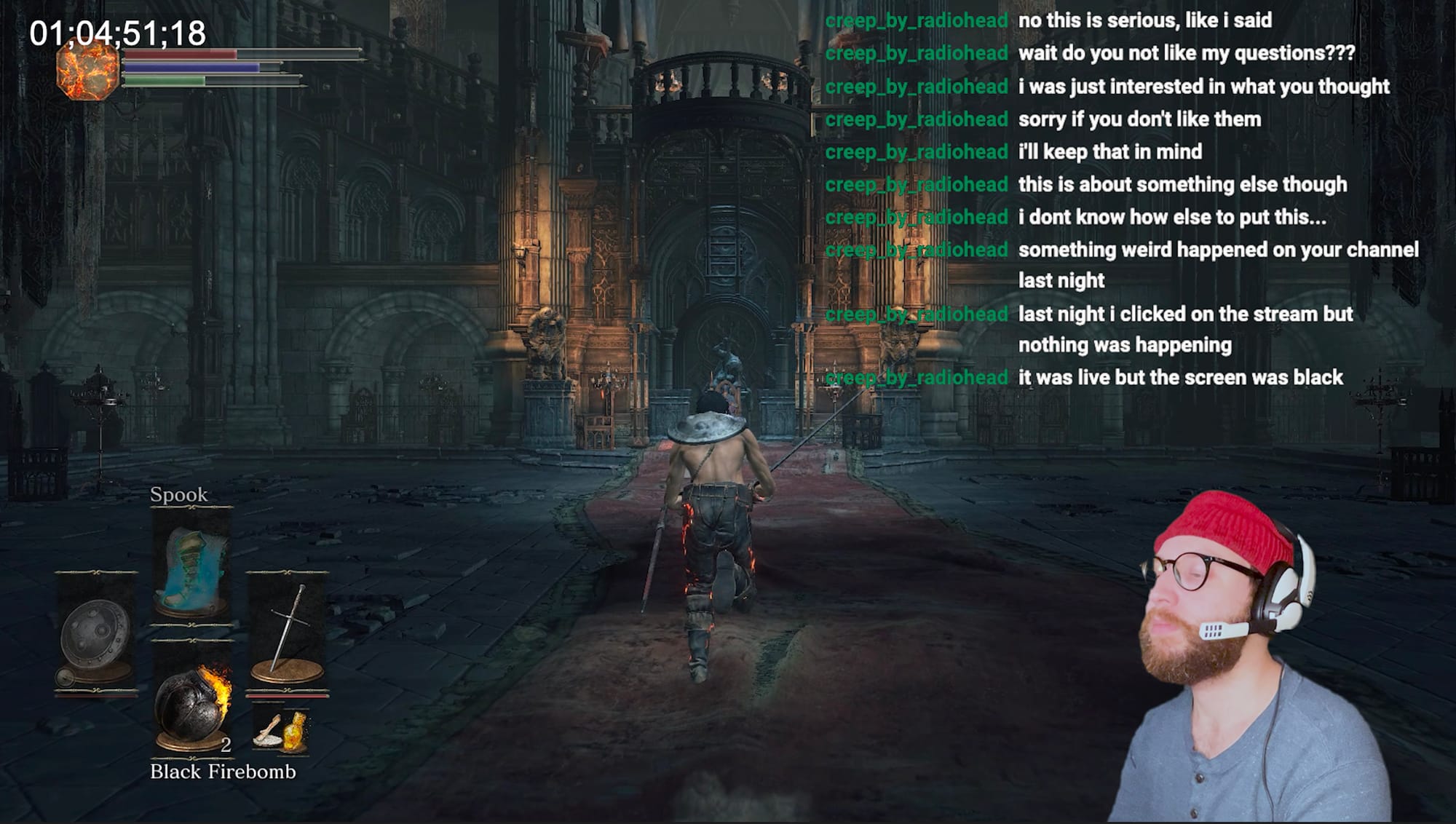
Lurker1 (2023), the longest film in the programme at 31 minutes, shifts to the ecology of livestreaming. Go Short describes it as the record of the final three nights of a Twitch streamer practicing a Dark Souls III speedrun while speaking to a single chat participant named ‘creep_by_radiohead’; both accounts have since been deactivated. The setup is minimal. Güt turns the stream archive into a document of asymmetrical attention: a performer addressing a near-empty channel, a spectator whose presence is impossible to parse (intimate, parasocial, manipulative, or some combination), and a platform space already shadowed by disappearance. The deactivated accounts emphasize the work’s relation to platform temporality. What survives is the residue of contact: a trace of exchange held inside an interface built for perpetual present tense.
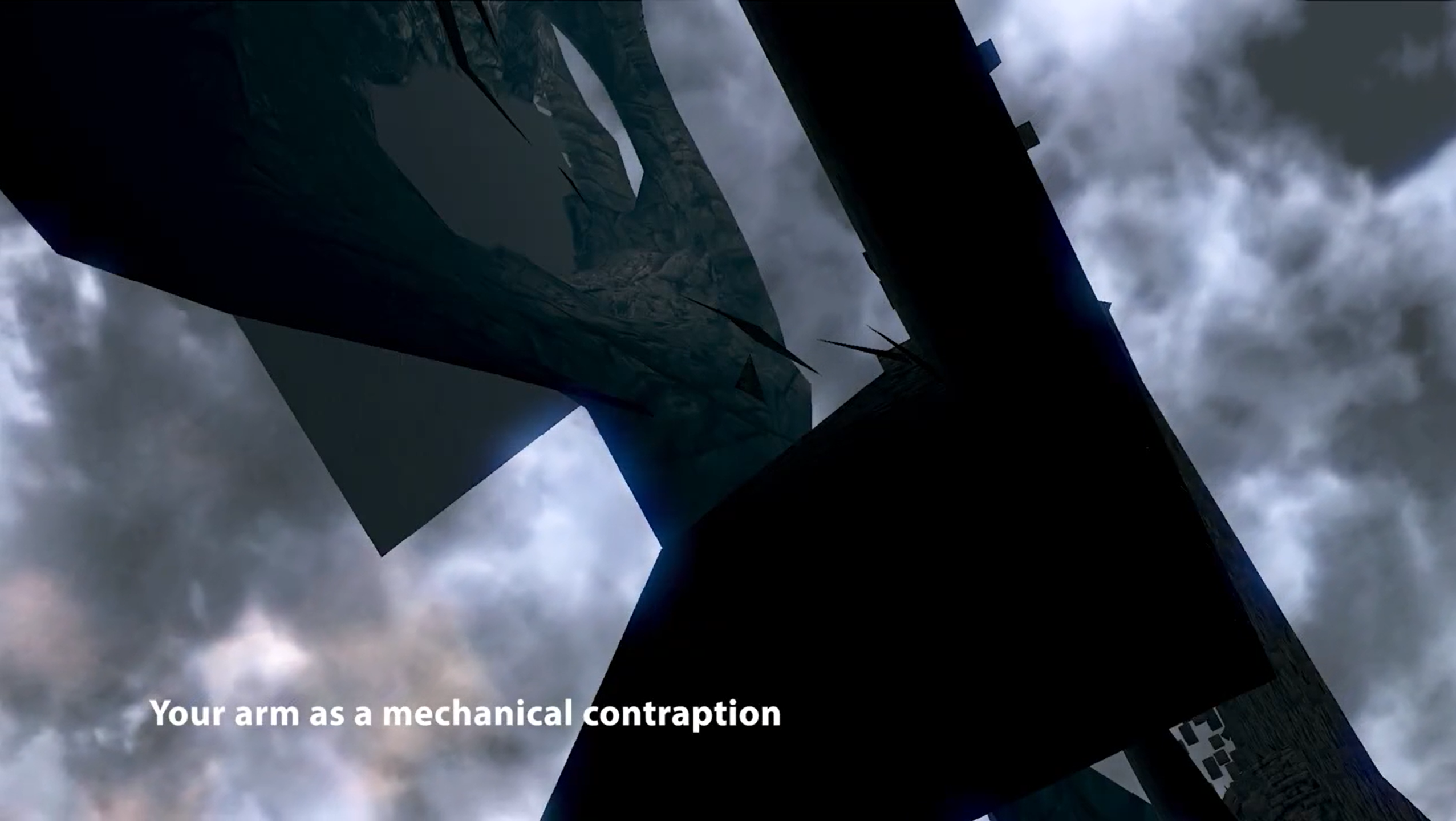
With YLOD (video for a bricked PS3) (2025), Güt moves from networked performance to hardware failure, using Lance McDonald’s Dark Souls debug menu mod to produce a field of glitched skins and broken spatial logic inside a dead PlayStation 3. The programme note focuses on those moments when game space collapses, when the fantasy the machine is supposed to uphold gives way. A broken console sits at digital intimacy’s more poignant end: desire persisting after utility, the device still soliciting attention long past the point of use. Güt treats glitch as the afterlife of use.
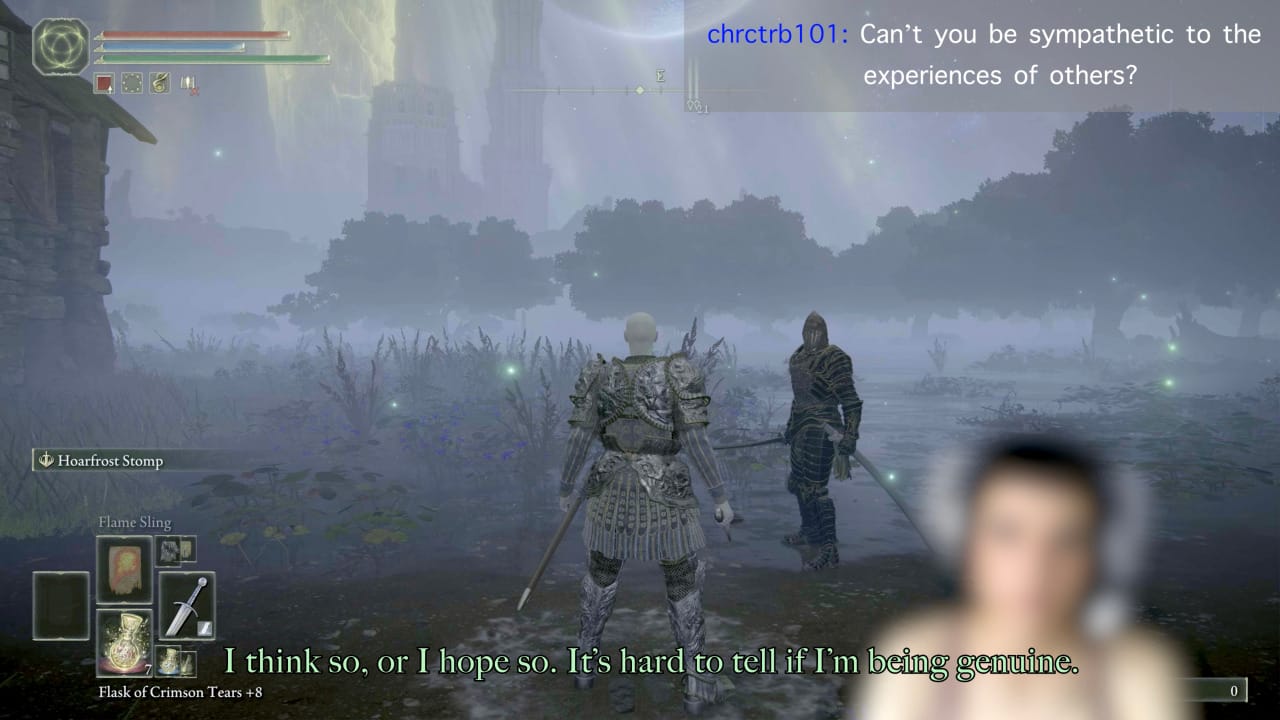
Hurt/Comfort (2022) turns to a different threshold. Here, a streamer plays Elden Ring while trying to address an invisible audience, her image warped by a Gaussian blur. A chat dialogue comforts her, then materialises as a second avatar in the game, allowing the two to ‘trade places’. The work borrows its title from a fanfiction category in which pain is inflicted on a character so that care can follow. Güt uses that language without endorsing or deflating it, employing it to think about spectatorship, self-division, and the fantasy that mediation might console us. The result is uneasiness. Care comes through the interface, and so does dissociation. The spectator becomes, in shifting sequence, accomplice, witness, proxy, and possible replacement.
Then there is The Last Chainmail Video (2020), “A Powerpoint presentation about my last chainmail video”. The chain mail is not only armour: it evokes the chain letter too, with its recirculated messages, forwarded affects, and communal scripts of warning or seduction. The PowerPoint operates by the same logic: an administrative container awkwardly tasked with carrying private fixation. Güt repeatedly works this gap between sincerity and format, obsession and template.
Across these five films, roleplay is inseparable from error/horror, fandom from the coercions that quietly govern it, multiplayer space from the trace left when connection doesn’t hold. The avatars, NPCs, stream overlays, mods, menus, and spectators that populate her work are not merely technical categories, each is also a social position, each carries an affective charge.
Scheduled separately as a participatory performance in Red Dead Redemption 2, the live work My Desert Heart (10 April 2026) follows two player-characters walking toward a duel from opposite ends of the map, narrating their eventual meeting while confronting animals, outlaws, and other players. As the two die and respawn, their controls pass to new actors, whose voices change with each handoff. The work extends concerns visible in Güt’s earlier Welcome to My Desert Nexus, a three-act play performed inside Red Dead Redemption Online. In both pieces, the frontier functions as an arena where contact is perpetually deferred and rerouted, exposed at every moment to interruption.
That orientation is especially pointed at a short film festival. Güt’s work returns, persistently, to incompletion, a stream dwindling to one viewer, a console that no longer works, a confession passing through blur and chat, a game engine hosting a relation it cannot fully support, two avatars crossing hostile terrain toward each other. Even when the pieces are tightly made, they retain the texture of fragile systems. They carry the sensation of something half-lived and half-buffered, as if emotional knowledge now arrives most reliably through lag and failed transmission.