EVENT: ART GAMES! (10–14 MARCH 2026, SAN FRANCISCO)

Art Games!
March 10–14 2026
tiat, 151 Powell Street, San Francisco
Art Games! was timed, pointedly, to coincide with the Game Developers Conference, the industry’s largest and loudest annual gathering held a few blocks away. That proximity was itself a curatorial argument: where GDC convened around business and deals, pipelines and metrics, Art Games! gathered artists and researchers “using games as a creative medium”, foregrounding work that existed outside conventional commercial platforms and instead centred play, interaction, and systems as forms of artistic expression and experimentation. This conjunction (collusion?) was show’s implicit frame, a frame was complicated by the exhibition’s co-presentation with World Labs, a spatial intelligence company building frontier world models that perceive, generate, reason, and interact with the 3D world. World Labs was also the company whose Marble world-generation model powered Hugues Bruyère’s Dormant Memories, included in the show. The overlap between sponsor and exhibiting technology was worth naming, not to impugn the curatorial intent, but because it raised precisely the questions the exhibition elsewhere asked: Where does the art system end and the commercial platform begin? At GDC week, in a gallery co-presented by a generative AI company, the show could not entirely bracket its own institutional conditions.
Nor, perhaps, should it have tried.
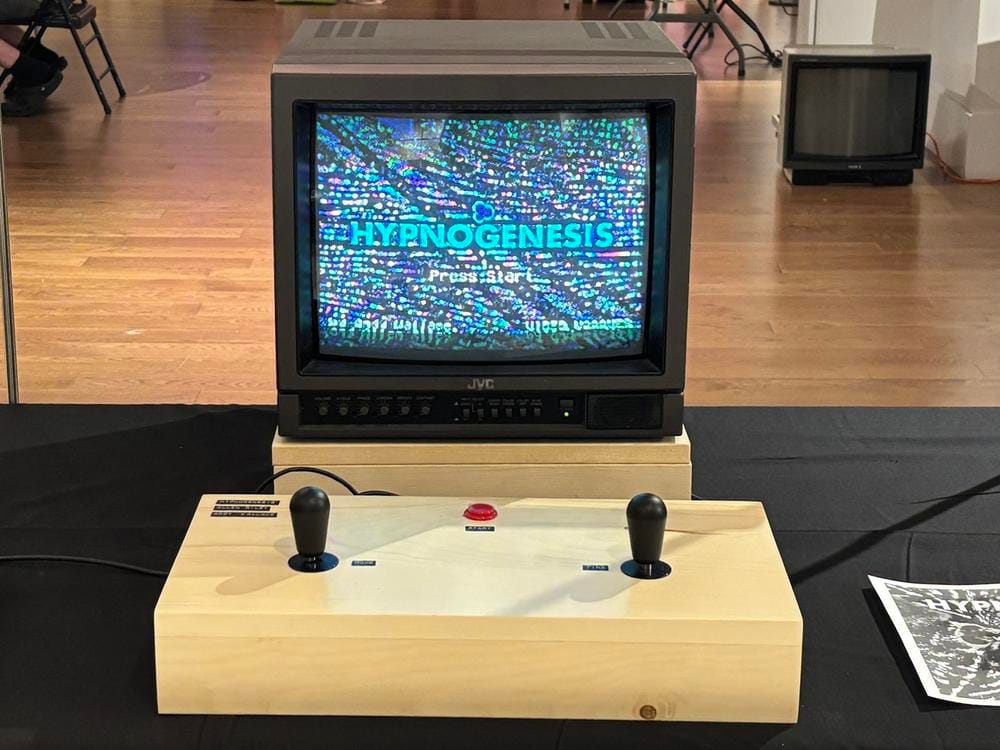
The more persuasive works did not oppose critique to play. Rather, they made play itself the vehicle of critique. Allen Riley and Andy Wallace’s Hypnogenesis — a video feedback space shooter in which arcade gameplay was integrated with the controls of a video synthesizer — had the blunt legibility of a cabinet, but its force lies in the way it collapses cabinet, instrument, and display into one feedback apparatus. in the way it collapsed authorship, display technology, and input into a single unstable loop. The player was not mastering a system so much as entering a volatile circuit in which the boundary between controller and instrument refused to stabilise. In the context of a GDC week show, the arcade cabinet carried additional pathos: it is the form that preceded the industry entirely, before platforms, before storefronts, before the very infrastructure the so-called festival of gaming exists to service.
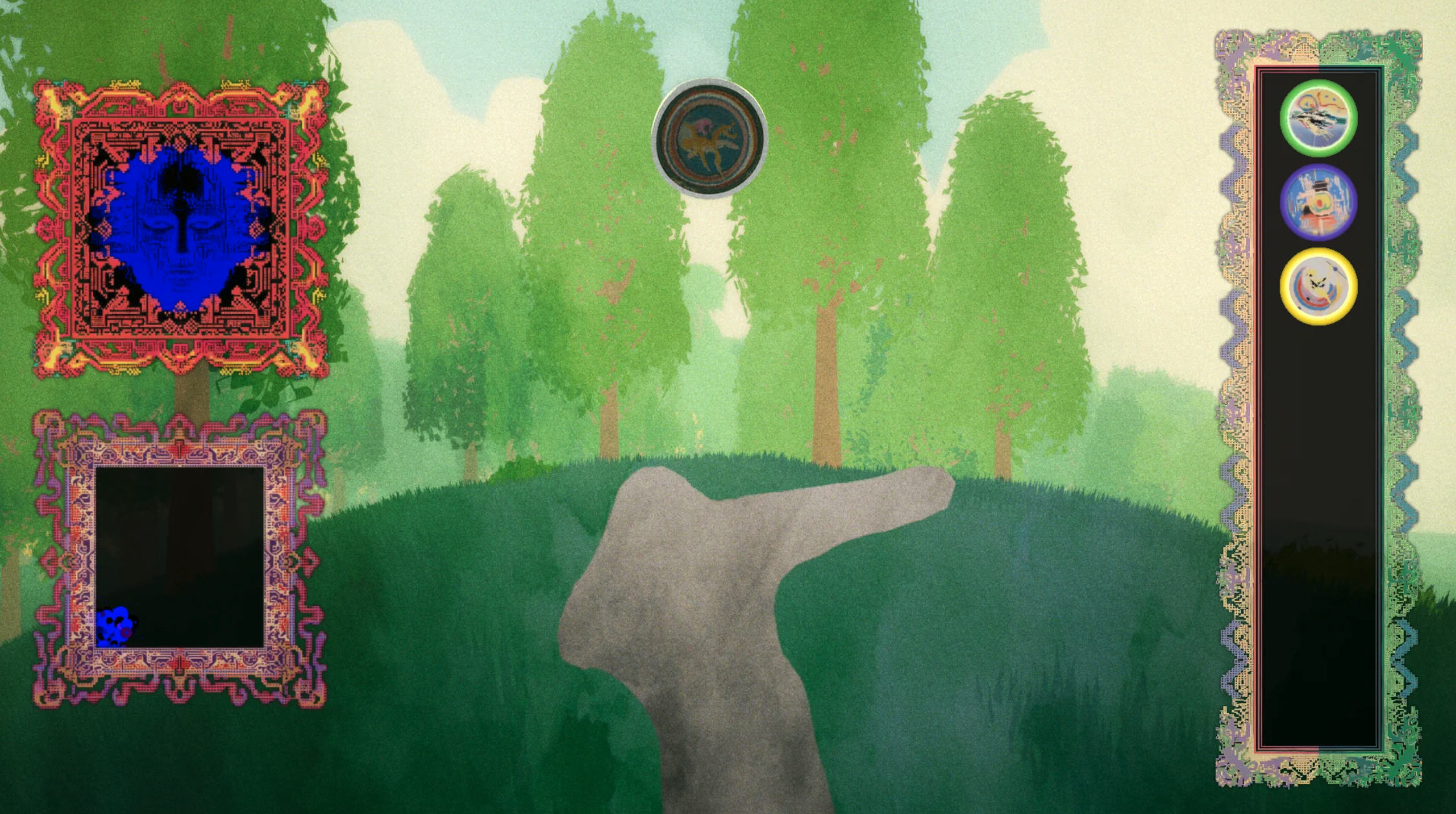
Will Freudenheim’s Schema (2023) was one of the exhibition’s clearest studies in delegated agency. A digital creature moved through a forest world, gathering glowing pearls by day and turning them into generative sound by night, while its behaviour was shaped in real time through a controller and Twitch chat. What made the work compelling is the narrowness of that control. Viewers did not command a wide repertoire of actions; they adjusted only two variables (arousal and inward-to-outward orientation), yet those minimal inputs were enough to tilt the creature toward curiosity, anxiety, contentment, or aggression, and with them its manner of approaching, avoiding, or confronting the world around it. That restrain gave the piece its charge. Collective participation did not appear here as expressive plenitude or communal playfulness. It appeared as a compact model of governance, in which very slight interventions could reorganise an inner life. In other words, Schema is persuasive precisely because it avoids the usual rhetoric of networked interactivity and posed a stricter question instead: how little control is needed before shared influence starts to resemble mere management?
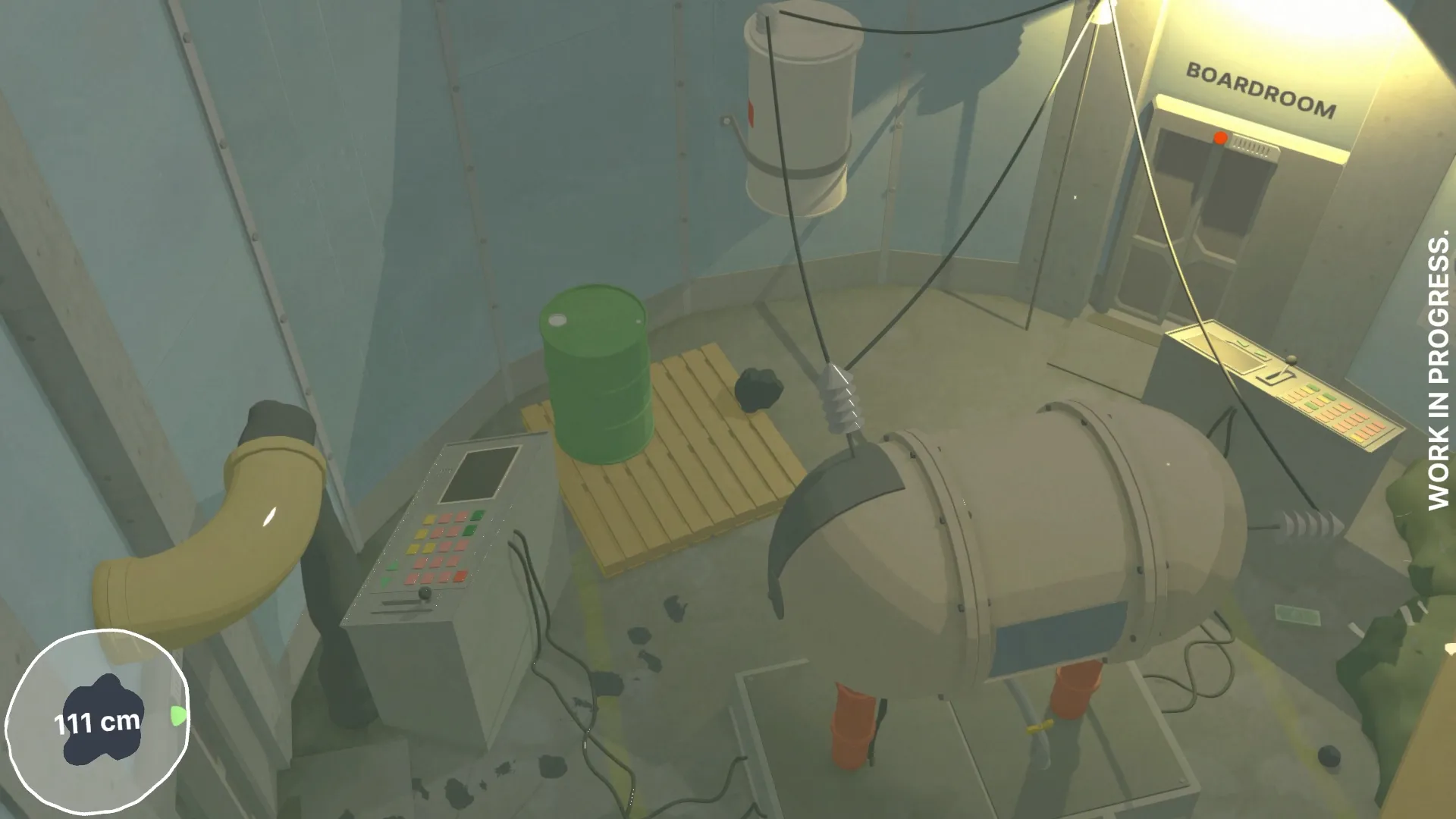
Elsewhere, the exhibition leaned into parody, sometimes productively, sometimes too comfortably. Peter Nichols’s Crude Oil had an appealing formal absurdity: you played as a puddle of petroleum escaping Big Oil, collecting mass, operating heavy machinery, flushing polluters down the drain. The blob was funny, mobile, and tactile, and the work’s tonal lightness prevented it from hardening into thesis. That the full game was set to release on Steam later in the summer was worth noting: it raised questions about where the gallery ended and the commercial storefront began, a tension the exhibition otherwise sidestepped. Which is to say: Art Games! catches the work mid-trajectory: not before the market, not after it, but during its transition between art context and storefront context. Not a dichotomy: a continuum.
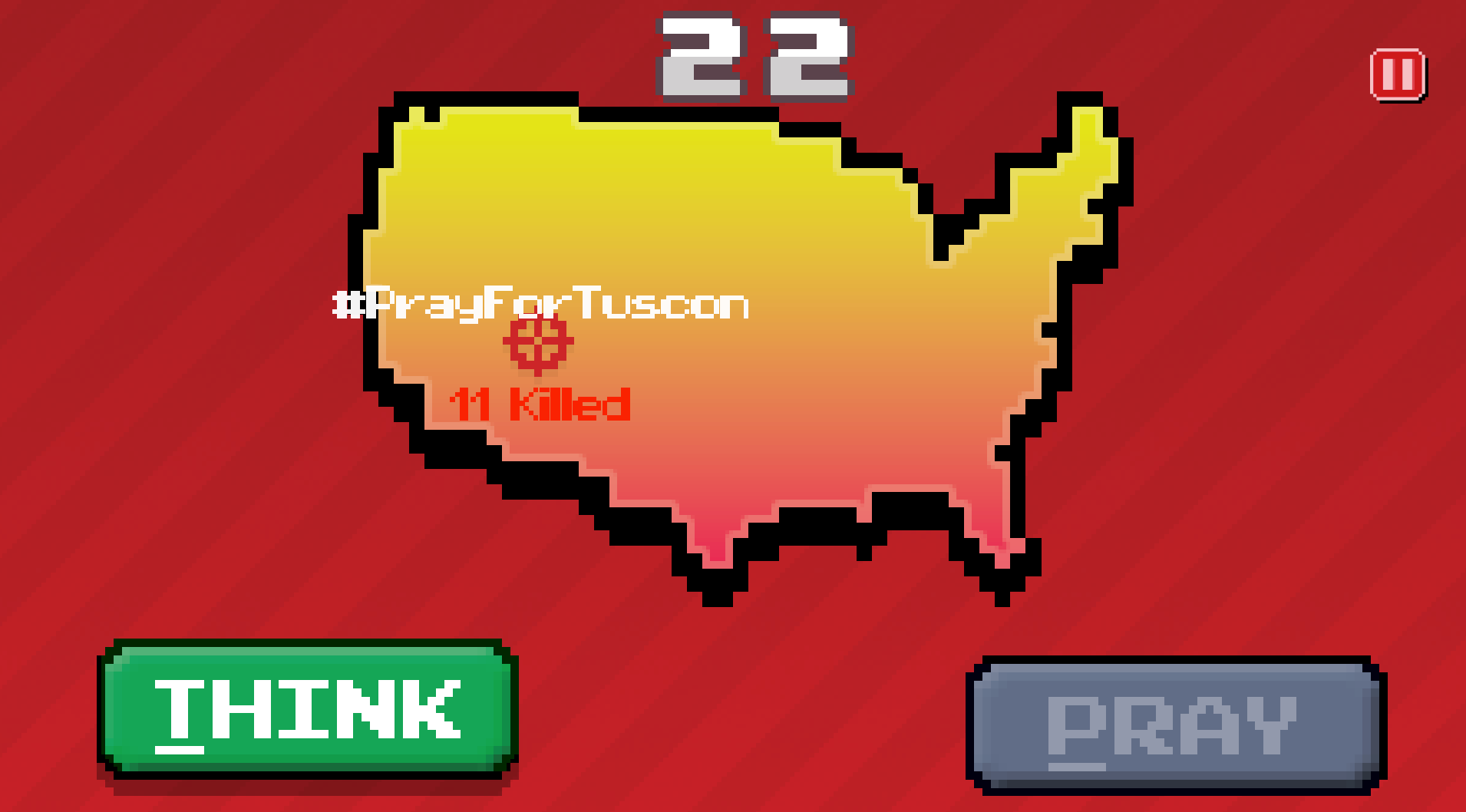
Brian Moore’s Thoughts & Prayers (2016) — a game in which players attempted to end gun violence through the titular ritual, and in which nothing ever happened — arrived with the rigour of a one-line joke whose punchline never changed. That the piece still landed said less about its formal sophistication than about the durability of the conditions it mocked. Its persistence in the exhibition, a decade after its making, inadvertently functioned as a kind of durational performance: the work had outlasted every news cycle it addressed, which was perhaps the most tragic message in the entire show.
Several artists used game structures to think through ecology, care, and nonhuman life without resorting to the pieties that often accompany those themes. Helen Shewolfe Tseng’s straw dogs — described as a microgame-poem, and framed by a quote from the Tao Te Ching: “Heaven and earth aren’t humane. To them the ten thousand things are straw dogs”, imagined a simplified dynamic ecosystem that reacted and adapted to human intervention, inviting the player to sit with unintended consequences. The Taoist framing risked sounding didactic on paper, but in the context of the show it read more modestly: as a constraint on action and interpretation alike.
Peter Whidden and Rayne Beckman’s Mote
Peter Whidden and Rayne Beckman’s Mote shifted the scale entirely. An interactive ecosystem simulation composed of hundreds of thousands of organisms, it used a custom GPU-based physics engine to model interactions between simple behaviours at massive scale, integrating physics, computational biology, and machine learning to produce a wide range of emergent phenomena. It was less interested in representing life than in producing conditions under which patterned behaviour could be observed, manipulated, and briefly inhabited. In these works, ecology appears as rule-set, feedback, and consequence rather than as theme alone.
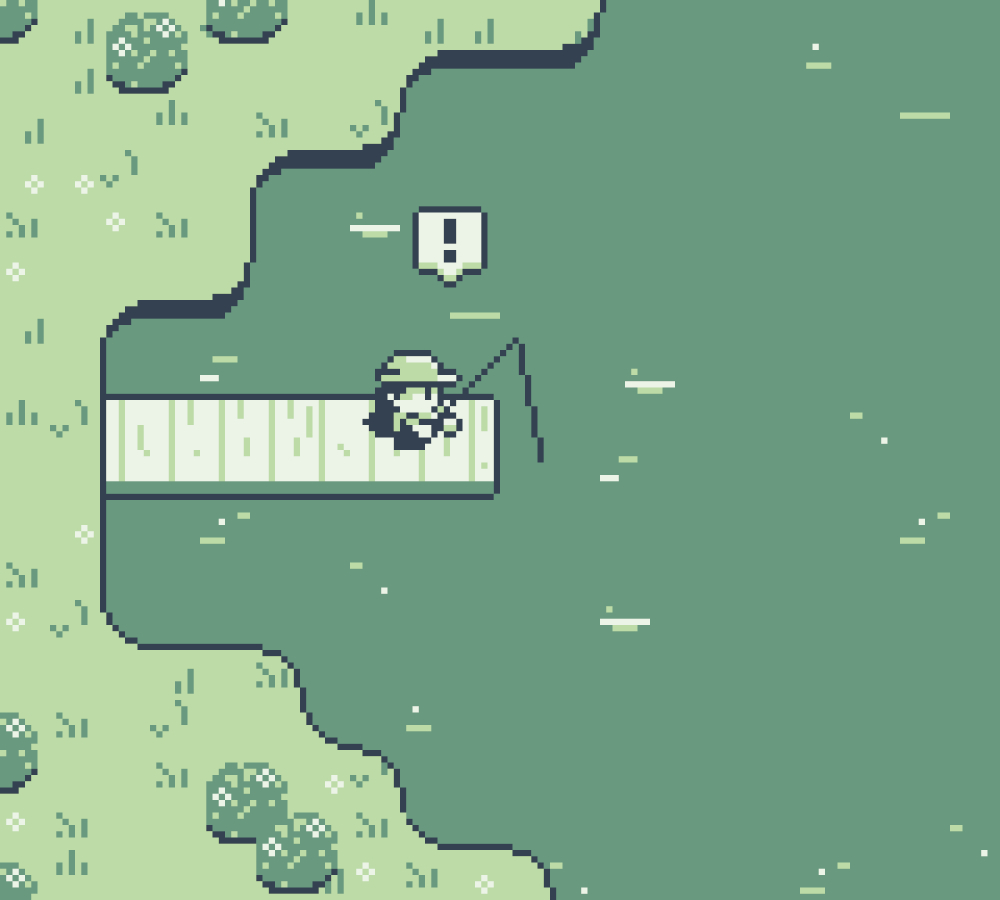
Jackie Liu’s Fishin’ for Average Caucasian Boyfriends (2024) — a semi-autobiographical Game Boy-style work based on a real conversation the artist had with her mother at a seafood restaurant — had the good sense to remain awkward and cringe. The work understands that family scripts are often most visible when repeated in miniature, under the alibi of play. Its title did part of the work, but the piece did not depend on irony alone: it understood that inherited scripts can be rendered most clearly through playful repetition rather than overt confession. The parting question the work posed — What if we refuse to play the game?— applied as readily to the genre conventions it occupied as to the social pressures it depicted.
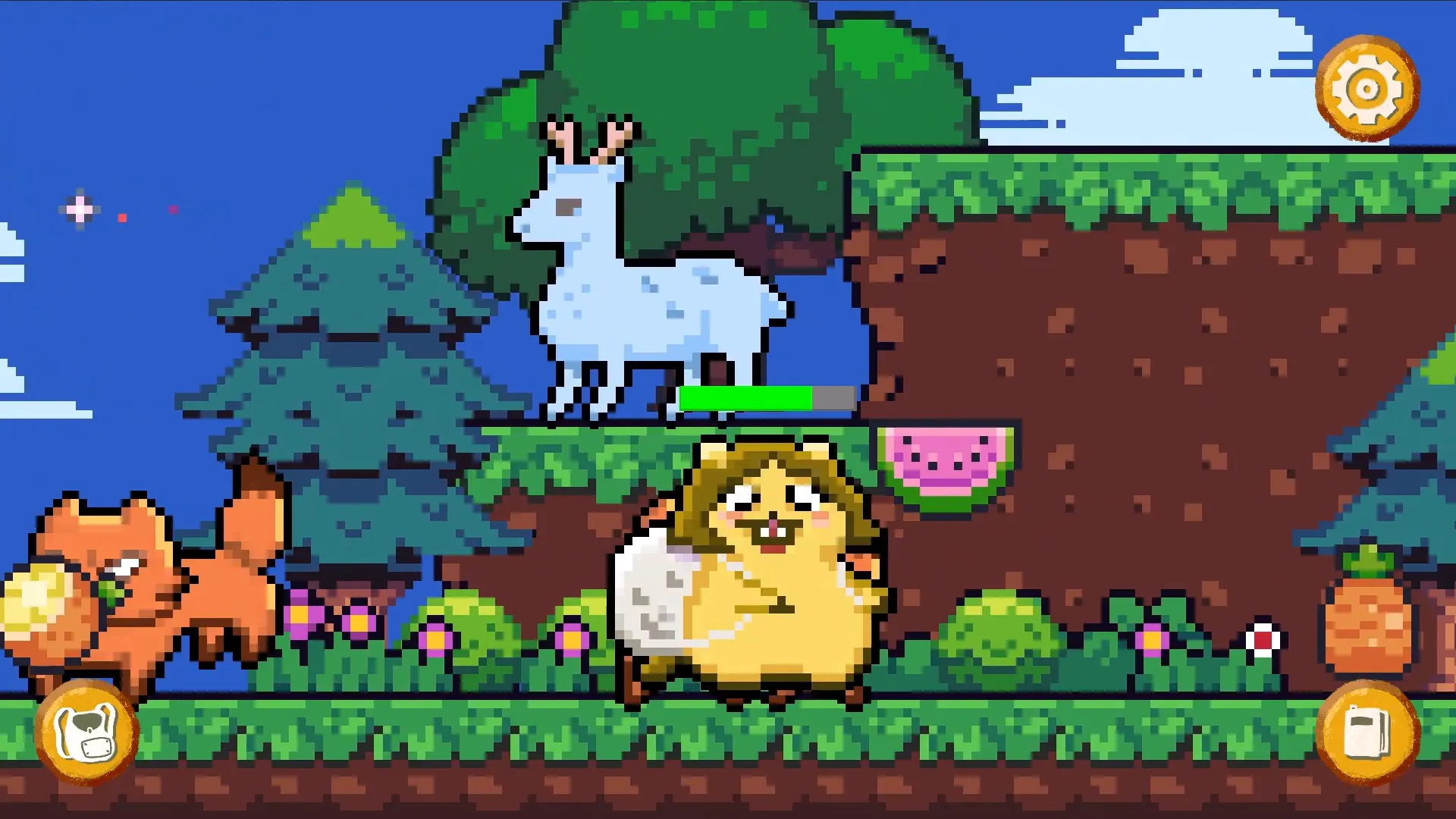
Ruixuan Li’s (Rashel’s) Go Groundshel! likewise retooled platform-game conventions through a deliberately ungainly premise: a groundhog girl rescued her male partner while lacking combat training and urgently needing to find a toilet. The bodily inconvenience at its centre kept puncturing the heroic arc the work nominally inhabited and the absent toilet, as a structuring absence, had more formal wit than most games manage with their entire design vocabulary.
Max Kreminski’s BLABRECS (2020) — an AI-based Scrabble mod that forced players to use nonsense words validated by a classifier trained on the dictionary — was arguably the show’s most timely piece, even if it predated the current moment. In an era when large language models normalise vocabulary and flatten idiom, a game that rewarded linguistic invention and surfaced players’ diverse linguistic backgrounds as a formal feature felt less like novelty than counter-proposal.
If the exhibition had a weakness, it lay, perhaps ironically, in its inclusiveness. The curatorial statement was broad enough to accommodate almost any project made with or around game logic, and that openness could flatten distinctions between pieces that were formally ambitious and pieces that were simply adjacent to current conversations around interaction, AI, ecology, or participation.
There was a subtler structural tension the show might have pressed harder: between works that demanded meatware, a body — e.g., the steel lever and cast-iron valve wheel of Charlie Stigler’s Cool-It, the arcade cabinet physicality of Hypnogenesis — and works that existed on phones, browsers, or streaming interfaces. These two modes of encounter carried different assumptions about attention, public space, and what it meant to play in front of other people. That the exhibition housed both without explicitly staging the friction between them was an opportunity missed, particularly in a five-day run where duration and fatigue were already variables.
On the other hand, the exhibition’s value lay precisely in showing that the contemporary art game remains unresolved and undefined and medium agnostic. It could take the form of a cabinet, a browser poem, a streaming system, a multiplayer phone simulation, an AI Scrabble variant, a volumetric portal, or a heavy industrial control panel masquerading as a children’s reflex game. Stigler’s Cool-It — Cold War reactor interface crossed with a Bop It, demanding that players operate a steel panel in response to barked audio commands while the pace accelerated toward failure — made the point almost too neatly: serious systems and ludic systems are not opposites, and perhaps never were.
Thus, more than a survey of “art games,” Art Games! registered as an overview of interface regimes and of delegated agency, each work distributing action across cabinets, chats, phones, browsers, portals, classifiers, levers, and valves. Its real through-line was therefore not the medium in the abstract, but the concrete apparatus through which action was organised, constrained, hijacked and rerouted. The exhibition was not especially invested in the stale task of redeeming games as art. It was more interested in showing that contemporary art now works through game-like interfaces and adjacent technical systems.
Such emphasis also clarifies where the show’s political force resided. The more incisive works were not the ones that announced a position most loudly, but the ones that narrowed the field of possible action. During GDC week, only blocks from an industry built on optimising interaction and maximising retention, the exhibition’s most compelling claim was that art did not stand outside the systems surrounding it, but could render their forms of control briefly intelligible to both thought and feeling.
All images courtesy of the artists