EVENT: AFTERLIFE (MARCH 20–AUGUST 16 2026 LIVERPOOL, UK)
AFTERLIFE by Only Slime
FACT Liverpool (88 Wood Street, Liverpool L1 4DQ)
20 March–16 August 2026
Galleries open Wednesday–Sunday, 11:00–18:00 (closed Monday–Tuesday)
Exhibitions are free to enter
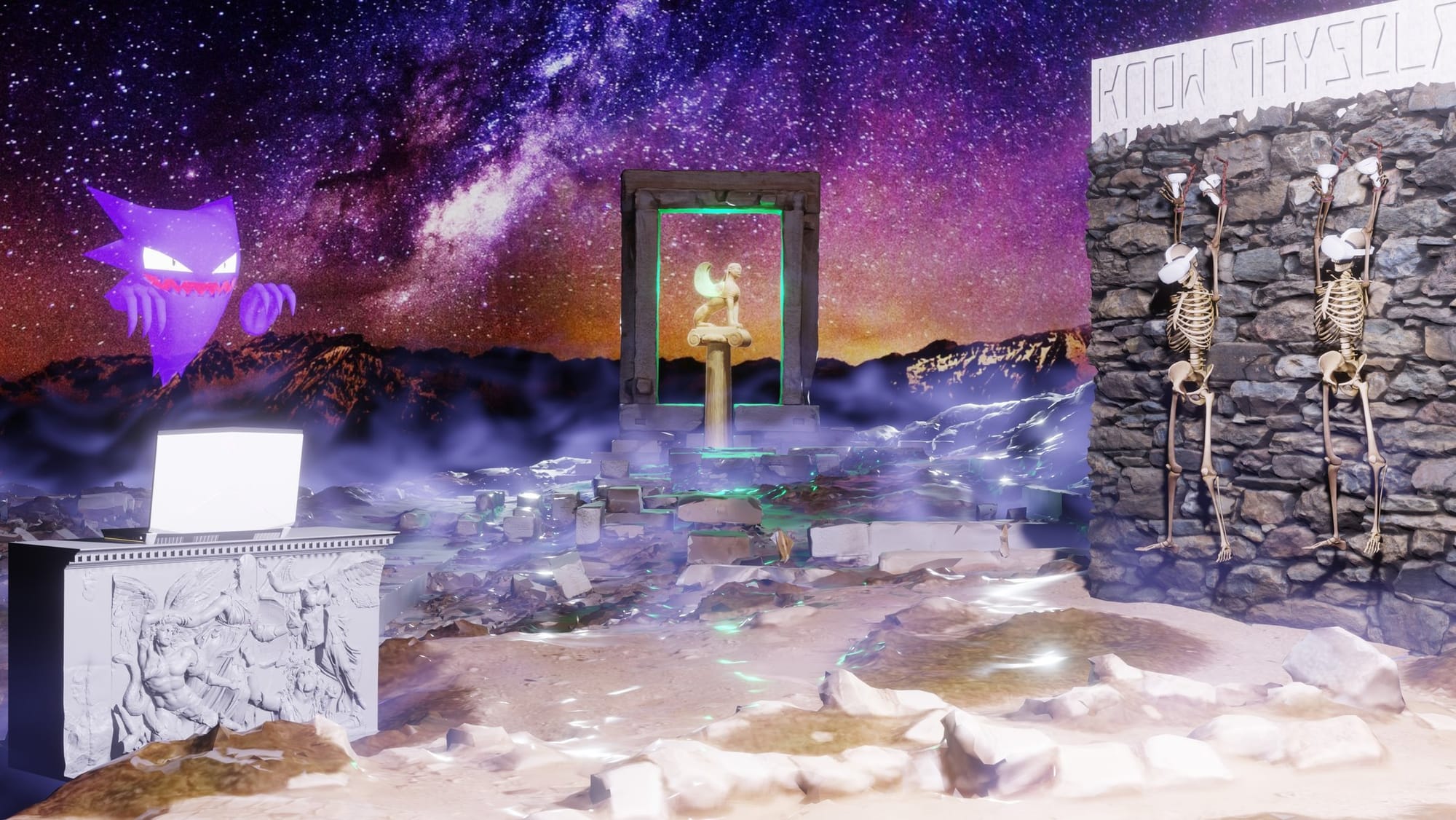
From 20 March to 16 August 2026, FACT Liverpool presents AFTERLIFE, an expanded installation by the artist duo Only Slime (Tobi/Toby Pfeil and Claudia Cox). The work adapts the duo’s “computer-game opera” into a participatory gallery environment: visitors are invited to embody on-screen characters through motion tracking, and to move between fantasy underworlds and dream states while the piece tests who, exactly, holds the controller inside a system authored by someone else.
FACT has long operated at the junction of exhibition-making and screen culture, hosting galleries and a cinema in the same building, and describing its remit as the support and presentation of art and film engaging new technologies and digital culture. In that setting, AFTERLIFE does not need to justify its hybridity. It arrives already legible as a gallery work that thinks like a videogame, and as a game-derived artwork that refuses the default “play” contract.
Only Slime formed in 2022 and work across music, game design, AI-assisted art, performance, installation, and 3D animation, an interdisciplinary profile also reflected in Norwegian performing-arts documentation of the group. Their practice is not simply “game aesthetics” grafted onto contemporary music. Rather, it is a production method in which real-time animation, voice processing, and interactive dramaturgy are treated as co-equal compositional materials.
That hybrid posture has travelled well. AFTERLIFE has circulated in music and performance contexts as a motion-capture “video game opera,” performed live through avatars controlled in a game engine. The piece has also been recognised within contemporary composition circuits: AFTERLIFE was among the winners of Norsk Komponistforening’s “Årets verk” (Work of the Year) for the 2021–2023 period.
AFTERLIFE follows two 3D characters across fantasy underworlds and dream states, drawing on Greek mythology and contemporary internet culture. The installation uses motion tracking and “playful mini-games” to pull the visitor into the work: your actions influence what the characters do and the routes they take.
AFTERLIFE states its central problem with admirable bluntness: shifting power dynamics between creator, player, and avatar, and the question of what control looks like inside a system built by someone else. That formulation is familiar to anyone working in critical game studies, but the installation format forces the issue into a bodily register. Motion capture does not just “represent” agency: it makes agency measurable, legible, and, at times, humiliating. You move, the avatar responds, except when it doesn’t, or responds in ways the system allows rather than what you intended. This is where the work exceeds the standard gallery promise of interactivity. Participation here is not a feel-good add-on or faux agency: it is the medium’s own disciplinary technique. To “embody” the character is to accept the rig, to negotiate tracking, latency, calibration, and the pre-scripted grammar of actions.
In other words, AFTERLIFE treats the visitor less as sovereign user than as a performer recruited into an authored pipeline.