EVENT: ESCAPE>CONTROL>PLAY (OCTOBER 13–DECEMBER 12, PHILADELPHIA)

essential information
Escape > Control > Play: The Art of the Video Game
Leonard Pearlstein Gallery, Drexel University
URBN Annex, 3401 Filbert Street, Philadelphia
October 13–December 12, 2026
Opening reception: October 15, 5:00–7:30 p.m
Admission is free
On October 13, Philadelphia’s Leonard Pearlstein Gallery opens Escape > Control > Play: The Art of the Video Game, an interactive exhibition bringing contemporary art, independent game design, experimental interfaces, and videogame history into the same gallery. Curated by Talia Greene and Mark Stockton, the exhibition runs through December 12 at Drexel University’s Antoinette Westphal College of Media Arts & Design. The project received a $90,000 grant from The Pew Center for Arts & Heritage.

The exhibition approaches games through three sections: <Future Imaginaries>, Queer Games >> Histories + Futures, and Collaboration->Community.
Visitors can encounter Hsin-Chien Huang’s VR work Bodyless, Jeremy Couillard’s Escape from Lavender Island, LuYang’s The Great Adventure of Material World - Game Film, .Compost Coop’s The Alembic Hotel, Bennett Foddy and AP Thomson’s Multibowl, Derek Yu and collaborators’ UFO 50, Erin Truesdell’s alternative-controller game Haber Dasher, and work by Brian Gibson. The installation also includes a gaming lounge, archival material, bespoke consoles, and playable works.
Gallery director Mark Stockton describes the project in spatial terms. Drawing on the sonic and social environment of the arcade, he proposes transforming the conventional white cube through forms of play that require participation rather than detached observation. This distinction gives Escape > Control > Play a productive position within the longer history of exhibitions devoted to videogames. The institutional argument for games as legitimate artistic objects has already been made many times. Drexel instead concentrates on what games do inside an exhibition: how they organize bodies, require cooperation, retain histories, fabricate others, and depend on particular conditions of access.
Several works are especially effective when considered through the problem of videogame history itself.
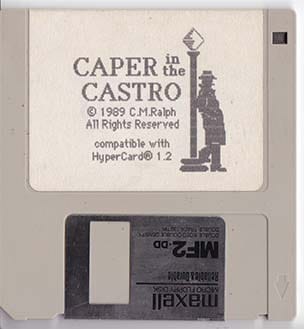
Caper in the Castro, presented within Queer Games >> Histories + Futures, offers an unusually literal case of recovery. Created by C.M. Ralph in 1989 with HyperCard, the game casts the player as lesbian private detective Tracker McDyke, searching for the kidnapped drag queen Tessy LaFemme. Ralph originally distributed it through bulletin board systems as “Charityware”, asking players to donate to an AIDS organization rather than pay for the game. For years the software was effectively considered lost. Ralph rediscovered original disks in 2017, after which Adrienne Shaw, founder of the LGBTQ Video Game Archive, and Andrew Borman at The Strong National Museum of Play collaborated on its digital preservation. The Strong now preserves disk images of Caper in the Castro and Ralph’s later heterosexual rewrite, Murder on Main Street.

At Drexel, Shaw has collaborated with Ari Gass on the queer games section, which places this recovered title alongside contemporary material associated with Trans Game Zine. The pairing situates game preservation within a history of community formation and representation rather than treating old software primarily as technological heritage.
Across the exhibition, UFO 50 performs an almost inverse operation. Released in 2024 by a development group including Derek Yu and Jon Perry, the collection contains fifty complete games attributed to UFO Soft, a fictional videogame company active during the 1980s. Shared characters, sequels, changing visual conventions, and an internal chronology give this invented company something resembling an archaeological record. The developers explicitly describe the premise as an “alternate universe”: the works resemble lost 8-bit games while incorporating contemporary design ideas. Drexel extends the fiction materially by presenting UFO 50 through specially produced 3D-printed consoles.
The proximity between Caper in the Castro and UFO 50 creates one of the exhibition’s key conceptual connections. One reconstructs a videogame history that nearly disappeared. The other manufactures a history convincing enough to produce nostalgia for software that never existed. In each case, the archive is playable and experiental.
Bennett Foddy and AP Thomson’s Multibowl makes the instability of game history even more explicit. Built from a modified version of MAME, Multibowl combines brief competitive sequences extracted from more than 300 historical videogames. Foddy has described the 2016 project as, possibly, the first “videogame collage”. Its dependence on copyrighted commercial games also determines how audiences can encounter it. The creators have never released Multibowl for general distribution. Instead, they present it at festivals, museums, and galleries, where individual games appear for only a few seconds at a time. The gallery therefore provides more than exhibition space. It supplies the temporary conditions under which the work can circulate.
Other projects connect this concern with historical memory to political and technological systems. Hsin-Chien Huang’s Bodyless places the visitor inside a VR narrative based on the artist’s memories of Taiwan under martial law. First presented in the interactive section of Venice Virtual Reality in 2019, the work follows the ghost of a deceased political prisoner through a world in which memories, bodies, and urban space are progressively converted into digital forms. Huang explicitly connects the classificatory logic of authoritarian government with contemporary digital surveillance.
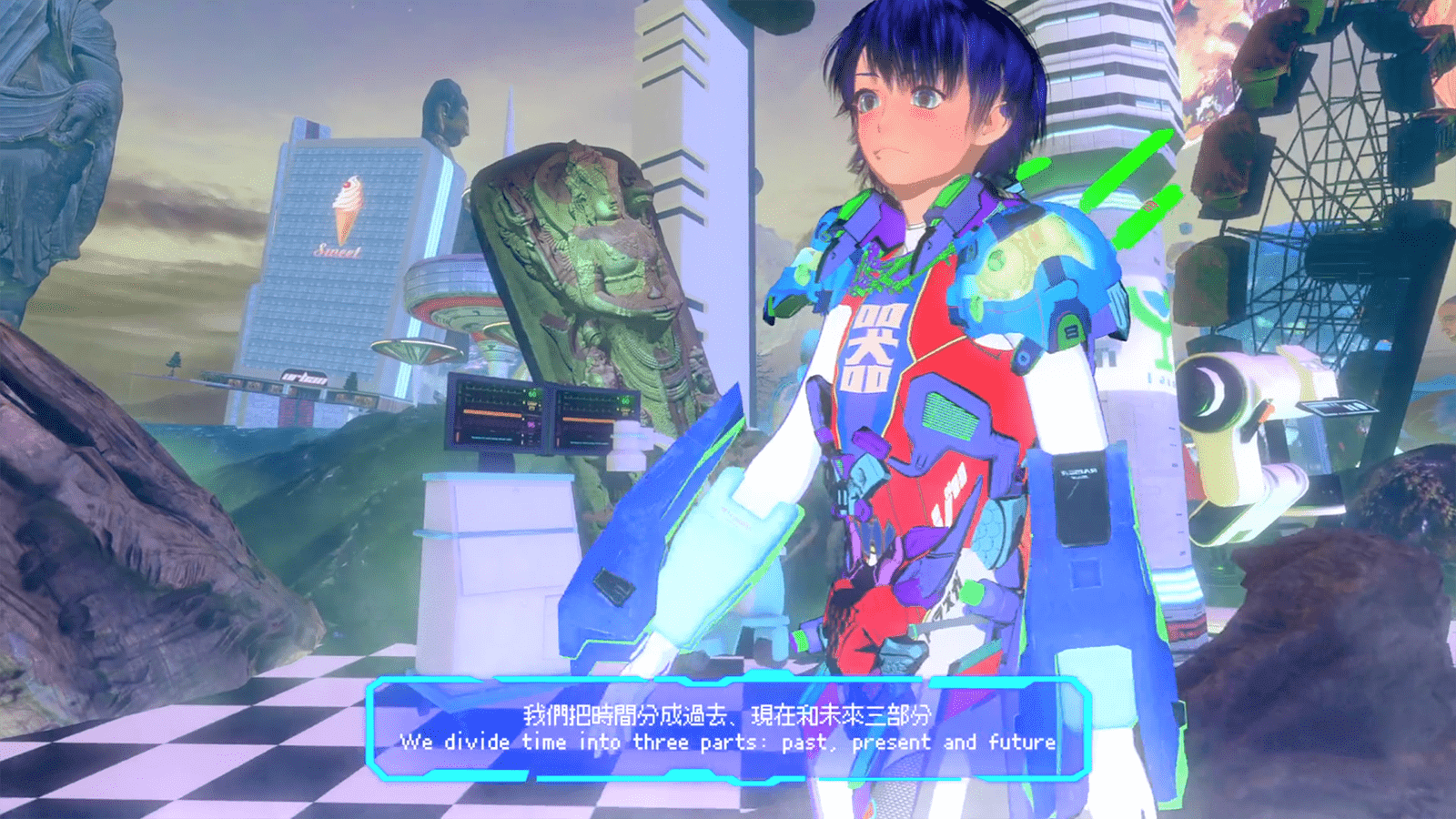
LuYang’s The Great Adventure of Material World - Game Film (2020) moves through a different relationship between game imagery and the body. The 26-minute work draws on videogame aesthetics alongside Buddhism, anime, neuroscience, and questions of material existence. Previous presentations, including Mori Art Museum’s MAM Screen 015, have situated the film within LuYang’s sustained use of 3D modeling and motion capture to examine embodiment and identity.
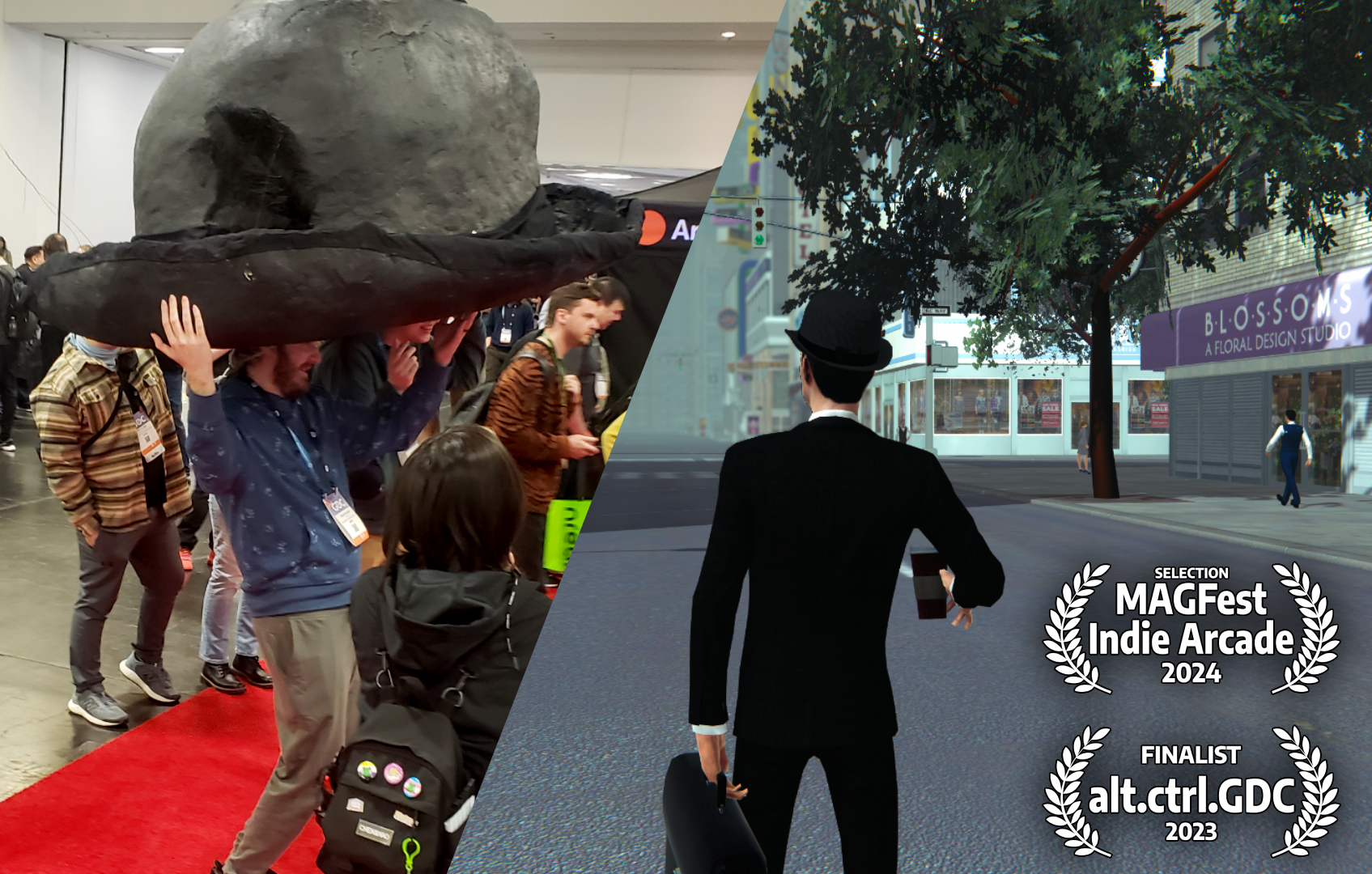
Physical control returns directly in Erin Truesdell’s Haber Dasher. Two participants operate an enormous bowler hat together while controlling an alien named Zorg through a caricature of corporate life. A finalist in alt.ctrl.GDC 2023, the project belongs to Truesdell’s broader research into collaborative and embodied forms of gameplay.
Brian Gibson, Mike Mandel, Thrasher, 2024. Source: Brian Gibson, Mike Mandel
Brian Gibson and Mike Mandel’s Thrasher likewise replaces conventional screen-based interaction with bodily movement in its VR version, which supports hand tracking as well as controllers.
The exhibition’s title consequently acquires several meanings. “Control” refers to controllers, interfaces, software restrictions, institutional systems, and the social mechanisms represented inside the works. “Escape” appears repeatedly as a design premise, although these games rarely imagine escape as uncomplicated liberation. “Play” becomes a method for examining systems by entering them, manipulating their rules, or temporarily producing alternatives.
The public program extends these concerns beyond the installations:
Bennett Foddy appears in conversation on October 23
Erin Truesdell leads an alternative-controller workshop on November 13.
On November 18, Tabitha Nikolai, Jeremy Couillard, and Hsin-Chien Huang discuss worldbuilding, while a December 4 event considers queer games, platform censorship, and alternative distribution.
Escape > Control > Play arrives at a moment when the question of whether videogames belong in museums has become considerably less productive than the questions generated by their presence there. Preservation, emulation, physical interfaces, multiplayer behavior, intellectual property, and obsolete hardware all complicate the apparently simple act of putting a game on display. Drexel’s exhibition treats those conditions as part of the material.
The result is extremely compelling where the gallery functions as a temporary repository for improbable histories: a queer detective game rescued from aging Macintosh disks, hundreds of commercial titles recombined into an unreleasable collage, and fifty imaginary games attributed to a company that never existed. Here, videogame history appears neither fixed nor complete. It has to be recovered, reconstructed, played, and sometimes invented.