Chad Chatterton on acmipark and game spaces
Originally published on GameScenes on November 18, 2010.
This email conversation with Australian artist Chad Chatterton took place in October 2010 and was conducted by Mathias Jansson as part of Game Artworlds: The Early Years, a GameScenes series devoted to formative artists and works in game-based art.
The interview revisits Melbourne’s early game-art milieu around 200 Gertrude Street, Chatterton’s collaborations with Julian Oliver and the Selectparks network, and the development of acmipark, commissioned by the Australian Centre for the Moving Image. Chatterton also discusses the influence of Half-Life, the shift of his studio practice from physical construction to game-development tools, and his 2000 exhibition World’s End.
Editor’s note, 2026: This interview is republished as an archival document. Spelling, punctuation, capitalization, and evident typographical errors have been lightly standardized. The substance and historical perspective of the original exchange remain unchanged.
GameScenes: The 200 Gertrude Street Gallery in Melbourne seems to have been an important place for artists experimenting with videogames. You, Stephen Honegger, and Julian Oliver all had exhibitions there at the beginning of the 2000s. Can you tell me something about the gallery and its relevance for the Australian Game Art scene?
Chad Chatterton: Well, Stephen, Julian and I were friends and in fact all lived together in a warehouse studio setup at one stage, so our connections weren’t through the gallery as such, but the gallery was — and still is, I presume — an important hub of the Melbourne art scene.
It housed a stable of subsidized studios that were available for young artists to apply for, and from there you had access, an obligation in fact, to exhibit. But any artist could apply to show at Gertrude Street, and it was something of a bridge between the artist-run spaces Melbourne is known for and the more developed or institutionalized art scene beyond.
Visiting curators coming to Melbourne would usually drop in and take a stroll through the studios, for example, and there was also a studio set aside for foreign artists who had obtained a residency.
In 2000 Max Delaney was running the show at Gertrude Street, and he was very hands-on and active at all levels of the art scene. It’s largely thanks to him that Gertrude Street was interested in the work we produced. He had read a piece I’d written in Like art magazine and asked if I’d curate a show.
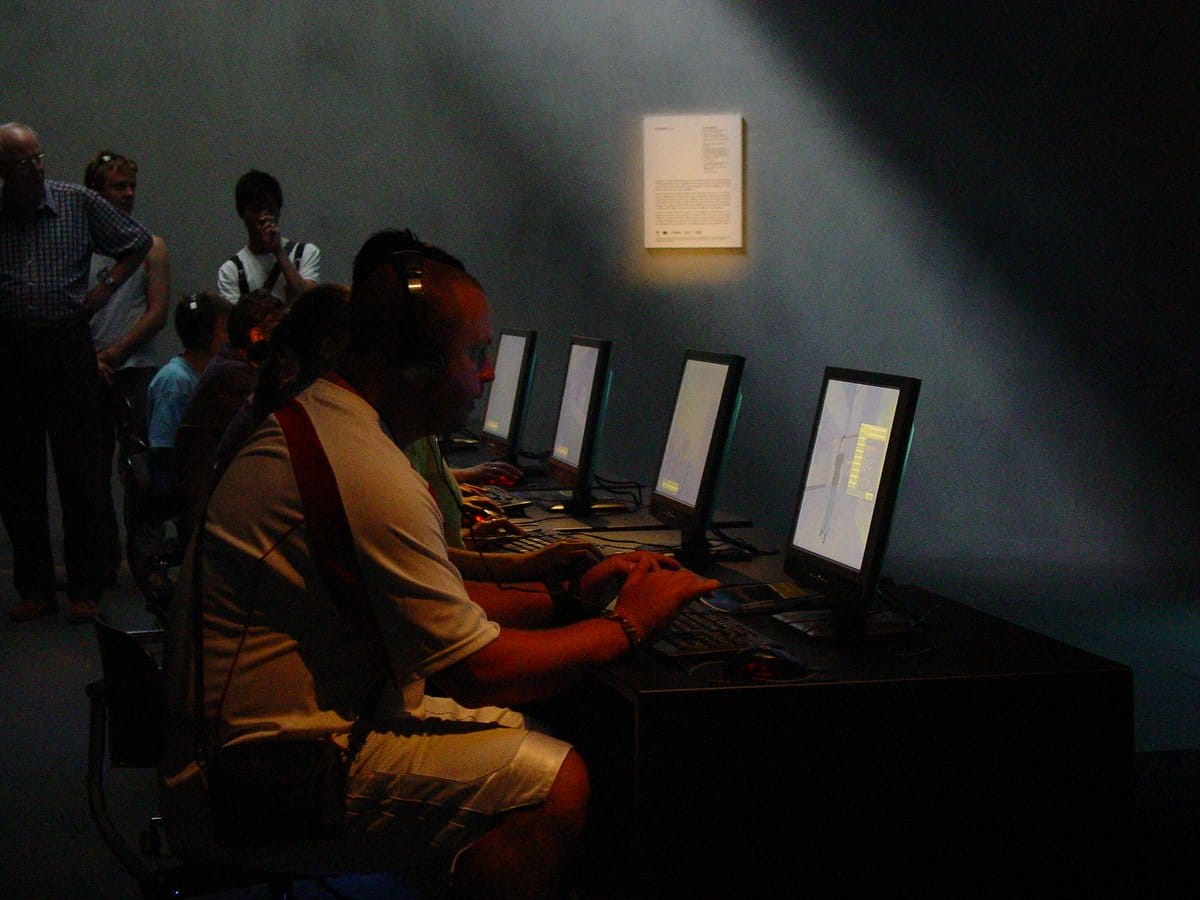
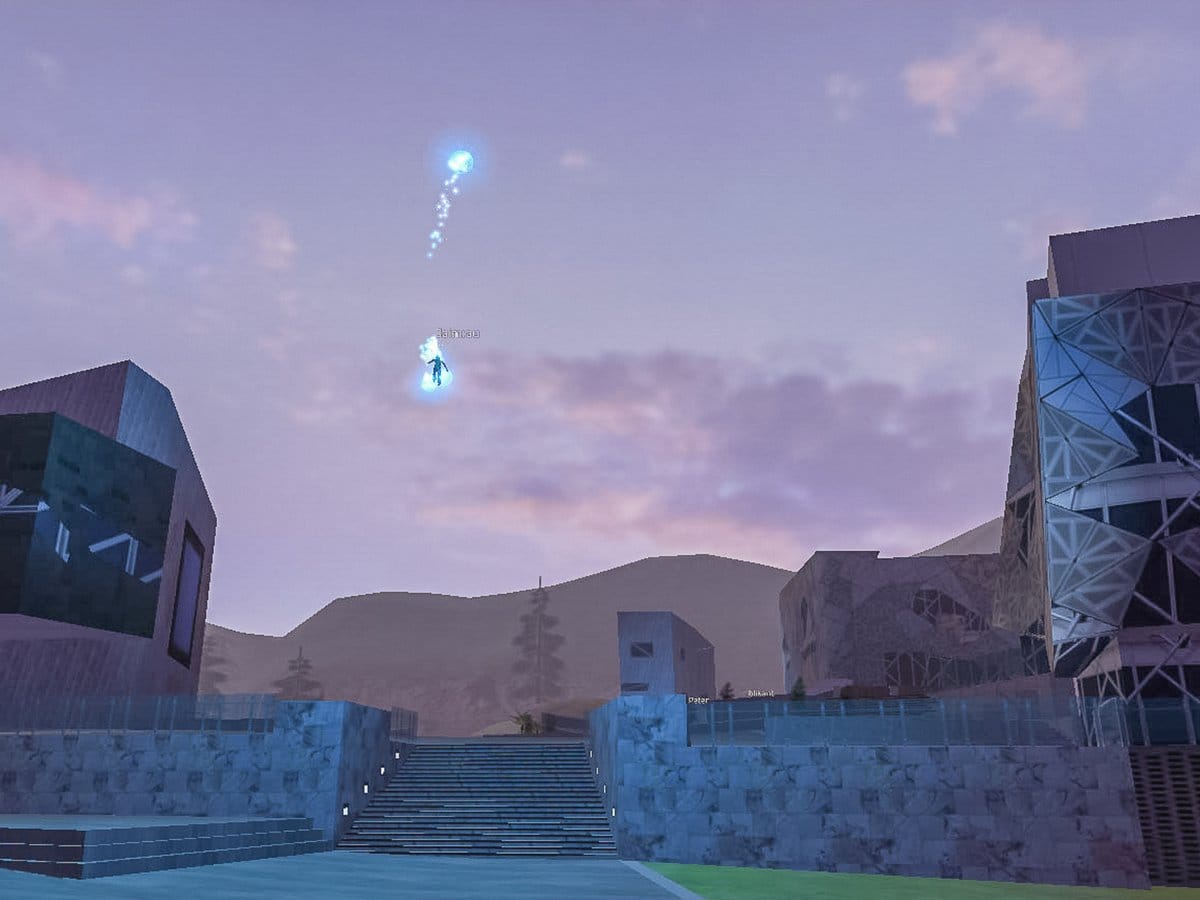
acmipark (2001–2002) is a virtual environment that contains a site-specific, multiplayer, game-based reimagining of the Australian Centre for the Moving Image, extending the real-world architecture of Federation Square into a fantastic abstraction. acmipark was a non-commercial public artwork commissioned by ACMI, built from the ground up using RenderWare. Source: acmipark
GameScenes: Together with the other members of Selectparks you created acmipark. Today it is part of the Australian Centre for the Moving Image collection. Can you tell me something about acmipark and perhaps why it was commissioned by ACMI?
Chad Chatterton: Julian Oliver was due to deliver a paper at the Royal Melbourne Institute of Technology. At the time we were still riding high on our excitement about Half-Life, and spent a lot of time discussing the untapped potential of game engines.
Julian’s presentation was directing this discussion towards architects and Virtual Reality professionals. His point was that the time and money spent on architectural fly-throughs and VR projects was falling short of the potential that game engines offered, saying that games had given us a body in our virtual spaces and, as a result, we were now experiencing our virtual spaces as places.
Places where you can become a local, spatially interacting with actual communities.
For the presentation Julian asked me if I wanted to model something indicative of the points he was making, so I chose to model the Architecture Department, where most of the audience spent much of their time.
Everyone in the audience was therefore familiar with the space we projected during the presentation, and it was a powerful moment for this group of professionals to see a real-time rendering of a place they knew, with all the freedom of movement a game environment can provide.
Using an elevator in the level, we then entered Julian’s Qthoth map, which represented a degree of abstraction and interaction. It’s extremely cool and also operates as a tool for live sound performance.
So we were demonstrating the potential game engines have to simulate the real and also the fantastic, highlighting the bodily dimension and what that body can generate through interactivity, particularly in relation to sound.
Helen Stuckey of the Australian Centre for the Moving Image was in the audience and suggested to us that we ought to submit a proposal to Cinemedia’s Digital Media Fund, which funded art projects in Australia related to the screen.
Helen is really remarkable and has a great deal to do with the health and interest of the game-art scene in Melbourne.
At the time ACMI was part of a major architectural development in the heart of Melbourne called Federation Square.
The idea that we developed was to simulate Federation Square and contextualize it in picturesque park surroundings, complete with interactive sound installations, all of which functioned as an online world that anyone could access for free.
In this way, acmipark effectively extended the public space of ACMI.
On another level, acmipark was where we cut our teeth. It was ridiculously ambitious and it was a sink-or-swim moment.
A moment that lasted two years.
GameScenes: When did your interest in videogames and their artistic potential begin?
Chad Chatterton: For me the overlap of art and game doesn’t boil down to any one thing, of course. However, Julian, Stephen and I did share a significant experience that really nourished our enthusiasm for a good long while.
We spent some twenty-four hours locked away in a computer lab and discovered what it was like to really play Half-Life multiplayer deathmatch.
It was a transformative experience to be so utterly submerged in that game space together. After that we spoke and thought about gaming and game engines constantly.
I won’t attempt to define art on any level, but I will say that creating places in game engines, which is what I do, allows you to engage with the details of your surroundings: their form, color, the way different surfaces react to light, sound and movement, and the effects of time.
I’m constantly thinking about the construction of landscapes and objects, and the relationships of those objects to their landscapes.
It’s a practice that positions the world as teacher in a very rich way.
Half-Life wasn’t my first experience with gaming, of course. My father was a computer science teacher, and we always had computers at home when I was growing up.
I have fond memories of swapping games at school on data cassettes and floppy disks.
However, when I was studying at university I didn’t really give much thought to games at all, so seeing Half-Life was a kind of homecoming.
[Insert image: Chad Chatterton and Julian Oliver, Interactive Architectural Simulations and Games Spaces, 2000–2001.]
Created in collaboration with Julian Oliver for a presentation series given at the Royal Melbourne Institute of Technology, Australia, a virtual simulation of the Architecture Department led into progressively abstracted gameplay spaces which focused on player kinetics and sound generation. Built using the Half-Life engine.
— Chad Chatterton
GameScenes: One of your first solo exhibitions was World’s End, a formal analysis of the graphics of destruction in gaming, at First Floor Artists and Writers Space in Melbourne. Can you tell me something about the show and which games, engines, or tools you used to create the work?
Chad Chatterton: I was given a slot at the beginning of 2000 at First Floor Artists and Writers Space. It was a last-minute thing and was an earlier slot in the art calendar than usual, meaning they probably just wanted somebody to pay the rent.
Whether you take the Christian calendar seriously or not, 2000 was a pretty momentous New Year, I think you’ll agree, so I decided to take it.
Exhibitions are like significant diary entries, and I thought it would be an interesting time to have a show.
At the time I was living with a guy who, together with his girlfriend, took the Y2K threat very seriously. They were stocking up on long-life milk and had even organized a house in the country where they would be safe.
He actually was a big influence on my interest in and understanding of gaming, and went on to write for some gaming magazines in the UK. I remember he managed to convince the Melbourne University library to subscribe to Edge magazine.
I wanted to feed off this fear associated with the turn of the century by looking at the graphics of explosions.
In the end I sourced R-Type mostly, which I thought was as beautiful a display of pixels as anything I’d seen.
It perfectly occupies that space between symbol and thing, with just enough resolution and color range to become more than the sum of its parts.
The show itself builds on earlier work I did using small concrete blocks that I’d made. I would carry several hundred of these blocks to the gallery and then start playing with them, building these knee-high architectural structures in the gallery space.
So with World’s End I wasn’t exactly sure what I was going to build when I started, and for me that was part of the joy.
When I look at the few images I have of the exhibit now, I can see that the pieces are just sketches, iterations that might have evolved into a more worthwhile show down the line.
But it’s an obvious thing to do, build with pixel blocks in this way. It’s actually a very easy thing to do, and that in itself is pleasurable, but I guess it wasn’t what I was looking for.
In the end I realized that this impulse to “take from game and build in the real world” is flawed and generally not very interesting.
A year later I had left Gertrude Street, packed up my studio, materials and tools, and folded everything into a computer, where I focused on learning the tools of the game-development trade.
All images courtesy of the artist.
Interview by Mathias Jansson.
Archival links
Chad Chatterton
http://www.chadchatterton.com/
acmipark
http://www.acmi.net.au/acmipark.aspx
Originally published on GameScenes, November 18, 2010.