Axel Stockburger on Game/r Spaces
Originally published on GameScenes on July 7, 2010.
This email conversation with artist and theorist Axel Stockburger took place in June 2010 and was conducted by Mathias Jansson as part of Game Artworlds: The Early Years, a GameScenes series devoted to artists working with videogames during the formative decades of game art.
Born in 1974, Stockburger studied at the University of Applied Arts Vienna with Peter Weibel and later completed a PhD at the University of the Arts London. His artistic and theoretical work has examined mediated space, videogame environments, networked play, sound, simulation, and the relationship between physical bodies and virtual worlds.
The conversation ranges from Doom and Quake to Henri Lefebvre, machinic spatiality, Grand Theft Auto, gold farming, game spectatorship, and the limits of “game art” as a critical category.
Editor’s note, 2026: This interview is republished as an archival document. Spelling, punctuation, capitalization, and evident typographical errors have been lightly standardized. The substance, terminology, and historical perspective of the original exchange remain unchanged.
GameScenes: What is your relationship with videogames? When did you start playing? What games did you like?
Axel Stockburger: My first contact with videogames must have been visiting game arcades during holidays in Italy as a child. The games I loved ranged from Wonder Boy to Pac-Man and the various renditions of Space Invaders.
A little bit later, a school friend got a Commodore 64, which became a center of attention for a period of time. I will always remember the chuckling sound the little goblin in Barbarian made when it kicked the pixelated severed head of the opponent, which would be left lying on the ground, into a hole.
After this period my gaming became infrequent, and I remember playing adventure games like the Monkey Islandseries, Day of the Tentacle, and Indiana Jones on the PC.
Between fourteen and eighteen I lost track of gaming, and my interest awoke again when I started to study media arts at the University of Applied Arts Vienna under Professor Peter Weibel, who at the time was producing and curating interactive art pieces. We went to see works at Ars Electronica in Linz, among them works by artists like Jeffrey Shaw, which were usually produced with expensive Silicon Graphics computers.
At the same time, however, the students started to play Doom at night in the studios on cheap PCs. The idea of playing against other human beings inside a simulated space really fascinated me, and I was convinced that while we were being taught about the fine-art side of things, there was a popular mass-media universe that had already taken a whole step further in an exciting direction.
I became hooked on online FPS games when Quake emerged on the scene.
I clearly remember one night at the studio when I was still a relative newbie. I was there alone, waiting for some render jobs for a video piece, when I decided to play a round of Quake. In the first two hours I was regularly blasted to pieces, and I didn’t fully understand where people were finding all the extra weapons and gear that I never seemed to be able to get.
I became a bit frustrated and hopped between servers a lot, when I ended up on a Canadian server playing against a single opponent who was clearly much more skilled and knowledgeable than me. After fragging me about thirty times, we started to chat, and he decided to introduce me to the game space by leading me through the different levels, showing me all the secret paths, locations of items, and hidden bits and pieces.
We spent a good part of a night in 1996 doing this, and I will never forget the experience.
On my way home in the morning, I began to think about what had just happened, and I realized that this was something entirely new for me: to share a spatial, performative experience with somebody as far away as Canada.
At this point I have to admit that I never became particularly good at any video or computer game. In this sense, I don’t consider myself a gamer.
Quite often I actually enjoyed it more to watch other people play, so I would be able to see what comes next without having to put the effort in. The exploratory side of gaming, combined with moments of emergence and the potential to affect the action, even if this just means co-piloting somebody else through a tricky sequence of a game, was what interested me at the time.
Up to this day I often enjoy not having to do too much in a game.
To give you an example, I remember using GTA as a kind of video synthesizer, in the sense that I enjoyed jumping onto the roof of a car and just letting it drive through the city, thereby generating chance encounters and situations that were aesthetically pleasing to me.
I guess this slightly passive involvement in gaming led me to watch other people who were playing much more closely, and I began to wonder why I was so captured by this image.
If you didn’t watch the screen, but the people themselves, they seemed to be immersed in a different kind of reality, completely shutting out the rest of their environment. To me this image became a very strong metaphor for our entanglement with technology, an image that captures with the utmost precision what millions of humans are engaged in every day when they interact with symbolic machines.

GameScenes: You wrote and defended your thesis, The Rendered Arena: Modalities of Space in Video and Computer Games, in 2006. When did you make a conscious decision to investigate videogames academically? Why? There were not that many researchers interested in this topic back then.
Axel Stockburger: What led me to do research into games was my fascination with the medium that had emerged from my artistic work.
My art is guided by a thorough interest in mediated spatiality, ranging from film and sound to digital games. In a number of video pieces I wanted to capture the odd situation of people simultaneously engaged with the physical world and mediated space.
Since fine art, and especially painting, has long been concerned with the creation of spatial representation, I realized that by focusing on these aspects in the context of digital games I might be able to find out how the practices of generating such representations are changing and bringing about novel forms of art.
When I started my research, I was puzzled that issues of spatiality did not seem to interest many scholars in the field of game studies. The focus was on narrative and ludic structures in games, and a more complex conceptualization of aspects of spatiality did not seem to exist.
I started my PhD as a practice-based research project funded by the London University of the Arts. Thus I had a lot of freedom to develop a very subjective research agenda.
At first I asked myself how one could conceptualize the role of sound for spatial representation in digital games. This question emerged from a series of experiments I had made with video/sound installations that concentrated on “acousmatic” situations, which were meant to create specific kinds of spaces between sound and vision.
I had read Michel Chion’s work about sound in films, which had influenced my video pieces, and I thought that a similar analysis was missing in the field of games. Since then there has been a lot of excellent work in this direction, but at the time this issue seemed to have been neglected to a certain degree.
Then I began to ask myself how I could possibly talk about space and spatiality, which is obviously an immensely important subject throughout the history of philosophy, without considering the history of thinking about space.
I spent nearly three years reading about space in contexts ranging from physics, fine art, and architecture to the humanities.
Finally, I settled on Henri Lefebvre’s concept of space as a social product that is informed by aspects of the conceptual and the lived.
Based on this concept, it was possible to develop a model that aims to explain how the different elements that are dynamically interconnected with each other, when it comes to the kind of spatiality generated by computer games, can be understood as distinctive elements working together as a system.
I wanted to demonstrate that this spatiality is the result of a dense web of practices and elements, ranging from the narrative, for example tales of journey and exploration, to images and sounds, rules, and the physical involvement of the players.
It was a very interesting task for me to map out a model that would be able to explain how this different kind of spatiality is created, but also how it is related to historical forms and devices.
At the same time, I started to research artistic approaches to game spaces and made an effort to show how these often experimental pieces were dealing with some of the questions and issues that had appeared throughout my other inquiries.
GameScenes: As a researcher and a practitioner, how would you describe the evolution of Game Art? Can you name a few milestones? An influential work or artist that left a mark in the history of Game Art?
Axel Stockburger: At first I have to state that I have a very skeptical stance towards the term “game art,” because I am convinced that the creation of such niches does not do the works justice.
Just as the term “video art” has lost its purpose because the medium has become an essential part of so many different artistic endeavors in contemporary art that it has simply become obsolete, game art should not become a term that limits the possibilities of artists and artworks to cross the boundaries established by economic realities and academic categorization.
I think it is necessary to maintain a broader perspective and realize that some of the works that are currently being tagged as “game art” belong to a much longer tradition, since games and play have been important paradigms throughout the history of modern art.
In this sense, I would start with the particular language games and the general importance of play in the work of Marcel Duchamp and bring up the Situationist approach to the notion of play.
I am convinced that games can be regarded as models for different social practices and issues. They allow a specific sharpening of the focus because they are capable of generating temporary worlds.
Personally, I really like the work of the Israeli artist Uri Tzaig. For me the piece Universal Square (1997) is a seminal work because it shows how a tiny change in the rules of a game can have a huge ripple effect.
This work is about a football game between an Israeli team and a Palestinian team, and Tzaig simply introduces a second ball. It is at once a perfect metaphor pointing towards the political reality of the Israeli-Palestinian conflict, but it also works on a very subtle level in relation to media systems, for example when the TV teams that were present to transmit the event became increasingly confused about where to point their cameras.
Another great example of work that does not rely on computers is the art of Gabriel Orozco, who has introduced toys, games, and playing fields into his work as a means to enrich his philosophical inquiries.
In relation to artistic work based on computer and video games, I am much less interested in approaches that deal with the ever-shifting aesthetics found in games than in those that manage to embed their work in a wider context of art and philosophy and adopt a conceptual approach.
For example, Joseph DeLappe’s works are very important from my point of view because they try to point towards the emergence of new types of audiences for artistic interventions. There are few artists who manage to adopt the aesthetic potential of computer games and introduce concepts that take the medium beyond.
The works of Sylvia Eckermann and Mathias Fuchs were very important in that respect because they initially conceived 3D games as vehicles for knowledge production and dissemination.
At present there are too many interesting artists whose work is influenced by game paradigms to name.
In general, I am convinced that the transformations brought about by contemporary game culture, ranging from the formation of new forms of cooperation and collaborative engagement to the ability to interconnect and contextualize a myriad of different cultural forms, will deeply affect how we produce and consume what has been called art up to this point.
The convergence between different narrative strategies, technologies, and media systems will only become productive as a backdrop for novel works of art if we manage to look beyond the confines of specific territories such as the entertainment industry, the academic sphere, or the art market.
GameScenes: As an artist, you have been documenting the gamer scene since 1996, as illustrated by works such as Tokyo Arcade Warriors, a series of videos portraying players of video and computer games filmed in a public game arcade in Shinjuku, Tokyo; Boys in the Hood; PSX Warriors: Gran Turismo; and Head Mounted Display. Can you tell me what you find so interesting about gamers and how it all started? Is there any kind of gamer in whom you are particularly interested?
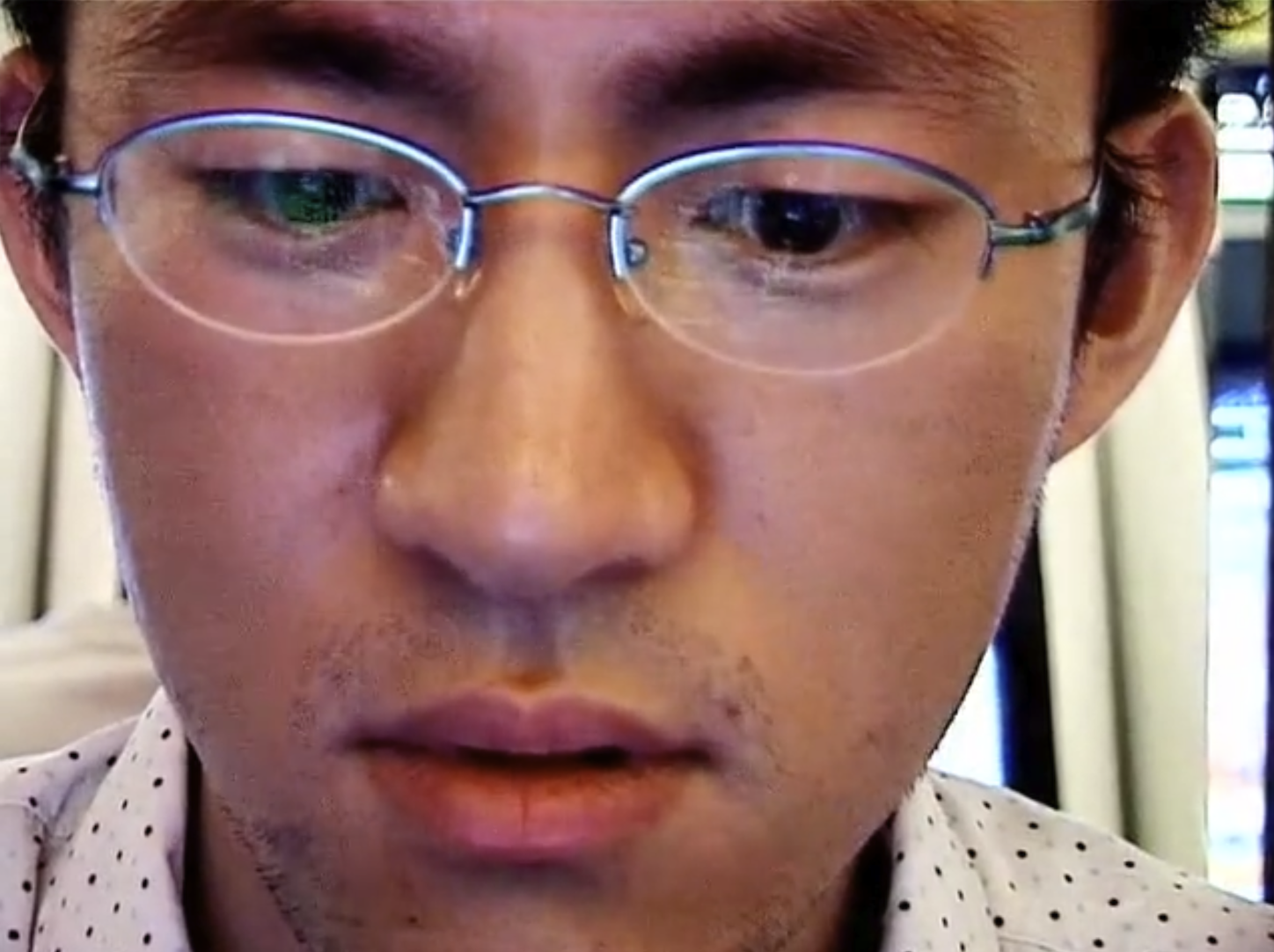
Axel Stockburger: In 1997 I made a video piece called Head Mounted Display, where I projected the imagery of a network game called Spectre Supreme onto the mirrored sunglasses of a person who did not move at all.
The only movement was the game action, refracted through the mirror lenses of his shades.
This piece was influenced by a lot of science-fiction writers like William Gibson and his notion of cyberspace, but also by writings of Jean Baudrillard about simulation.
I wanted to create an ironic commentary about the expensive interactive art pieces that were shown in museums at the time by using a cheap mass-media game. At the same time, technological developments like the so-called Head Mounted Displays developed by military research fascinated me.
In a philosophical sense I wanted to make a point about the Platonic tradition of idealism and its relation to contemporary media. The images projected onto the sunglasses were Platonic shapes, ideal forms that were reflected from the body of the observer who was to remain in shackles.
This singular “player” did not move at all and was merely a means for projection.
Later I began to observe players and their body movements more closely in works such as PSX Warriors – Tekken. I became fascinated by the remnants and traces of body movements produced by players playing fighting or racing games.
They did not need to tilt their bodies in the direction of their vehicles at every curve, but somehow their bodies involuntarily shadowed the virtual spaces they were moving in.
Around this time, in the late 1990s, there was a debate about bodies being lost in cyberspace, exemplified by Baudrillard’s writings about the fractal subject. However, as I observed, these bodies were very present, and their gestures during gameplay made that obvious.
With the introduction of motion sensors and systems like the Wii, the importance of bodies in front of the screen has been addressed, and the situation is slightly different today.
A second strand of inquiry in my artistic work opened when I started to record interviews with people who had played games like GTA III in Boys in the Hood.
Here I was interested in the tiny difference between real actions and actions performed in a game environment. The accounts of the players who were talking about their in-game actions appeared so “real” because they had “really” done what they were talking about.
The feeling of unease that emerges when a young man tells you with the greatest sincerity that he has just shot a few gang members in order to get a new car was interesting for me.
Additionally, these interview pieces addressed audiences in different ways. People who knew the game became interested because they could relate to the places and actions the players were talking about, while those who were ignorant of such games were simultaneously fascinated and disgusted by the stories, starting to imagine the wildest things.
Overall, these interviews dealt with the question of how the experience of a 3D game environment triggers our memories of spaces and events.
I had a very interesting experience in Moscow a few years ago, when I walked across Red Square, where I had never physically been, and I knew exactly where to expect buildings and entrances because I had played a first-person shooter with maps based on its architectural layout.
I thought that this was a particular experience connected to the novel spatiality of the medium, and I wanted to work with this.
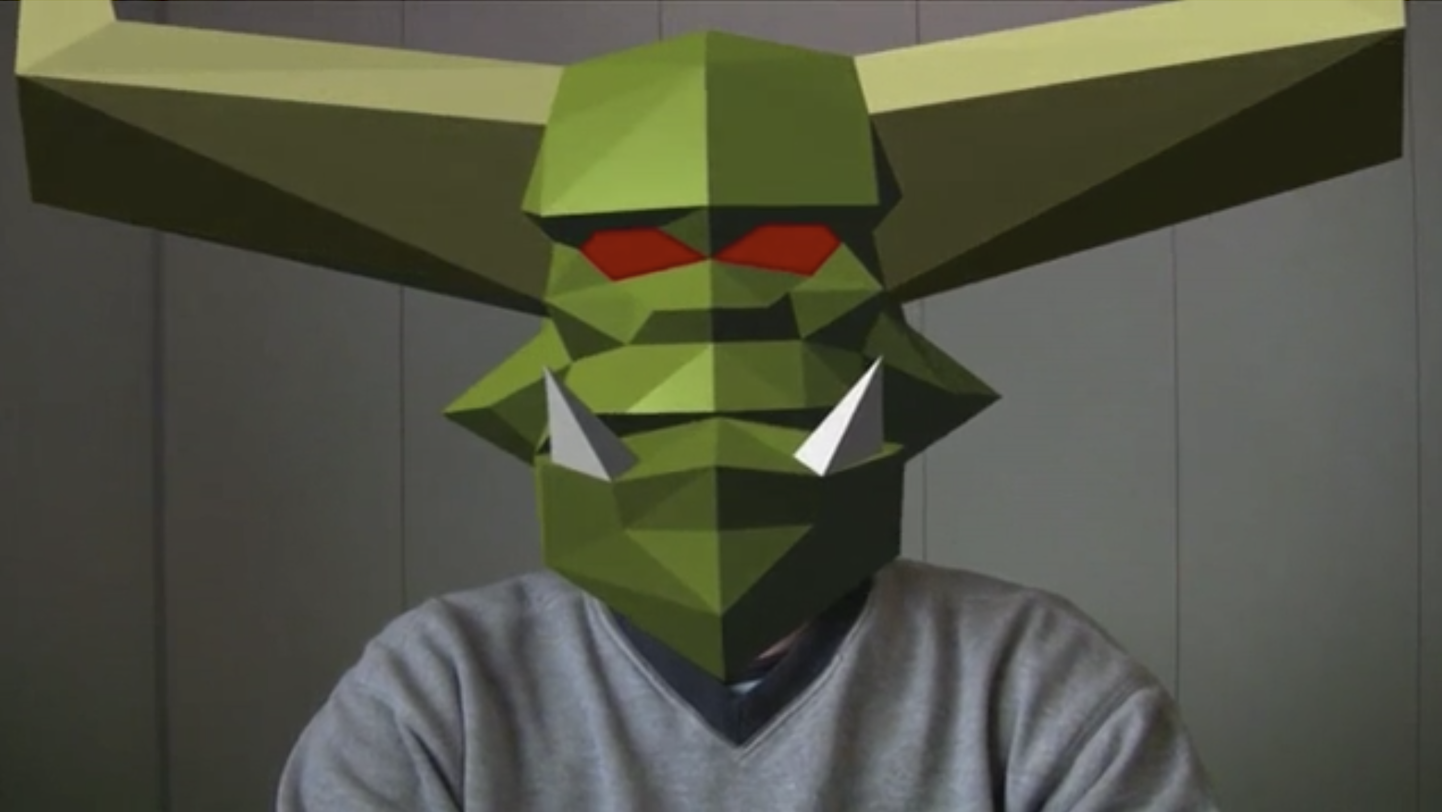
In my recent works related to games, such as Goldfarmer, I started to research the economics of games like World of Warcraft because I realized that phenomena like the outsourcing of gold farming, players playing for money, from Europe to Asia were an interesting small-scale model of global economic developments.
This is why I decided to interview one of the first gold farmers in Europe, who came from Denmark, in order to hear how this micro-economy started.
Since this person wanted to remain anonymous, I decided after the interview to track his head motion and put the head of his in-game avatar, an Orc, over his face.
This piece asks what it means when the border between play for enjoyment and relaxation changes place with the toil of work, and how the boundaries between work and play are redrawn and at times erased by contemporary economic developments.
My latest works, Bestiarium and Spellbound, have shifted from direct references to digital games towards phenomena of global narratives and franchises like Harry Potter and Pokémon.
I want to trace how and why the interest in these narratives is shared by a global community of fans and which kinds of specific knowledge are created around these phenomena. At present I am part of a research project where I am working in this direction.

GameScenes: As an artist and academic researcher, do you recognize an intellectual or cultural gap between the art world and the academic world when it comes to artistic practices based on game aesthetics and game technology?
Axel Stockburger: From my point of view, it is impossible to generalize how games and play have been regarded in the art world or the academic environment.
It seems that whether they are taken seriously as cultural and artistic forms depends to a large extent on the personal experiences of artists and researchers.
At times it seems that more traditional parts of the art establishment have certain problems with guarding the cultural border between highbrow intellectual endeavors and that which is perceived as cheap entertainment media.
However, many examples show that this changes with the diversification of games and the fact that an increasing number of people are exposed to them.
We have seen this hostility towards new forms of media and expression many times before, if we consider, for example, the relationship between Pop Art and comics, or the integration of popular culture in the form of music or fashion into the context of fine art.
I am, however, convinced that the cultural transformation brought about by the Internet and digital culture already has a much stronger impact on the bourgeois traditions of elitist fine-art circles than most people realize.
The emergence of cultural islands that form themselves around specific contents and interests will affect traditional separations between cultural fields and bring about changes that can be witnessed in their economic, social, and political restructuring.
The impact of new forms of participatory culture increasingly changes the way we perceive art and science.
Early signs of this change can already be seen in the growing interest in game culture in art and academia, because this field enables people from a wide range of disciplines to observe and understand new forms of meaningful global interaction.
The gap between engagement in online game universes and “real-world” political grassroots action is closing fast.
Interview by Mathias Jansson.
Archival links
Axel Stockburger
http://www.stockburger.at/
The Rendered Arena: Modalities of Space in Video and Computer Games
http://www.stockburger.at/files/2010/04/Stockburger_Phd.pdf
Originally published on GameScenes, July 7, 2010.